
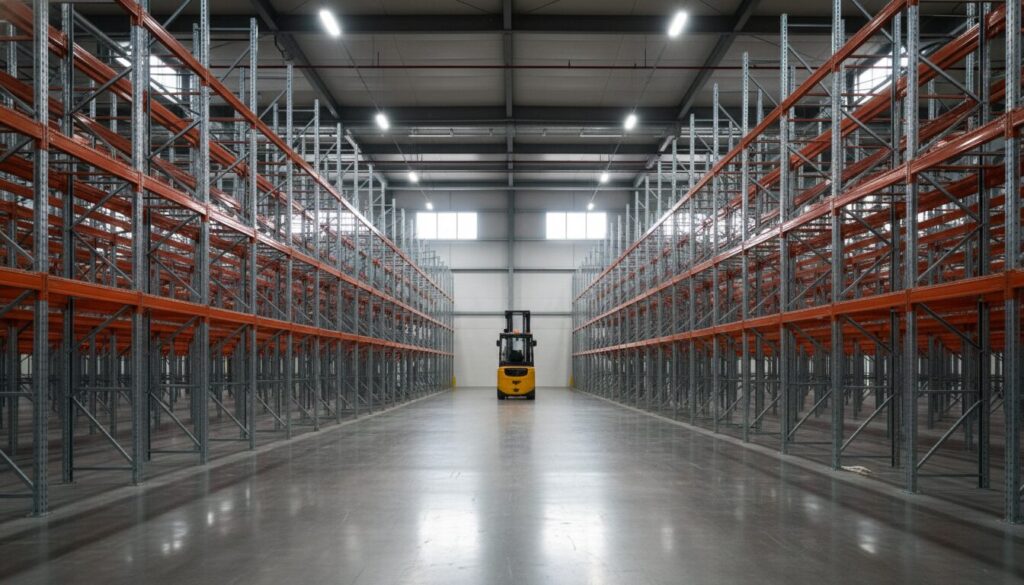
The pendulum of supply chain strategy has swung violently back, and it may have swung too far. After years of hoarding “Just-in-Case” buffer stock to inoculate against pandemic-era disruptions, December marked a decisive and potentially dangerous pivot.
New data reveals that companies executed a massive liquidation of inventories to close out the year, driving stock levels to historical lows. While this clears balance sheets and reduces storage costs, it exposes supply chains to acute risks in 2025. The data suggests that the safety net is gone just as the transportation market is beginning to tighten.
For logistics executives, the message is clear: the buffer is gone, and the cost of transportation volatility is about to rise.
The Great Inventory Purge: Why This Matters Now
The defining logistics narrative of late 2024 was the “inventory hangover”—warehouses stuffed with goods ordered during the demand spikes of previous years. December changed that narrative overnight. The aggressive drawdown of stock signals that companies are betting on a stable supply chain and predictable demand.
However, this shift to a lean model is colliding with a transport sector that is showing renewed signs of strain. With the Logistics Manager’s Index (LMI) for inventory levels collapsing and the Outbound Tender Reject Index (STRI) rising, shippers are entering a period of high vulnerability.
This is not merely a seasonal fluctuation; it is a structural shift back to hyper-dependent Just-In-Time (JIT) models. The danger lies in the timing. As discussed in our analysis of rising lead times, the “time buffer” that shippers rely on is shrinking.
See also: Why do truckload order lead times keep rising? 2025 Analysis
The Facts: Breaking Down the December Data
To understand the severity of the situation, we must look at the specific metrics reported in December. The numbers paint a picture of a sector contracting its physical assets (inventory) while facing increased friction in moving what remains.
| Metric | December Status | Historical Context | Implication |
|---|---|---|---|
| Inventory Levels (LMI) | 35.1 (Deep Contraction) | Lowest reading since index inception (2016). | Firms are aggressively destocking; minimal safety stock remains. |
| Warehouse Utilization | 42.9 (Contraction) | All-time low. | Facilities are emptying out; focus is on cost-cutting over storage capacity. |
| Tender Rejection (STRI) | 13% (Spike) | Highest level since April 2022. | Carriers are rejecting contract freight; capacity is tightening rapidly. |
| Strategy Shift | Defensive $\rightarrow$ Lean | Reversion to pre-pandemic JIT models. | Supply chains are prioritizing cash flow over resilience. |
The “Empty Warehouse” Phenomenon
An LMI reading of 35.1 is statistically significant. The neutral mark is 50.0; anything below indicates contraction. A drop of this magnitude signifies that inventory isn’t just “low”—it is being actively depleted without immediate replenishment.
Simultaneously, warehouse utilization falling to 42.9 corroborates the inventory data. Companies are clearing floor space. While this looks good on a balance sheet (reducing carrying costs), it means the physical infrastructure of the supply chain is currently under-utilized, leaving no room for error if demand surges.
Industry Impact: The Ripple Effect of Lean Inventories
The decision to empty warehouses has immediate downstream effects on every stakeholder in the logistics ecosystem. The return to lean inventory acts as a multiplier for volatility.
1. The Trap for Shippers: High-Stakes Replenishment
When warehouses are full, shippers have the luxury of time. They can negotiate rates and wait for optimal shipping windows. When warehouses are empty, every order becomes urgent.
- Spot Market Exposure: With no buffer stock, shippers must replenish goods immediately upon customer demand. If contract carriers reject tenders (which they are doing at a 13% rate), shippers are forced onto the spot market, paying premiums for speed.
- Stockout Risks: The margin for error is zero. A weather event, a port strike, or a production delay immediately translates to lost sales.
2. The Carrier Advantage: Leverage Returns
For the past year, shippers held the leverage. That dynamic is flipping.
- Capacity Strain: The STRI spike to 13% indicates that carriers are no longer accepting every load at contracted rates. They are prioritizing higher-paying freight or optimizing their networks.
- Rising Lead Times: As capacity tightens, the time it takes to secure a truck increases. As noted in our recent expert guide, lead times have jumped significantly, further complicating the JIT model.
See also: Why do truckload order lead times keep rising? Expert Guide
3. Warehousing Sector: Transformation Required
For 3PLs and warehouse operators, the drop in utilization is a revenue threat if their business model relies solely on storage fees.
- Throughput over Storage: To survive, warehouses must pivot to high-velocity throughput services (cross-docking) rather than long-term storage.
- Automation Necessity: With lower volumes of static storage, efficiency in moving goods in and out becomes the primary value driver.
LogiShift View: The Fragility Trap
The sudden drop in inventory levels to an LMI of 35.1 is not a sign of efficiency; it is a sign of fragility.
At LogiShift, we believe the industry is reacting too aggressively to the overstocking problems of 2023-2024. By swinging back to extreme Just-In-Time models, companies are ignoring the lessons learned during the pandemic.
The Divergence of Strategy
While the broader market is shedding inventory, forward-thinking organizations are taking a different approach. For example, recent developments at major industrial players show a move toward digital resilience rather than blindly cutting stock.
Consider Mitsui Chemicals’ recent DX platform launch. They are utilizing digital transformation to enable a “Just-in-Case” capability, ensuring procurement stability even when the market is volatile. This contrasts sharply with the general market trend of emptying warehouses to save cash.
See also: Mitsui Chemicals’ DX Platform: A New Era of Resilience
The “Perfect Storm” Scenario
We are currently seeing a dangerous convergence:
- Inventory Floors: Companies cannot fulfill orders from stock.
- Transport Ceilings: Carrier rejection rates are climbing, meaning trucks are harder to find.
- Economic Uncertainty: Inflationary pressures remain, making expedited freight costly.
If a demand spike occurs in Q1 or Q2 2025, the supply chain will not have the inventory to absorb it, nor the transport capacity to move it quickly. This creates a “bullwhip effect” where small fluctuations in demand cause massive spikes in freight rates and delays.
Furthermore, as high-value B2B logistics becomes a battleground—evidenced by FedEx’s strategic moves with BMW—the competition for reliable, high-speed capacity will only intensify.
See also: FedEx Nabs More BMW Business: The Strategic B2B Shift
Takeaway: What Companies Should Do Next
The data from December is a warning shot. The “inventory holiday” is over, and the reality of a constrained transport market is setting in.
Strategic Recommendations for 2025:
- Re-evaluate Safety Stock: Do not blindly follow the trend of destocking. Analyze your specific lead time variability. If your transport lanes are showing high rejection rates, you must hold more inventory, regardless of what the broader market is doing.
- Lock in Capacity: With STRI at 13%, reliance on the spot market is a gamble. Strengthen relationships with core carriers now. Prioritize “Shipper of Choice” behaviors to ensure your freight gets accepted.
- Monitor the LMI and STRI Spread: Watch the gap between inventory levels and tender rejections. If inventory stays low while rejections rise, expect a rate explosion.
- Hybrid Modeling: Move away from pure JIT. Adopt a hybrid model where high-turnover goods are lean, but critical components maintain a “Just-in-Case” buffer.
The warehouses may be empty today, but the cost to refill them tomorrow is rising by the hour. Executives must pivot from “cost cutting” to “continuity planning” immediately.