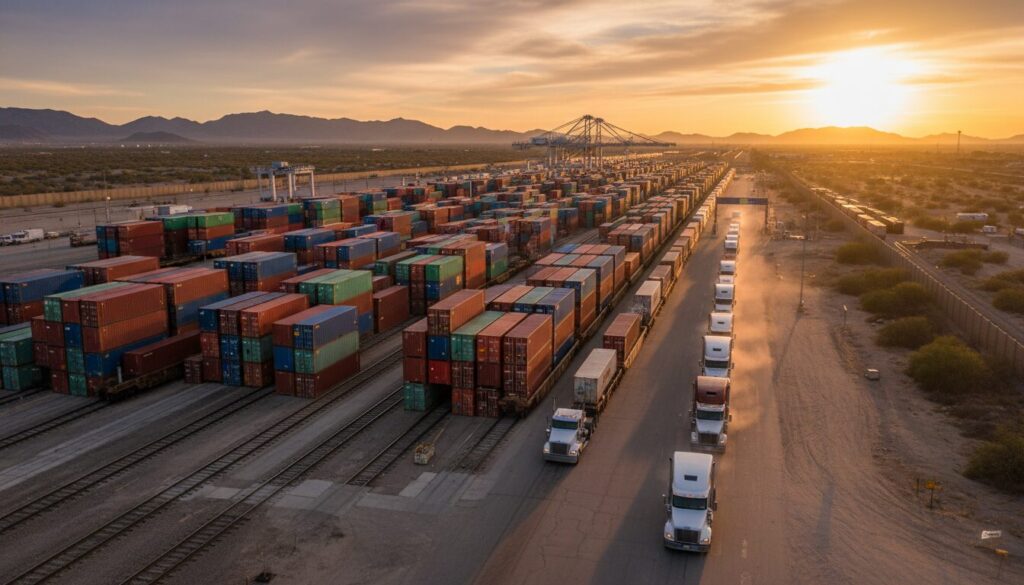
As global trade enters a new phase of geopolitical complexity in 2026, the focus for strategy executives has shifted sharply toward North America. The “Borderlands”—the industrial interface between the United States and Mexico—is currently the epicenter of a critical dichotomy: increasing investment volume versus increasing regulatory friction.
According to recent analysis from logistics giant Flexport, importers should prepare for significant “tariff noise” throughout 2026. While headlines regarding trade wars and protectionism dominate the news cycle, the on-the-ground reality is more nuanced. Flexport notes that while volatility is high, specific exemptions often soften the actual duty impacts. However, reliance on these exemptions brings a new risk: rigorous auditing.
For innovation leaders and supply chain strategists, the challenge is no longer just moving goods; it is navigating a landscape where Customs and Border Protection (CBP) is intensifying scrutiny on USMCA claims, and where supply chain visibility tools are becoming the only defense against disruption.
As discussed in Borderlands Mexico: High-Stakes Trade & Logistics Insights, the region is becoming the linchpin for resilient supply chains, but the stakes for compliance have never been higher.
Why It Matters: The Gap Between Noise and Reality
The term “tariff noise” refers to the uncertainty generated by political rhetoric and threatened duties, which often differs from the final effective tax rates paid by corporations. However, this noise creates real operational drag.
Flexport warns that 2026 will see a peak in this volatility. While statutory tariff rates may rise, the effective duty rate often remains lower due to the United States-Mexico-Canada Agreement (USMCA) and Section 301 exclusions. Yet, utilizing these benefits is becoming treacherous.
The USMCA Audit Spike
Approximately 85% of U.S. imports from Mexico and Canada currently enter duty-free under USMCA provisions. This massive volume of duty-free trade has attracted the attention of regulators.
- CBP Staffing: U.S. Customs and Border Protection is significantly increasing its audit staff specifically to investigate USMCA rules of origin claims.
- The Risk: Companies claiming duty-free status without watertight documentation face retroactive tariffs and penalties.
- The IEEPA Factor: A pending Supreme Court decision regarding the International Emergency Economic Powers Act (IEEPA) could redefine executive authority over tariffs. A ruling against broad executive power could lead to retroactive refunds for importers who paid tariffs under questionable national security justifications, turning compliance departments into potential profit recovery centers.
For a broader look at how structural volatility is shaping strategy, see: 5 Supply Chain Management Trends 2026: New Strategy.
Global Trend: Digitalizing the Border
The volatility in the Borderlands is driving a global trend: the rapid digitalization of cross-border logistics. As the “China Plus One” strategy matures, European and Asian manufacturers are utilizing Mexico as a production hub for the North American market. However, the complexity of managing cross-border freight—involving drayage, customs, and long-haul transport—has historically been a black box.
The Rise of Specialized Cross-Border DX
To combat the opacity of the border, logistics providers are launching specialized Digital Transformation (DX) tools. A prime example is Echo Global Logistics, which recently launched EchoXBorder.
This solution represents a shift from traditional freight forwarding to integrated cross-border management. It combines customs brokerage services directly with end-to-end visibility tools.
Comparative Analysis: Traditional vs. Digital Border Logistics
| Feature | Traditional Cross-Border Model | Modern Digital Model (e.g., EchoXBorder) |
|---|---|---|
| Customs Brokerage | Siloed; handled by third parties often disconnected from transport. | Integrated; seamless data flow between broker and carrier. |
| Visibility | Fragmented; “Black hole” during border crossing/drayage. | End-to-end tracking; real-time status at the bridge. |
| Risk Management | Reactive; issues discovered after delays occur. | Proactive; AI-driven alerts for documentation errors. |
| USMCA Compliance | Manual document collection. | Automated retrieval and storage of Origin Certificates. |
This trend is not limited to logistics providers. Governments and manufacturers are investing in AI to automate classification and reduce the risk of audit failures.
See also: Global Shift: AI Fixes Customs Classification.
Case Study: LS Cable & System USA
While tariff noise persists, the primary driver for supply chain shifts remains speed and proximity to demand. A compelling example of this strategy in action is LS Cable & System USA.
The Challenge: The AI Infrastructure Bottleneck
As the demand for Artificial Intelligence (AI) and data center infrastructure exploded in 2025 and 2026, the supply chain for power and data transmission cables became a bottleneck. Importing heavy infrastructure components from Asia involved long lead times and exposure to volatile trans-pacific shipping rates and potential Section 301 tariff hikes.
The Strategic Move: Localization
LS Cable & System USA executed a strategic pivot by opening a new distribution and production hub in the Houston area (Waller, Texas).
- Location Strategy: By positioning the hub in Texas, LS Cable sits at the nexus of the Borderlands. They can leverage raw materials or sub-components from Mexico while being physically present in the U.S. market.
- Lead Time Reduction: The localization strategy was explicitly designed to shorten lead times for “bus duct” systems—critical components for data centers.
- Tariff Mitigation: By finalizing value in the U.S., the company insulates critical infrastructure projects from the direct impact of finished-good import tariffs that might plague competitors shipping directly from overseas.
The Outcome
This move allows LS Cable to secure the supply chain for high-priority US tech clients (hyperscalers building data centers) while navigating the “tariff noise” Flexport warned of. They replaced regulatory uncertainty with physical proximity.
Key Takeaways for Logistics Leaders
The landscape of 2026 requires a shift from reactive compliance to proactive strategy. Based on the current trends in the Borderlands, executives should prioritize the following:
-
Audit-Proof Your Supply Chain
With CBP ramping up staff, 85% of duty-free claims are under the microscope. Ensure your “Rules of Origin” documentation is digitized and easily retrievable. Do not rely on supplier declarations without verification. -
Invest in “Border Tech”
The launch of tools like EchoXBorder signals that visibility is now a commodity. If your Logistics Service Provider (LSP) cannot offer real-time visibility into the customs clearance process at Laredo or Otay Mesa, it is time to switch partners. -
Monitor the Supreme Court Docket
The pending decision on IEEPA authority is a sleeper issue that could result in millions of dollars in refunds. Strategy teams should work with legal counsel to preserve rights to retroactive claims. -
Localize for Resilience
As demonstrated by LS Cable, the ultimate hedge against tariff noise is localization. Moving final assembly to the U.S. or Mexico (Nearshoring) reduces exposure to trans-oceanic geopolitical friction.
Future Outlook
Looking beyond 2026, the “tariff noise” is unlikely to subside. As political administrations in the U.S. continue to use trade policy as a primary lever for foreign policy, volatility will remain the status quo.
However, the industry is adapting. The delay in certain tariff increases, such as those discussed in White House delays furniture tariff increases for a year, suggests that governments are aware of the inflationary pressure these duties cause.
The future belongs to firms that can decouple their operations from this noise. By leveraging USMCA effectively, utilizing AI for compliance, and physically locating assets in the Borderlands region, companies can turn the North American supply chain into a competitive fortress.