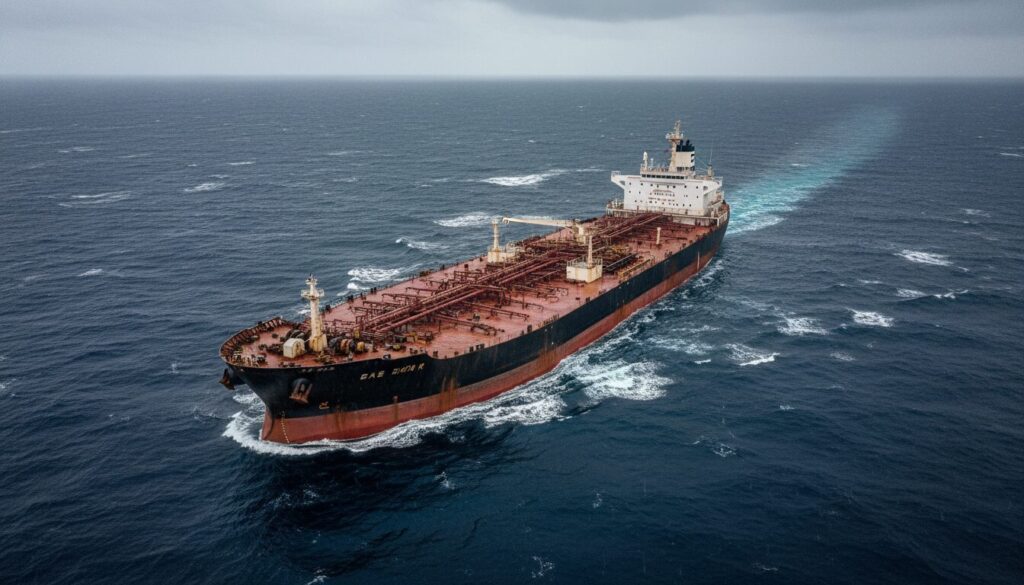
The global energy map is being redrawn, not by pipelines or diplomatic treaties, but by the silent, stagnated drift of a single vessel. The Sea Maverick, a tanker associated with the “dark fleet,” currently drifts aimlessly with 380,000 barrels of Russian naphtha onboard. This vessel is not merely a stranded asset; it is the physical manifestation of a critical bottleneck in the ambitious plan to revitalize Venezuela’s oil sector.
For innovation leaders and strategy executives, the plight of the Sea Maverick offers a high-stakes lesson in supply chain fragility. The United States, under a renewed administration policy targeting $100 billion in private investment for Venezuela, aims to displace Moscow’s energy influence. However, this geopolitical pivot has exposed a logistical chasm: the inability to swiftly replace Russian diluents with American exports.
This article examines the global logistics trends precipitated by this standoff, contrasts the failure of the dark fleet with the resilience of compliant supply chains, and outlines the future of energy logistics in a sanctioned world.
Why It Matters: The Naphtha Dependency
To understand the logistics crisis, one must understand the chemistry of Venezuelan oil. The Orinoco Belt holds some of the world’s largest reserves, but the crude is extra-heavy and tar-like. To transport this oil through pipelines to export terminals, it must be diluted.
Historically, Venezuela relied on Russian naphtha to dilute this heavy crude. The current logistical paralysis is driven by two colliding forces:
- The Interdiction: U.S. sanctions enforcement has effectively blocked Russian naphtha exports to Venezuela, dropping them from 30,000 barrels per day (bpd) to near zero.
- The Supply Gap: While the U.S. has ample supply—with naphtha stockpiles hitting seasonal record highs in late 2025—the logistical infrastructure to redirect these flows to Venezuela is currently insufficient to match the speed of the ban on Russian vessels.
For global supply chain strategists, this highlights a critical vulnerability: Single-Source Dependency. Venezuela’s entire production capability was tethered to a supply chain (Russian naphtha) that was politically fragile. When that link snapped, production stalled, regardless of the $100 billion investment potential waiting in the wings.
Global Trend: The Great Diluent Pivot
The situation in Venezuela is a microcosm of a larger global trend: the weaponization of supply chain logistics and the decoupling of energy flows between East and West. We are witnessing a tripartite divergence in how major economic blocs are handling energy logistics.
United States: From Sanctioner to Supplier
The U.S. strategy has shifted from pure containment to displacement. By blocking the Sea Maverick and similar vessels, the U.S. is clearing the market for its own exports.
- Logistics Shift: U.S. Gulf Coast refineries and exporters are reorienting supply chains to target South America.
- Inventory Pressure: With domestic naphtha stockpiles at record highs, U.S. producers are desperate for export outlets. The Venezuelan market represents a perfect “relief valve” for U.S. oversupply.
Europe: The Compliance Fortress
Europe has solidified its position as the enforcer of the G7 price cap and maritime sanctions.
- Insurance Ban: EU-based insurers (who cover 90% of the global fleet) are barred from covering vessels like the Sea Maverick. This forces these vessels into the “dark fleet”—uninsured, aging tankers that operate outside standard tracking systems.
- Risk Aversion: European logistics firms are increasingly refusing “grey” calls, leading to a bifurcation of global shipping: a premium, compliant fleet and a shrinking, risky dark fleet.
China: The Silent Observer
While China remains a major buyer of sanctioned oil, its role in the diluent trade for Venezuela is diminishing due to the logistical risks associated with crossing the U.S. Navy’s sphere of influence in the Caribbean.
- Strategic Retreat: Chinese logistics firms are wary of secondary sanctions that could bar them from Western ports, leaving the Russian dark fleet to shoulder the burden alone—a burden it is currently failing to carry.
Comparative Analysis of Energy Logistics Strategies
The following table outlines how major powers are adapting their logistics strategies in response to the Venezuelan bottleneck.
| Region | Strategic Focus | Logistics Tactic | Key Risk |
|---|---|---|---|
| United States | Displacement | Replacing Russian naphtha with U.S. exports via compliant tankers. | Infrastructure bottlenecks at Venezuelan receiving terminals. |
| Russia | Circumvention | Utilizing the “Dark Fleet” (e.g., Sea Maverick) to maintain influence. | Interdiction, mechanical failure, and stranded assets. |
| Europe | Enforcement | Denying insurance and port access to non-compliant vessels. | potential spikes in global shipping rates due to fleet reduction. |
| Venezuela | Survival | Desperately seeking alternative diluent sources to prevent well shut-ins. | Complete production collapse if diluents do not arrive. |
Case Study: Chevron vs. The Dark Fleet
To understand the solution to the Sea Maverick debacle, we must look at the “success story” currently operating in the same waters: Chevron’s Joint Venture (Petropiar).
While the Sea Maverick drifts, Chevron has successfully ramped up production in Venezuela, providing a blueprint for the $100 billion revitalization plan.
The Failure: Sea Maverick (The Dark Fleet Model)
The Sea Maverick represents the “Dark Fleet” model: opaque ownership, disabled transponders (AIS), and reliance on Russian inputs.
- The Logistical Flaw: It relied on secrecy. Once the U.S. intelligence apparatus identified the cargo as Russian naphtha, the vessel became radioactive. No port would accept it, and no legitimate buyer would touch the cargo.
- Result: 380,000 barrels stranded, causing downstream production halts in the Orinoco Belt.
The Success: Chevron (The Compliant Supply Chain)
In contrast, Chevron operates under General License 41 (GL 41) issued by the U.S. Treasury.
- The Mechanism: Chevron imports U.S.-sourced diluents (or uses light crude blends) to mix with Venezuelan heavy crude. The resulting blend is then exported exclusively to the United States.
- Logistical Transparency: Every barrel is tracked. The supply chain is integrated between the U.S. Gulf Coast and Puerto José.
- Outcome: Chevron has increased its Venezuelan output significantly, stabilizing its specific joint ventures while the rest of the industry struggles with the Russian shortage.
Innovation in Logistics: The Closed-Loop System
Chevron’s success demonstrates a “Closed-Loop Logistics” innovation. By controlling both the input (diluent) and the output (crude) and ensuring both ends touch U.S. jurisdiction, they eliminate the geopolitical risk that paralyzed the Sea Maverick.
Key Metrics of the Chevron Model:
- Reliability: Zero stranded cargoes in 2024-2025.
- Compliance Cost: Higher upfront due to legal/compliance overhead, but lower total cost due to elimination of demurrage (waiting fees) and seizure risks.
- Scalability: This is the model the Trump administration aims to scale up to the $100 billion target—replacing ad-hoc Russian smuggling with structured U.S. corporate logistics.
Key Takeaways for the Logistics Industry
The saga of the drifting tanker offers profound lessons for strategy executives across all industries, not just energy.
1. The “Geopolitical BOM” (Bill of Materials)
Supply chain leaders must now analyze their Bill of Materials not just for cost or availability, but for geopolitical origin.
- Lesson: If a critical input (like Naphtha) comes from a sanctioned adversary, your entire production line is at risk of being “stranded” like the Sea Maverick.
- Action: Audit Tier 2 and Tier 3 suppliers for geopolitical compliance.
2. Infrastructure as the New Diplomacy
The U.S. plan fails if the physical infrastructure isn’t there.
- Lesson: Policy shifts (like lifting sanctions) are faster than physical shifts (repairing pipelines or ports).
- Action: Logistics strategies must account for the “lag time” between political opening and operational readiness. The $100 billion plan is theoretical until the physical valves at Puerto José can accept U.S. tankers efficiently.
3. Visibility Trumps Secrecy
The Sea Maverick failed because it tried to hide.
- Lesson: In an era of satellite imagery and AI-driven maritime tracking (using tools like Windward or MarineTraffic), the “Dark Fleet” strategy is becoming obsolete.
- Action: Invest in supply chain transparency. Being able to prove the origin of your goods is now a license to operate.
Future Outlook
As we look toward 2026, the drifting Sea Maverick will likely be remembered as the turning point where Venezuela’s oil sector was forced to choose sides.
The “Americanization” of Venezuelan Logistics
We expect a rapid acceleration of U.S. naphtha exports to Venezuela. The U.S. Gulf Coast is primed to replace Russia as the primary supplier of diluents. This will require a massive logistical undertaking:
- Refitting Venezuelan ports to handle U.S. vessel standards.
- Reversing pipeline flows that were oriented toward non-Western markets.
The End of the Dark Fleet?
While the dark fleet will not vanish, its utility in high-volume, capital-intensive industries like oil production is waning. The risk of stranded assets is too high for the $100 billion investment targets. Investors will demand the “Chevron Model”—fully compliant, insured, and transparent supply chains.
Strategic Recommendation
For logistics and strategy executives: Bet on Transparency. The friction costs of sanctions evasion are now higher than the costs of compliance. The Sea Maverick is not just a ship; it is a warning buoy. The future of global supply chains belongs to those who can move goods in the light, not those who drift in the dark.