
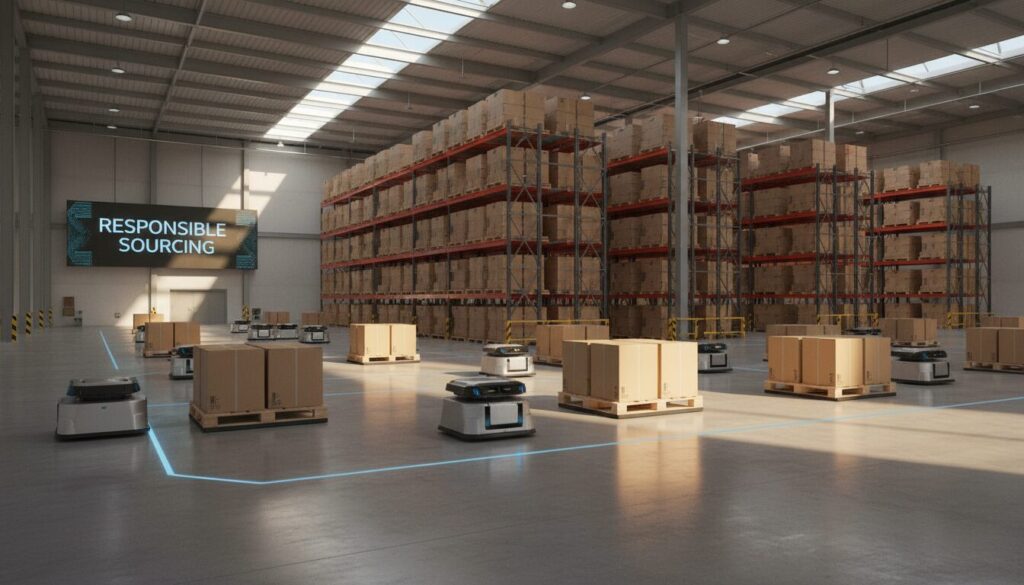
The logistics and supply chain landscape is currently facing a “perfect storm.” Operations leaders are battling unprecedented labor shortages, skyrocketing raw material costs, and an increasingly volatile geopolitical environment. Simultaneously, the pressure to maintain ethical, sustainable supply chains has shifted from a “nice-to-have” marketing slogan to a strict regulatory requirement.
For many executives, balancing cost efficiency with Environmental, Social, and Governance (ESG) compliance feels like an impossible trade-off. Manual auditing is too slow. Traditional procurement methods are too opaque.
This is where the industry is pivoting. This article explores the future of autonomous responsible sourcing—a transformative approach that leverages AI and automation to ensure ethical procurement without sacrificing speed or profitability. By the end of this guide, you will understand how to transition your operations from reactive compliance to proactive, autonomous value creation.
Understanding the Core Concepts
To navigate the future of autonomous responsible sourcing, we must first dismantle the terminology. It is the convergence of two powerful trends: digital transformation (DX) and ethical supply chain management.
Defining Responsible Sourcing
Responsible sourcing is the practice of procuring goods and services in a way that is socially responsible, environmentally sustainable, and economically viable. It goes beyond price and quality to include:
- Human Rights: ensuring no forced labor or child labor in the supply chain.
- Environmental Impact: Minimizing carbon footprint, water usage, and waste.
- Business Ethics: Preventing corruption and ensuring fair wages.
Defining the “Autonomous” Element
The “Autonomous” aspect refers to removing manual human intervention from the data collection, verification, and decision-making processes. It involves:
- Artificial Intelligence (AI): Algorithms that predict supplier risk based on global data patterns.
- Machine Learning (ML): Systems that learn from historical purchasing data to optimize supplier selection.
- Blockchain: Immutable ledgers that automatically record and verify the chain of custody.
The Shift from Manual to Autonomous
The transition represents a fundamental change in how logistics teams operate.
| Feature | Traditional Sourcing | Autonomous Responsible Sourcing |
|---|---|---|
| Verification | Annual on-site audits (Manual) | Real-time IoT & Satellite monitoring |
| Data Flow | Siloed Excel sheets and Emails | Integrated, cloud-based ecosystems |
| Risk Mgmt | Reactive (Post-incident response) | Predictive (Pre-incident avoidance) |
| Speed | Weeks to vet a new supplier | Minutes to verify via digital credentials |
Why Now? The Urgency of Adoption
The conversation around the future of autonomous responsible sourcing is no longer theoretical. Specific market forces are driving immediate adoption.
Regulatory Pressure and Compliance
Governments worldwide are tightening regulations. The European Union’s Corporate Sustainability Due Diligence Directive (CSDDD) and the German Supply Chain Act are just the beginning.
- Companies can face fines of up to 5% of global turnover for non-compliance.
- Manual compliance checks are statistically impossible for supply chains with Tier 2, Tier 3, and Tier 4 suppliers.
- Autonomous systems provide the only scalable way to map and monitor multi-tier supply networks continuously.
The Consumer Trust Deficit
Modern consumers, particularly Gen Z and Millennials, scrutinize brand origins. A single report of unethical labor practices can cause stock prices to plummet and alienate customers permanently.
- Transparency is the new currency.
- Autonomous sourcing provides “proof of origin” data that can be shared directly with consumers via QR codes.
Operational Resilience vs. Labor Shortage
Logistics faces a chronic talent shortage. There are simply not enough procurement officers to manually vet thousands of suppliers.
- Autonomous sourcing acts as a force multiplier, allowing a small team to manage a massive global network.
- It frees up human talent to focus on strategic relationships rather than data entry.
Quantitative and Qualitative Benefits
Adopting technology to drive the future of autonomous responsible sourcing yields measurable ROI.
Cost Reduction through Predictive Analytics
While responsible sourcing is often viewed as a cost center, autonomous systems flip this narrative.
- Avoided Disruption Costs: AI can predict climate events or labor strikes, allowing you to switch suppliers before a disruption occurs.
- Efficiency Gains: Automating the Request for Proposal (RFP) and vetting process reduces administrative costs by an estimated 30-50%.
Enhanced Brand Reputation and Market Share
Sustainability is a differentiator.
- Premium Pricing: Consumers are willing to pay a premium for verified sustainable products.
- Investor Attraction: High ESG scores, supported by verifiable data, attract institutional investors and lower the cost of capital.
Risk Mitigation in Real-Time
Traditional sourcing relies on audits that are valid only for the day they are performed.
- Continuous Monitoring: Autonomous systems scrape news, financial reports, and satellite imagery 24/7.
- Immediate Alerts: If a supplier’s factory region is flagged for water scarcity or labor riots, the system alerts procurement leaders instantly.
Key Technologies Driving the Future
To implement the future of autonomous responsible sourcing, logistics leaders must familiarize themselves with the “Tech Stack of Trust.”
Artificial Intelligence and Natural Language Processing (NLP)
AI tools can scan millions of documents, local news reports, and legal filings in dozens of languages to detect potential ethical violations regarding a supplier.
- Sentiment Analysis: Gauging the reputational health of a supplier based on online discourse.
- Pattern Recognition: Identifying fraudulent certification documents.
Blockchain and Distributed Ledger Technology (DLT)
Blockchain creates a single source of truth that cannot be altered.
- Smart Contracts: Payments are released to suppliers only when digital verification of ethical compliance (e.g., fair wage payment proof) is received.
- Traceability: Tracking a raw material from the mine to the final warehouse shelf.
Internet of Things (IoT) Sensors
IoT devices provide physical evidence of responsible practices.
- Environmental Monitoring: Sensors in factories reporting real-time air quality or water discharge data.
- Logistics Tracking: Ensuring goods are not diverted to unauthorized subcontractors.
Implementation: A Strategic Roadmap
Transitioning to the future of autonomous responsible sourcing is a journey. Do not attempt to overhaul your entire supply chain overnight.
Step 1: Data Unification and Cleansing
You cannot automate what you cannot see.
- Consolidate supplier data from ERPs, spreadsheets, and legacy systems into a single cloud-based platform.
- Standardize data formats for supplier IDs, certificates, and compliance metrics.
Step 2: Tier 1 Autonomous Vetting
Start with your direct suppliers (Tier 1).
- Implement an AI-driven platform to automatically request and verify certifications (ISO, Fair Trade, etc.).
- Set up automated alerts for expiring certificates.
Step 3: Multi-Tier Mapping
The biggest risks often lie deep in the supply chain (Tier 2 and beyond).
- Use AI tools to map the sub-suppliers of your direct suppliers.
- incentivize Tier 1 suppliers to digitally invite their vendors onto your platform.
Step 4: Change Management and Culture
Technology is easy; people are hard.
- Training: Upskill your procurement team to become data analysts rather than just buyers.
- Incentives: Redefine KPIs. Procurement bonuses should be tied to “Sustainable Reliability” scores, not just “Lowest Price.”
Challenges and Considerations
While the future is bright, there are hurdles to navigate.
Data Privacy and Security
Sharing deep supply chain data requires robust cybersecurity.
- Ensure your autonomous platforms are GDPR compliant.
- Use permissioned blockchains where trade secrets are protected while compliance data is shared.
The “Black Box” Problem
AI decision-making can be opaque.
- Ensure “Explainable AI” is used so procurement officers understand why a supplier was flagged as high-risk.
- Maintain a “Human-in-the-loop” for critical strategic decisions.
Conclusion
The future of autonomous responsible sourcing is not science fiction; it is the inevitable standard for modern logistics. The convergence of ethical demand and technological capability has created a new operational paradigm.
For logistics leaders, the choice is stark: cling to manual, opaque processes and risk regulatory fines and reputational damage, or embrace autonomous systems that drive transparency, efficiency, and trust.
Recommended Next Steps:
- Audit your current visibility: How far down your supply chain can you currently see?
- Pilot a project: Select one product line and implement autonomous tracing for it.
- Invest in clean data: Your AI is only as good as the data it feeds on.
By taking these steps today, you secure not just the compliance of your supply chain, but the future viability of your business.