The unveiling of the smart palletizing solution by Universal Robots, Robotiq, and Siemens at CES 2026 marks a pivotal moment for warehouse automation. While robotic palletizing is not new, the integration of high-payload cobots with industrial AI and high-fidelity digital twins represents a fundamental shift from static automation to dynamic, predictive logistics.
For supply chain executives, the significance of this partnership lies not in the hardware itself, but in the convergence of Operational Technology (OT) and Information Technology (IT). We are moving beyond the era of buying robots to perform repetitive tasks. We are entering an era where the facility is simulated, optimized, and validated virtually before a single bolt is tightened on the warehouse floor.
This analysis explores how the collaboration between Universal Robots partners with Robotiq and Siemens for smart palletizing creates a blueprint for the future of fulfillment centers.
The CES 2026 Reveal: Anatomy of the Partnership
To understand the strategic value of this announcement, one must dissect the unique contributions of each partner. This is not merely a vendor agreement; it is a technology stack designed to solve the “integration gap” that often stalls automation projects.
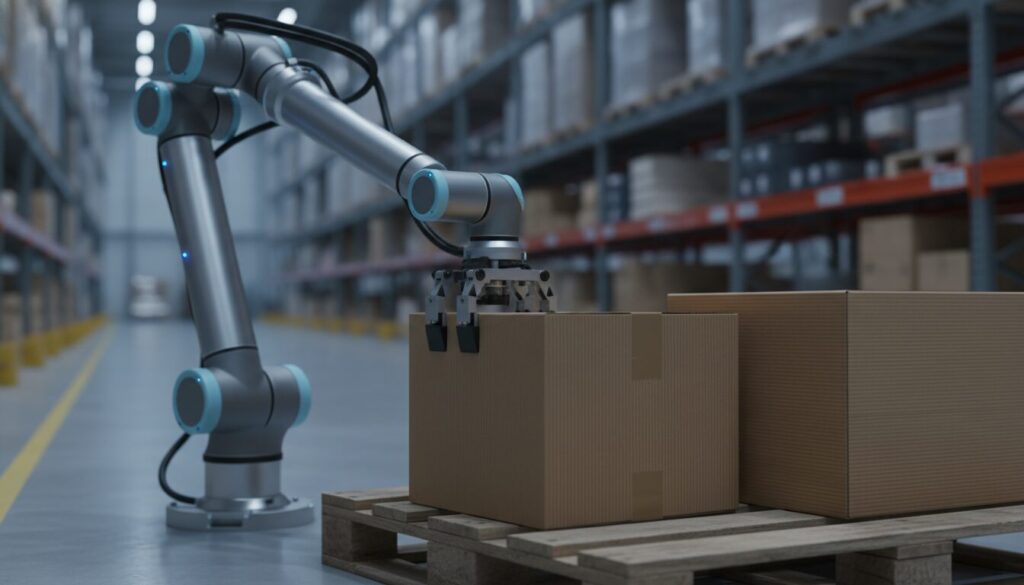
At the core, the solution utilizes the Universal Robots UR20, a collaborative robot (cobot) designed for higher payloads and faster cycle times, paired with Robotiq’s specialized palletizing cell. However, the differentiator is the “brain”—Siemens’ Digital Twin Composer, built on the NVIDIA Omniverse platform.
The 5W1H Briefing
For a quick grasp of the essential details, refer to the breakdown below:
| Dimension | Detail |
|---|---|
| Who | Universal Robots (Hardware), Robotiq (End-effectors), Siemens (Software/AI). |
| What | A smart palletizing solution integrating cobots with Industrial AI and Digital Twins. |
| Where | Unveiled at CES 2026; available for global industrial markets. |
| When | Immediate applicability for Q1/Q2 2026 facility planning cycles. |
| Why | To bridge the gap between digital planning and physical execution, maximizing ROI. |
| How | By using Siemens Digital Twin Composer to simulate and optimize gripper dynamics in real-time. |
The Technological Leap: Why This Combination Works
The synergy between these three entities addresses specific pain points in traditional palletizing:
- Universal Robots (UR20): Provides the necessary reach and payload capacity (20kg) to handle standard logistics boxes without the safety caging required by heavy industrial robots.
- Robotiq (PAL Ready Cell): Standardizes the physical interface, removing the need for custom engineering on grippers and suction cups.
- Siemens (Digital Twin Composer): This is the game-changer. By utilizing NVIDIA Omniverse, it creates a physics-accurate simulation. The system doesn’t just “guess” how a box will behave under suction; it simulates the dynamics, allowing the AI to optimize speed and grip strength before physical implementation.
Industry Impact: Ripples Across the Supply Chain
The deployment of this technology extends beyond the four walls of the warehouse. The ability to visualize and iterate facilities virtually fundamentally alters risk profiles and operational speeds for various stakeholders.
1. For Warehouses and 3PLs
The primary impact is the democratization of simulation. Historically, creating a “Digital Twin” of a palletizing line required expensive consultants and months of coding.
- Reduced Commissioning Time: With the Siemens and NVIDIA backbone, 3PLs can simulate a new palletizing line configuration in the cloud. They can test if the UR20 can handle a sudden influx of non-standard SKU shapes before disrupting operations.
- Space Optimization: Managers can visualize exactly how the Robotiq cell fits into existing workflows, ensuring that high-density storage does not compromise safety zones.
2. For Shippers and Manufacturers
Reliability in palletizing directly correlates to reduced product damage and freight costs.
- Dynamic Gripper Optimization: The use of Industrial Edge hardware means the system adjusts in real-time. If a box is slightly heavier or the cardboard quality is lower (porous), the AI adjusts the suction dynamics instantly. This reduces dropped boxes and line stoppages.
- Pack Density: AI-driven palletizing ensures optimal stacking patterns, maximizing truck fill rates and reducing shipping air—a critical metric for sustainability and cost control.
3. For System Integrators
This partnership signals a shift in the integrator business model.
- Risk Mitigation: Integrators can prove the solution works to the client via the Digital Twin before purchasing hardware. This aligns expectations and validates cycle times (picks per minute) contractually based on accurate simulations.
LogiShift View: The “So What?” for Executives
While the hardware specs of the UR20 are impressive, the real story here is Virtual Commissioning as a Standard.
At LogiShift, we analyze the hidden trends. The Universal Robots partnership with Robotiq and Siemens for smart palletizing is a harbinger of “Software-Defined Logistics.”
The Death of “Trial and Error”
Traditionally, tweaking a palletizing robot to handle a new product line involved downtime. Engineers would stand by the line, adjusting waypoints and suction delays. This solution moves that process to the virtual world.
The “Store-to-Floor” Latency
We predict that this technology will drastically reduce “Store-to-Floor” latency—the time it takes to adapt a warehouse to a new product launched in the online store.
- Scenario: Marketing launches a new, oddly shaped promotional bundle.
- Old Way: The warehouse discovers the robot drops the bundle. Operations halt. Manual labor is deployed.
- New Way: The SKU data is fed into the Siemens Digital Twin. The AI recalibrates the UR20 and Robotiq gripper strategy virtually. The update is pushed to the physical robot over the air (OTA). The line never stops.
The Rise of the “Brownfield” Savior
This solution is particularly aggressive in targeting “brownfield” sites (existing, older warehouses). Because the UR20 has a small footprint and the simulation allows for tight-space validation, companies can retrofit advanced automation into legacy facilities without major construction. This extends the life of existing real estate assets.
Strategic Takeaways: What Companies Should Do Next
The collaboration between Universal Robots, Robotiq, and Siemens is not just a product release; it is a signal of where the industry bar is being set. Executives should adjust their strategies accordingly.
1. Demand Digital Validation
When issuing RFPs for automation, require vendors to provide Digital Twin validation. Do not accept static CAD drawings. Demand a physics-based simulation (like that offered by Siemens/NVIDIA) to prove the cycle times are achievable with your specific product mix.
2. Rethink “Cobot” ROI
Stop viewing collaborative robots solely as labor replacement. View them as data generation endpoints. The Industrial Edge hardware in this solution provides granular data on grip success, cycle variance, and arm torque. This data is invaluable for predictive maintenance and bottleneck analysis.
3. Invest in Master Data Quality
The efficacy of a Digital Twin relies on the quality of input data. If your SKU dimensions and weights in your WMS are inaccurate, the simulation will fail. Clean master data is now a prerequisite for physical automation.
Summary
The partnership between Universal Robots, Robotiq, and Siemens transforms palletizing from a mechanical task into an intelligent, data-driven workflow. By bridging the physical and digital worlds, they have removed the guesswork from automation. For logistics leaders, the message is clear: the future belongs to those who simulate before they execute.