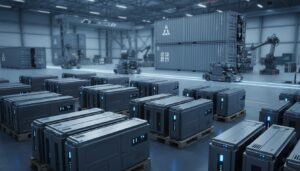

The global logistics sector is currently witnessing a paradigm shift. For decades, the industry standard for automation was heavy infrastructure—massive Automated Storage and Retrieval Systems (AS/RS) that required years of planning, months of construction, and significant capital expenditure (CAPEX). However, a new trend is emerging from the high-tech hubs of Asia: “Agile Automation.”
This shift is best exemplified by the recent strategic move by Alps Logistics in Japan. In a groundbreaking deployment, the company successfully installed and operationalized a high-density automated warehouse system for small electronic parts in just five weeks across two key hubs.
For innovation leaders and strategy executives in the US and Europe, this case study is not just a success story from Japan; it is a blueprint for the future of supply chain resilience. It demonstrates that automation no longer requires a halt in operations or a year-long lead time.
Why It Matters: The Global Urgency for “Brownfield” Speed
The logistics landscape is facing a dual crisis: a chronic labor shortage and an explosion in SKU complexity.
In the United States, warehouse turnover rates hover around 40-60%. In Europe, an aging population is shrinking the blue-collar workforce. In Japan, this demographic cliff is already steep, forcing logistics companies to automate not for cost savings, but for survival.
However, the traditional solution—building new, fully automated distribution centers (Greenfield projects)—is losing viability due to rising real estate costs and the need for proximity to urban centers. The battleground has shifted to “Brownfield” environments: retrofitting existing, older warehouses with modern tech.
The Agility Gap
The core problem with retrofitting is disruption. Installing a traditional crane-based AS/RS in an active warehouse is akin to changing the engine of a car while driving it. It usually involves:
- Months of downtime.
- Dust and debris from construction.
- Complex software integration periods.
Alps Logistics has shattered this norm. By deploying a system in five weeks, they have proven that high-density automation can be “plug-and-play.” This speed is critical for global supply chains that must pivot quickly in response to geopolitical shocks or sudden demand spikes.
Global Trend: The Rise of Modular Robotics
To understand the significance of the Alps Logistics case, we must contextualize it within the broader global adoption of modular warehousing.
United States: The Micro-Fulfillment Boom
In the US, the focus is on “Micro-Fulfillment Centers” (MFCs). Retailers like Walmart and grocers like Kroger are utilizing robotics (e.g., Symbotic, Ocado) to fit automation into the back of existing stores or small urban depots. The goal is speed to consumer.
China: The Speed of Implementation
China leads the world in the adoption of Autonomous Mobile Robots (AMRs) and bin-to-person systems (like Geek+ and Hai Robotics). The Chinese model prioritizes flexibility; if volume peaks during “Singles Day,” they simply add more robots to the grid.
Europe: Density is King
In Europe, where land is scarce and expensive, high-density storage (Cubic storage like AutoStore) dominates. European firms prioritize cubic utilization over pure speed.
The Convergence
The Alps Logistics case represents a convergence of these trends:
- US-style integration into existing workflows.
- Chinese-style rapid deployment speed.
- European-style storage density for small parts.
Comparison: Traditional vs. Agile Automation
The following table illustrates the shift in strategic thinking regarding warehouse automation.
| Feature | Traditional AS/RS (Heavy Iron) | Agile Modular AS/RS (Alps Logistics Model) |
|---|---|---|
| Deployment Time | 6 – 18 Months | 4 – 8 Weeks |
| Infrastructure | Requires reinforced floors/racking | Light racking, often self-supporting |
| Flexibility | Static (Hard to move/expand) | Modular (Scalable, movable) |
| Disruption | High (Requires shutdown) | Low (Parallel implementation) |
| Target SKU | Pallets / Large Cartons | Small Parts / Bin-sized items |
Case Study: Alps Logistics’ 5-Week Sprint
Alps Logistics, a specialist in electronic components logistics, faced a specific challenge. Electronic parts are shrinking in size but growing in variety. Managing thousands of tiny components manually leads to “picking fatigue” and increases the risk of shipping errors—a critical failure point in the just-in-time electronics manufacturing supply chain.
The Deployment Sites
Alps Logistics targeted two strategic locations for this overhaul:
- Yokohama Office (Kanagawa Prefecture): A critical gateway hub handling import/export flows.
- Kazo Office (Saitama Prefecture): A major domestic distribution center serving the Kanto region.
The Solution: RAX Solutions “rBox”
The company selected the “rBox” system provided by RAX Solutions. This system is a “Bin-to-Person” automated storage and retrieval solution designed specifically for small-box containment.
Technical Specifications
- Capacity: The system manages approximately 15,000 items across the two sites.
- Configuration: It utilizes a tandem depth configuration. This means bins are stored two-deep, doubling the density compared to single-depth shelving without significantly increasing the footprint.
- SKU Optimization: The system uses dedicated trays optimized for the dimensions of electronic components.
The Execution: Speed as a Competitive Advantage
The most startling aspect of this case is the timeline. Alps Logistics brought the system to full operation in approximately five weeks.
This rapid turnaround included:
- Physical Assembly: Erecting the racking and robot grid.
- Software Integration: Linking the rBox control system with Alps Logistics’ Warehouse Management System (WMS).
- Testing: Calibrating the robotics for picking accuracy.
Operational Impact
- Error Elimination: By switching to a Goods-to-Person (GTP) model, the robot brings the correct bin to the operator. The operator no longer walks aisles searching for tiny part numbers. This virtually eliminates picking errors.
- Standardization: The system enforces a standardized workflow. Regardless of the operator’s experience level, the picking process remains consistent, reducing training time for new hires—a crucial factor in a tight labor market.
- Space Efficiency: The tandem depth storage allowed Alps to maximize the vertical space of their existing facilities, avoiding the need for expensive warehouse expansion.
Key Takeaways for Global Leaders
For executives looking to replicate this success, the Alps Logistics case offers three critical lessons.
1. Velocity is the New ROI
In traditional CAPEX models, Return on Investment (ROI) is calculated over 5-10 years. However, in today’s volatile market, Time-to-Value is the superior metric. A system that goes live in 5 weeks starts generating value almost immediately, whereas a 12-month project ties up capital and risks becoming obsolete before it even launches.
2. Segment Your Strategy (The “Small Part” Problem)
Alps Logistics did not try to automate everything. They focused specifically on “small commercial goods.”
- Strategic Tip: Do not look for a “one-size-fits-all” automation solution. Use heavy AS/RS for pallets, AMRs for cartons, and specialized bin-systems (like rBox) for small parts. Hybrid environments are the future.
3. Software Integration is the Bottleneck
The physical build of robots is fast; the software integration usually causes delays. The success of the Alps deployment suggests a highly mature API/WMS integration capability.
- Strategic Tip: When selecting automation vendors, audit their software integration speed, not just their hardware specs. “Plug-and-play” claims must be verified.
Future Outlook: The Era of “Pop-Up” Automation
The success of Alps Logistics and RAX Solutions signals the beginning of the “Pop-Up Automation” era.
As we look toward 2025 and beyond, we expect to see:
- Leasable Robotics: Logistics providers will lease automation grids for peak seasons (e.g., Q4 holiday rush) and return them in Q1, enabled by 5-week deployment timelines.
- The End of the “Mega-Warehouse”: Companies will favor a distributed network of smaller, highly automated hubs (like the Yokohama/Kazo model) closer to customers, rather than massive, manual centralized warehouses.
- Resilience via Redundancy: Because these systems are fast to install, companies can quickly spin up backup sites in the event of natural disasters or supply chain blockages, adding a layer of physical resilience to their operations.
Alps Logistics has proven that “fast” and “reliable” are no longer mutually exclusive in warehouse automation. For the global supply chain, the race is no longer just about who has the biggest warehouse, but who can modernize the fastest.