The era of rigid, single-purpose automation in the supply chain is officially ending. At CES 2026, Nvidia unveiled a comprehensive technology stack for “Physical AI,” signaling a decisive shift toward generalist robots capable of reasoning, adapting, and operating in unstructured environments. By positioning itself as the “Android of generalist robotics,” Nvidia is attempting to do for physical automation what Google did for smartphones: create a standardized, open-platform foundation that democratizes development and accelerates adoption.
For logistics executives, this is not just a hardware update; it is a fundamental restructuring of the automation market. The introduction of the Jetson T4000, the Cosmos foundation models, and the expansion of the Isaac simulation platform suggests that the barriers to deploying intelligent robotics in warehouses, yards, and last-mile delivery are about to crumble.
The Dawn of Physical AI in Logistics
For decades, logistics automation was defined by predictability. AGVs followed magnetic tape; arms picked items from perfectly aligned trays; and “smart” conveyors merely routed barcodes. If the environment changed—a box fell, a pallet was misaligned, or a human stepped in the way—the system halted.
Nvidia’s CES 2026 announcement targets this rigidity. “Physical AI” refers to robots that possess a world model—they understand physics, causality, and intent. They do not just execute scripts; they perceive the environment and reason through problems in real-time.
By aiming to be the “Android of generalist robotics,” Nvidia is providing the operating system and the brain (compute) that allows hardware manufacturers—whether they are building humanoid laborers or autonomous forklifts—to bypass years of R&D. This significantly lowers the cost of entry and ensures that logistics providers will soon have access to a diverse ecosystem of interoperable robots.
The Facts: Deconstructing Nvidia’s CES 2026 Reveal
To understand the trajectory of the market, executives must look at the specific components of Nvidia’s new stack. It is a three-pronged approach covering the Brain (Hardware), the Instincts (Models), and the Training Ground (Simulation).
The Hardware: Jetson T4000
The centerpiece of the announcement is the Jetson T4000. This system-on-module is designed specifically for edge AI robotics, addressing the power-to-performance bottleneck that has plagued mobile robotics.
| Feature | Specification | Logistics Implication |
|---|---|---|
| Compute Power | 1,200 Teraflops | Enables real-time reasoning and safety checks without cloud latency. |
| Memory | 64GB Unified Memory | Allows large “world models” (VLMs) to run directly on the robot. |
| Efficiency | 40-70 Watts | Extends battery shift life for AMRs and humanoids significantly. |
| Architecture | Blackwell GPU | Standardizes the architecture from cloud training to edge inference. |
The Models: Cosmos and Isaac GR00T
Nvidia introduced Cosmos Reason 2, a Vision-Language Model (VLM), and updated its humanoid control model, Isaac GR00T N1.6.
- Cosmos Reason 2: This model gives robots common sense. Instead of programming a robot to “pick up box A,” a logistics manager can tell the robot to “clean up the loading dock,” and the robot understands what items constitute “trash” versus “freight.”
- Isaac GR00T N1.6: This focuses on whole-body control. It allows humanoid robots to maintain balance while lifting heavy, uneven loads—a critical capability for trailer unloading.
The Ecosystem: Democratizing Development
Perhaps the most disruptive element is the partnership with Hugging Face. By connecting 13 million AI developers to Nvidia’s robotics tools, the talent pool for solving logistics problems has expanded exponentially. We are moving from a world where only specialized robotics engineers could code a picking arm, to one where general AI developers can deploy logic to physical machines.
Industry Impact: The Ripple Effect Across the Supply Chain
The standardization of robotics intelligence will affect every node of the supply chain. However, the nature of the impact differs by sector.
Warehousing: The End of “Brownfield” Constraints
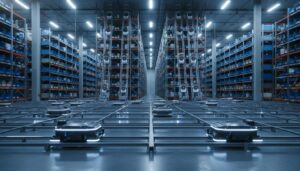
Historically, high-level automation required “Greenfield” sites—purpose-built facilities with perfect floors and lighting. Generalist robots powered by Physical AI can operate in “Brownfield” environments—older, messier, human-centric warehouses.
- Dynamic Path Planning: With the compute power of the T4000, AMRs no longer need predefined lanes. They can navigate cluttered aisles just as a human would, stepping around debris or temporary obstructions without throwing an error code.
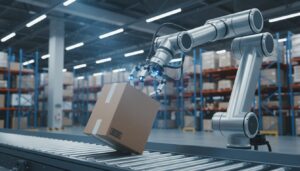
- Handling “Ugly” Freight: The Cosmos VLM enables robots to recognize and handle non-standard freight—tires, furniture, kayaks—that traditionally broke automated sortation systems.
- Scalability: Because the software stack is standardized, a warehouse could theoretically deploy forklifts from Vendor A and pickers from Vendor B, all running on the same underlying logic and simulation data.
Transportation and Yards: Ruggedized Intelligence
The mention of Caterpillar’s adoption of this tech signals strong applications in heavy industry and yard management.
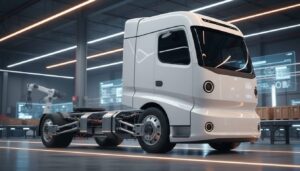
- Autonomous Yard Dogs: Shunting trucks in a yard requires handling mud, rain, and unpredictable traffic. Physical AI allows yard trucks to “see” through weather and predict the movement of human drivers, reducing accidents and increasing throughput.
- Last-Mile Delivery: Sidewalk robots have struggled with “edge cases”—curbs, snow, and aggressive pedestrians. The new reasoning capabilities allow these bots to negotiate complex urban environments without constant tele-operator intervention.
Manufacturing and Integration: The Integrator Squeeze
For system integrators, the landscape is shifting. Custom coding for every deployment is becoming obsolete. The value proposition shifts from “making the robot work” to “optimizing the workflow.” Integrators who rely on charging for basic setup will lose out to those who leverage Nvidia’s stack to deploy fleets rapidly.
LogiShift View: The “Smartphone Moment” for Robotics
While the hardware specs are impressive, the true revolution here is interoperability.
In the early 2000s, mobile phones were fragmented. Apps written for a Nokia didn’t work on a BlackBerry. Then came Android (and iOS), creating a standard layer that allowed software innovation to explode. Nvidia is forcing this moment on the robotics industry.
The Rise of Software-Defined Automation
We predict a shift in how logistics companies buy automation. You will stop buying “a palletizer” and start buying “compute capacity” with a robotic chassis attached. The value is no longer in the mechanical arm; it is in the software update that teaches that arm to handle a new SKU type overnight.
The “Zero-Shot” Learning Revolution
The most profound capability of the Cosmos and GR00T models is “zero-shot” learning—the ability to perform a task without having been explicitly trained on it.
- Scenario: A logistics center receives a shipment of goods in new, triangular packaging.
- Old Way: The vision system fails. An engineer must retrain the model with thousands of images of the new package. Downtime: Days/Weeks.
- New Way: The robot creates a synthetic simulation in Isaac, practices picking the triangle a thousand times in the digital twin (in seconds), and updates its own control policy. Downtime: Minutes.
The Commoditization of Chassis
If Nvidia succeeds in being the “Android” of this space, the physical robot hardware becomes a commodity. Logistics buyers will have leverage. If the software intelligence is portable, you are not locked into a hardware vendor. This will drive down the capital expenditure (CapEx) required for general-purpose humanoids significantly over the next 3-5 years.
Strategic Takeaway: What Executives Must Do Next
The announcement at CES 2026 is a signal that the pilot phase of AI robotics is transitioning into the standardization phase. Logistics leaders must adjust their technology roadmaps immediately.
1. Audit Your Automation Contracts
Review current and pending contracts with robotics vendors. Are you buying closed, proprietary systems? Push for vendors who are building on open, adaptable stacks like Nvidia’s Isaac. Avoid “black box” solutions that cannot be updated with new foundation models.
2. Prepare for Edge Compute
The Jetson T4000 processes data on the device. However, your facility still needs the bandwidth to handle updates and telemetry. Ensure your warehouse Wi-Fi 7 or private 5G networks are robust enough to handle fleets of robots that are constantly learning and sharing data.
3. Pilot “Generalist” over “Specialist”
Stop looking for a robot that only does barcode scanning. Begin pilots with multi-purpose, generalist robots (humanoids or advanced AMRs) that utilize Physical AI. Test their ability to switch tasks—e.g., scanning inventory in the morning and moving trash in the afternoon.
4. Invest in Digital Twins
Nvidia’s stack relies heavily on simulation (Isaac). If you do not have a digital twin of your warehouse, you cannot leverage the full training capabilities of these new robots. Start mapping your facilities digitally now to enable “sim-to-real” deployment later.
The Bottom Line: Nvidia’s move to become the Android of robotics transforms automation from a capital-heavy, rigid investment into a software-defined, flexible asset. For the supply chain, this means the dream of a truly adaptive, fully automated warehouse is no longer science fiction—it is a software update away.