
The logistics landscape is currently facing a perfect storm.
Are you struggling with the skyrocketing costs of last-mile delivery? Do you find your operations team constantly battling labor shortages while customers demand delivery speeds that seem impossible to maintain profitably?
If you are an operations leader or a logistics executive, these pain points are likely keeping you awake at night. You may have invested in warehouse automation or dabbled in urban warehousing, yet true efficiency remains elusive.
The solution lies in a strategic evolution: moving From Micro-Fulfillment to Adaptive Ecosystems. This shift is not just about adding more small warehouses; it is about creating a living, breathing supply chain network that reacts to changes in real-time.
This comprehensive guide will explain how transitioning from standalone micro-fulfillment strategies to holistic adaptive ecosystems can optimize your costs, delight your customers, and future-proof your logistics operations.
Understanding the Shift: From Micro-Fulfillment to Adaptive Ecosystems
To navigate the future of logistics, we must first define the core concepts and understand the relationship between them. This is not a choice between one or the other, but rather an evolution of maturity in supply chain strategy.
What is Micro-Fulfillment?
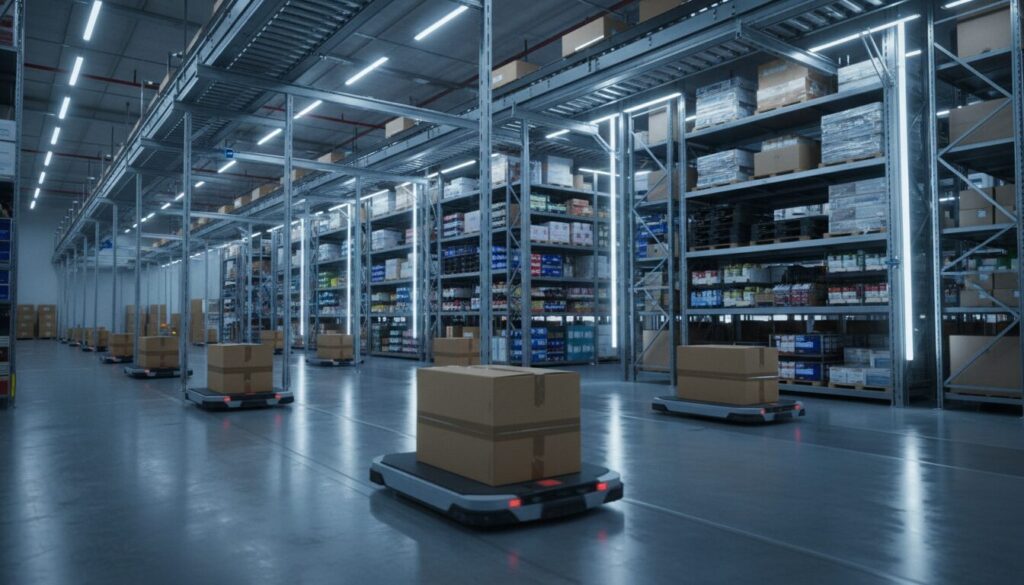
Micro-fulfillment centers (MFCs) are small-scale, highly automated warehouse facilities located in densely populated urban areas.
Unlike massive regional distribution centers (DCs) located on the outskirts of cities, MFCs bring inventory closer to the end consumer.
Key Characteristics of MFCs:
- Proximity: Located within cities to enable same-day or 1-hour delivery.
- Automation: heavily reliant on robotics (AS/RS systems) to pick items rapidly in small footprints.
- Focus: primarily solves the “speed” aspect of the last-mile challenge.
What are Adaptive Ecosystems?
An Adaptive Ecosystem is a dynamic supply chain network where various nodes—regional hubs, dark stores, MFCs, and even retail storefronts—are interconnected and orchestrated by intelligent software.
While Micro-Fulfillment is a physical asset strategy, an Adaptive Ecosystem is a digital and operational strategy. It treats the supply chain as a flexible organism rather than a rigid linear process.
Key Characteristics of Adaptive Ecosystems:
- Interconnectivity: All nodes share real-time data.
- Fluidity: Inventory flows dynamically between nodes based on predicted demand, not just static replenishment schedules.
- Resilience: If one node fails (e.g., a power outage in an MFC), the system automatically re-routes orders to the next best node without human intervention.
Comparing the Models
The following table illustrates the operational differences between a standard logistics setup, a standalone MFC approach, and a fully Adaptive Ecosystem.
| Feature | Traditional Logistics | Standalone Micro-Fulfillment | Adaptive Ecosystems |
|---|---|---|---|
| Primary Goal | Cost efficiency via bulk | Speed of delivery | Agility & Resilience |
| Inventory Logic | Push-based (Forecast) | Localized stock holding | Predictive & Dynamic |
| Flexibility | Low (Rigid routes) | Medium (Urban access) | High (Real-time routing) |
| Technology | Standard WMS | WCS + Robotics | AI-Driven Orchestration |
Why Now? The Urgency of Evolution
The transition From Micro-Fulfillment to Adaptive Ecosystems is becoming critical due to specific global trends. Relying solely on speed (MFCs) is no longer a competitive moat; agility is the new currency.
The Saturation of “Speed”
A few years ago, offering next-day delivery was a differentiator. Today, it is a baseline expectation. As competitors saturate the market with MFCs to achieve speed, the cost of maintaining these high-speed networks becomes the new battleground.
Companies realize that having expensive inventory sitting in 20 different urban locations is inefficient if that inventory is “trapped” in a silo.
Volatility as the New Normal
Recent years have taught logistics professionals that stability is a myth.
- Supply Shocks: Raw material shortages.
- Demand Spikes: Viral social media trends clearing out stock overnight.
- Labor Crises: Unpredictable workforce availability.
A static Micro-Fulfillment strategy struggles when demand shifts unexpectedly. An Adaptive Ecosystem uses data to predict these shifts and move inventory before the bottleneck occurs.
The Rise of Cognitive Supply Chains
Technological maturity has finally caught up with the concept. With the advent of affordable AI and IoT (Internet of Things), machines can now make decisions that previously required human analysis.
This “Digital Transformation” allows systems to process millions of variables (weather, traffic, social sentiment, historical sales) to optimize the network in real-time.
Benefits of Adopting Adaptive Logistics Ecosystems
Moving From Micro-Fulfillment to Adaptive Ecosystems yields significant advantages. These benefits go beyond simple speed, impacting the bottom line and long-term sustainability.
Optimized Inventory Placement
In a traditional setup, safety stock is held at every location, bloating working capital.
In an adaptive ecosystem, inventory is viewed holistically. AI algorithms determine the optimal placement of stock.
- Reduction in Safety Stock: By knowing exactly where inventory is across the network, you can hold less total stock while maintaining service levels.
- Reduced Markdowns: Inventory is routed to locations where demand is highest, reducing the need for clearance sales at low-performing nodes.
Dramatic Reduction in Last-Mile Costs
While MFCs reduce the distance to the customer, they can be expensive to operate if not utilized correctly. Adaptive ecosystems optimize the “Cost to Serve.”
The system might decide that for a specific low-margin order, it is more profitable to ship from a regional hub via a slower method, rather than depleting the premium stock in an urban MFC. This intelligent routing preserves margins.
Enhanced Resilience and Continuity
The most significant qualitative benefit is peace of mind.
- Risk Mitigation: If a labor strike hits one facility, the ecosystem automatically diverts orders to alternative nodes (stores, partner warehouses) without disrupting the customer experience.
- Scalability: You can plug in temporary nodes (like pop-up fulfillment centers during peak season) into the ecosystem easily because the software layer is designed for flexibility.
Implementation: Building the Ecosystem
Transitioning From Micro-Fulfillment to Adaptive Ecosystems is not an overnight process. It requires a strategic roadmap. Here are the key steps for successful implementation.
Step 1: Unify the Data Layer
You cannot have an adaptive system if your data is siloed.
- Audit Systems: Ensure your WMS (Warehouse Management System), ERP (Enterprise Resource Planning), and OMS (Order Management System) can talk to each other via APIs.
- Real-Time Visibility: Implement tools that provide a “Control Tower” view of inventory across all nodes—including intransit stock.
Step 2: Intelligent Distributed Order Management (DOM)
The heart of an adaptive ecosystem is a sophisticated DOM system.
Standard order management follows simple rules (e.g., “Ship from closest warehouse”). Intelligent DOM uses logic such as:
- “Ship from Store A because it has excess labor capacity right now.”
- “Split the shipment because Item X is out of stock at the MFC but available at the Regional DC.”
Investing in a DOM that supports complex logic is non-negotiable for this transition.
Step 3: Diversify Physical Nodes
Move away from a “one-size-fits-all” warehouse strategy. A healthy ecosystem typically includes a mix of:
- Regional Hubs: For slow-moving, bulk inventory.
- Micro-Fulfillment Centers: For high-velocity items in cities.
- Dark Stores: Retail locations converted to local fulfillment.
- Partner Networks: 3PLs or shared warehousing space for overflow.
Step 4: Leverage AI for Predictive Modeling
Shift from reactive to proactive.
- Demand Sensing: Use AI to analyze local events (e.g., a sports game or approaching storm) to pre-position relevant inventory in the local MFC before orders start rolling in.
- Dynamic Replenishment: Allow the system to trigger replenishment orders automatically based on predicted outflow rather than static min/max levels.
Challenges to Anticipate
While the journey From Micro-Fulfillment to Adaptive Ecosystems is necessary, it comes with hurdles.
Cultural Resistance
Operations teams are often used to static routines. Moving to a dynamic model where “the system decides” can cause friction. Change management and training are just as important as the software.
Integration Complexity
Connecting legacy systems with modern AI tools can be technically challenging. It is often recommended to use middleware solutions or cloud-native supply chain platforms that sit on top of legacy infrastructure to bridge the gap.
Conclusion: The Path Forward
The logistics industry is moving rapidly From Micro-Fulfillment to Adaptive Ecosystems.
Micro-fulfillment was the necessary first step—it taught us how to operate in small, urban spaces. However, the future belongs to those who can connect these spaces into a cohesive, intelligent network.
By adopting an adaptive ecosystem, you are not just speeding up delivery; you are building a resilient operation capable of weathering market volatility and protecting profit margins.
Recommended Next Steps:
- Assess your current network: Map out your nodes and identify where inventory gets “stuck.”
- Investigate DOM solutions: Look for Order Management Systems that emphasize “orchestration” and “logic-based routing.”
- Start small: Pilot the ecosystem concept in one region before rolling it out nationally.
The era of static warehousing is over. The era of the adaptive ecosystem has arrived.