The era of “science project” autonomous vehicles is officially drawing to a close. The logistics industry is witnessing a pivotal shift from experimental retrofits to industrialized, factory-grade reliability.
The announcement that Kodiak AI partners with Bosch to scale autonomous truck platform capabilities marks a watershed moment for the freight sector. This is no longer just about software code or sensors; it is about the heavy iron and redundant actuation systems required to remove the human driver safely. By aligning with the world’s largest automotive supplier, Kodiak AI is signaling to the market that it is ready to transition from pilot programs to mass commercialization.
For logistics executives, this partnership validates the timeline for driverless operations. With a target set for the second half of 2026, the supply chain for autonomous hardware is finally catching up to the capabilities of artificial intelligence.
The Facts: Industrializing the Driverless Supply Chain
To understand the magnitude of this deal, one must look past the headline and into the engineering realities of autonomous trucking. A self-driving truck cannot rely on standard braking and steering systems; it requires fail-operational redundancy. If a primary system fails, a secondary system must immediately take over—a capability Bosch has spent decades perfecting.
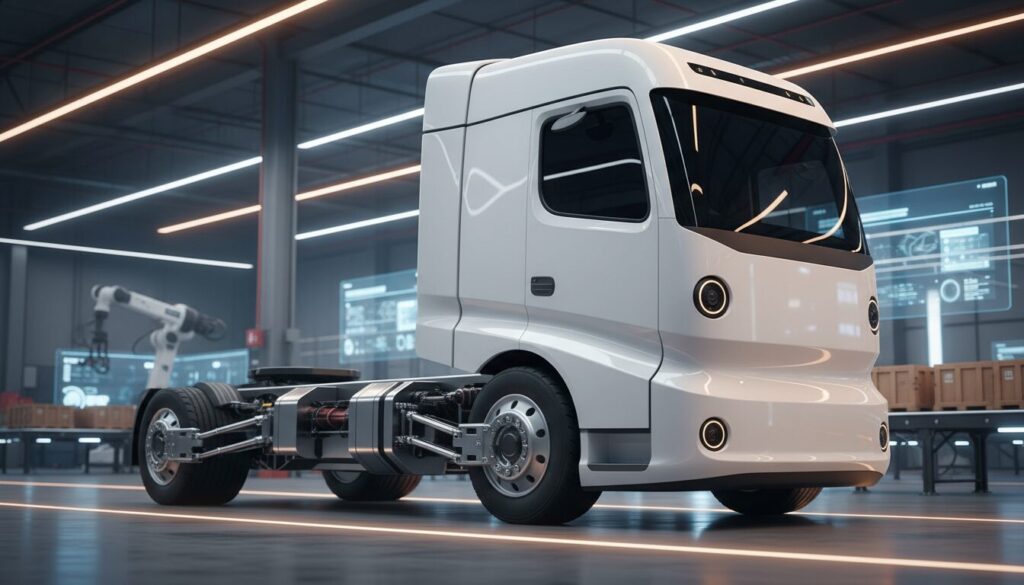
This partnership focuses on integrating Bosch’s redundant steering and braking actuators directly into Kodiak’s autonomous platform. This move facilitates both factory-line integration for new builds and a standardized, reliable method for aftermarket upfitting.
Key Partnership Details
The following table outlines the core components of the Kodiak-Bosch alliance and the current standing of Kodiak AI.
| Metric | Detail |
|---|---|
| Primary Partner | Bosch (World’s largest automotive supplier) |
| Core Objective | Industrialize and scale the “Kodiak Driver” platform via redundant hardware integration. |
| Target Timeline | H2 2026 for driverless highway operations. |
| Valuation Context | Kodiak AI is valued at approximately ~$2.5 billion following its September SPAC merger. |
| Operational Scope | Supports both factory-installed solutions (OEM level) and aftermarket upfitting. |
| Current Validation | Active fleet operations in the Permian Basin with Atlas Energy Solutions (handling frac sand logistics). |
From Prototype to Product
The collaboration addresses the single biggest bottleneck in the autonomous vehicle (AV) sector: the supply chain. Previously, AV developers had to cobble together redundant systems or rely on custom, low-volume parts. By partnering with Bosch, Kodiak gains access to an automotive-grade supply chain capable of producing thousands of units with established warranty and service networks.
This “industrialization” means that when the software is ready for driver-out operations in 2026, the hardware will not be the limiting factor.
Industry Impact: Ripples Across the Supply Chain
The strategic alignment between a Silicon Valley AI firm and a German engineering giant creates specific operational impacts across the logistics spectrum.
Impact on Carriers and Fleet Operators
For carriers, the reliability of the asset is paramount. The involvement of Bosch reduces the perceived risk of adopting Kodiak’s technology.
- Maintenance Standardization: Carriers are hesitant to adopt technology that requires niche specialists to repair. Bosch’s global footprint implies that maintenance for these redundant systems could eventually be handled by existing service networks, lowering the barrier to entry for mid-sized fleets.
- Asset Lifespan: Factory-integrated or professionally upfitted systems last longer than experimental retrofits. This improves the residual value of autonomous assets.
- Shift in OpEx Models: As reliability increases, carriers can more accurately model the total cost of ownership (TCO) for 2027 and beyond, moving from theoretical savings to bankable operational reductions.
Impact on Shippers and Manufactures
Shippers looking to secure capacity for the latter half of the decade should view this as a signal to start serious pilot negotiations.
- Capacity Planning: The 2026 timeline provides a concrete date for when “driver-out” capacity might become scalable on major lanes.
- Supply Chain Resilience: Automated lanes offer immunity to driver shortages and hours-of-service (HOS) restrictions. The industrialization of the hardware ensures that these trucks can run nearly 24/7 without mechanical downtime caused by prototype failures.
Impact on the Competitive Landscape
This deal puts pressure on Original Equipment Manufacturers (OEMs) and other AV developers.
- The “Tier 1” Seal of Approval: Other AV startups that lack a Tier 1 supplier partner may struggle to convince the market of their hardware’s safety.
- OEM Neutrality: Kodiak’s approach allows for upfitting on various truck chassis. This flexibility contrasts with competitors who may be locked into a single OEM ecosystem, giving Kodiak a broader potential market.
LogiShift View: The “Intel Inside” Strategy
While the industry focuses on the 2026 timeline, the deeper implication of this news is Kodiak’s strategic positioning. By partnering with Bosch, Kodiak is effectively pursuing an “Intel Inside” strategy for autonomous trucking.
The “So What?” here is the separation of software intelligence from hardware chassis.
The Decoupling of Tech and Truck
Historically, there was a fear that AV technology would only be available through specific truck manufacturers (e.g., buying a Daimler truck to get Torc software). The Kodiak-Bosch deal suggests a different future: a modular ecosystem.
- Modular Redundancy: Bosch provides the “muscle” (steering/braking), and Kodiak provides the “brain.” This package can theoretically be applied to a Kenworth, a Peterbilt, or a Volvo.
- Scalability over Exclusivity: This validates the move toward factory-installed systems that are OEM-agnostic. It reduces the dependency on truck manufacturers to develop their own proprietary AI, allowing them to focus on building the chassis while suppliers like Bosch and Kodiak handle the autonomy.
The Valuation Validation
The ~$2.5 billion valuation following the SPAC merger is not just a financial metric; it is a resource war chest. In the hardware-intensive world of logistics, capital determines survival. This valuation, combined with the Atlas Energy Solutions contract in the Permian Basin, proves that Kodiak is generating revenue now, not just promising it later. They are stress-testing their systems in the harsh environments of West Texas oilfields, which serves as the ultimate proving ground for the Bosch components before they hit interstate highways.
Addressing the Skepticism
The industry has been burned by AV timelines before. However, the difference between a 2020 prediction and a 2026 target is the supply chain. Previous targets failed because the manufacturing capacity for redundant drive-by-wire trucks did not exist. With Bosch, that capacity is now being built.
Takeaway: Preparing for the 2026 Horizon
The partnership between Kodiak AI and Bosch transforms autonomous trucking from a speculative venture into an inevitable industrial reality. The convergence of software maturity and hardware mass-production capability creates a clear path to the 2026 deployment target.
Actionable Steps for Logistics Leaders:
- Re-evaluate Lane Strategy: Analyze your high-volume, long-haul lanes (>500 miles). These will be the first to transition to autonomous carriage. Begin engaging with carriers who are pre-ordering or piloting these technologies.
- Monitor the Permian Basin: Watch the performance of Kodiak’s fleet with Atlas Energy. This is the “canary in the coal mine.” Success there predicts success on the highway.
- Audit Maintenance Capabilities: If you run a private fleet, consider the implications of servicing vehicles with Bosch’s redundant systems. Will you need new tooling or training for your mechanics by 2027?
- Strategic Partnerships: For shippers, now is the time to build multi-year contracts that include clauses for autonomous pilots. Locking in rates or capacity access now could provide a significant competitive advantage when the technology goes live in H2 2026.
The integration of Bosch’s industrial might with Kodiak’s AI innovation signals that the autonomous truck is no longer coming—it is being manufactured.