The era of predictable, linear supply chains is officially over. For global strategy executives and logistics leaders, the narrative has shifted from pure cost optimization to aggressive resilience. Nowhere is this shift more palpable than at the Rio Grande.
Why It Matters: The Information Gap in the Nearshoring Boom
The “China Plus One” strategy has rapidly evolved into a “Mexico First” mandate for North American market access. However, while capital investment is flooding into Mexico, operational intelligence has lagged behind.
The sheer velocity of the nearshoring boom has created a dangerous information vacuum. Logistics leaders are navigating a landscape defined by new tariffs, shifting labor dynamics, and complex security risks without a playbook.
Consider the data: Chihuahua, a northern Mexican state bordering Texas and New Mexico, has surged to become the country’s top exporting powerhouse. In the first nine months of 2025 alone, Chihuahua’s exports reached $76.5 billion, representing a staggering 38.3% year-over-year increase.
This isn’t just growth; it is a structural realignment of global trade. Yet, for decision-makers in Tokyo, Berlin, or Chicago, the on-the-ground reality of moving freight across the US-Mexico border remains opaque. This opacity is the friction point where margins are lost and compliance risks soar.
Global Trend: The Great Decoupling and Protectionist Walls
To understand the urgency of the US-Mexico conversation, one must look at the macro-environment involving China and Europe.
The Tariff Wall
In a decisive move to align with United States trade policy and protect its burgeoning industrial base, the Mexican government recently enforced significant tariffs. These levies, ranging from 5% to 35%, target goods originating from nations with which Mexico does not have a Free Trade Agreement (FTA).
This policy directly impacts imports from major manufacturing hubs like China and India.
For global supply chain strategists, this signals two critical realities:
- The Backdoor is Closing: Companies can no longer easily transship Chinese components through Mexico to avoid US Section 301 tariffs without facing Mexican levies first.
- Vertical Integration is Mandatory: To benefit from the USMCA (United States-Mexico-Canada Agreement) duty-free status, supply chains must deepen their roots within North America to meet “Rules of Origin” requirements.
The European Angle
European manufacturers, particularly in automotive and aerospace (e.g., Audi, BMW, Safran), are accelerating their Mexican footprints. They are not just exporting to Mexico; they are manufacturing in Mexico for the US consumer. The challenge they face is distinct: transposing European efficiency models onto North American cross-border infrastructure that is currently strained to its breaking point.
Case Study: “Borderless Coverage” and the Reliance Partners Strategy
In this volatile environment, access to high-level intelligence is as valuable as physical infrastructure. This is where the emergence of specialized media and consulting acts as a strategic enabler.
Reliance Partners, a leading freight insurance agency based in Chattanooga, Tennessee, identified that the primary barrier to entry for many logistics firms wasn’t just capital—it was knowledge.
The Initiative: Borderless Coverage
Mark Vickers, an Executive Vice President at Reliance Partners and a recognized authority on cross-border logistics, launched the “Borderless Coverage” podcast series.
While a podcast might seem like a standard marketing tool, in the context of high-stakes logistics, it serves a critical operational function: De-risking the Unknown.
The series focuses on high-stakes US–Mexico trade conversations that are often absent from boardroom discussions. By bringing in policymakers, customs brokers, and security experts, Vickers is digitizing the “tribal knowledge” required to operate at the border.
Solving Specific Pain Points
The “Borderless Coverage” initiative addresses the granular complexities that derail shipments. For instance, the explosive growth in Chihuahua ($76.5B in exports) has outpaced insurance capacity.
- The Problem: Many US domestic insurance policies become void the moment a trailer crosses the Rio Grande. Mexican carriers have limited liability (often capped at pennies per pound), leaving shippers exposed to total loss in the event of theft or accidents.
- The Insight: Vickers uses the platform to educate shippers on “Global Shipper’s Interest” coverage and the nuances of Mexican labor laws that affect driver liability.
- The Result: By democratizing this information, Reliance Partners positions itself not just as a vendor, but as a strategic architect of the nearshoring supply chain. This thought leadership directly supports the inflow of foreign direct investment (FDI) by lowering the perceived risk for foreign companies.
The Strategic Alignment
This media strategy aligns perfectly with the macro-economic shifts. As the 2026 USMCA review approaches, the podcast serves as a real-time monitor of regulatory sentiment, helping companies prepare for potential changes in the trade agreement.
Key Takeaways: Adapting to the New North American Reality
For innovation leaders, the success of Chihuahua and the educational push by Reliance Partners offer concrete lessons.
1. Localization of Risk Intelligence
You cannot manage Mexican operations with a US or EU mindset. The legal frameworks for cargo liability and labor are fundamentally different. Leaders must invest in localized legal and insurance expertise immediately, not after the first loss.
2. The “35% Rule”
Sourcing teams must audit their Bill of Materials (BOM). If you rely on sub-components from China or India for your Mexican assembly, the new 5-35% tariffs could wipe out your margin advantage. Re-shoring or near-shoring those sub-tier suppliers is the next phase of optimization.
3. Infrastructure vs. Volume
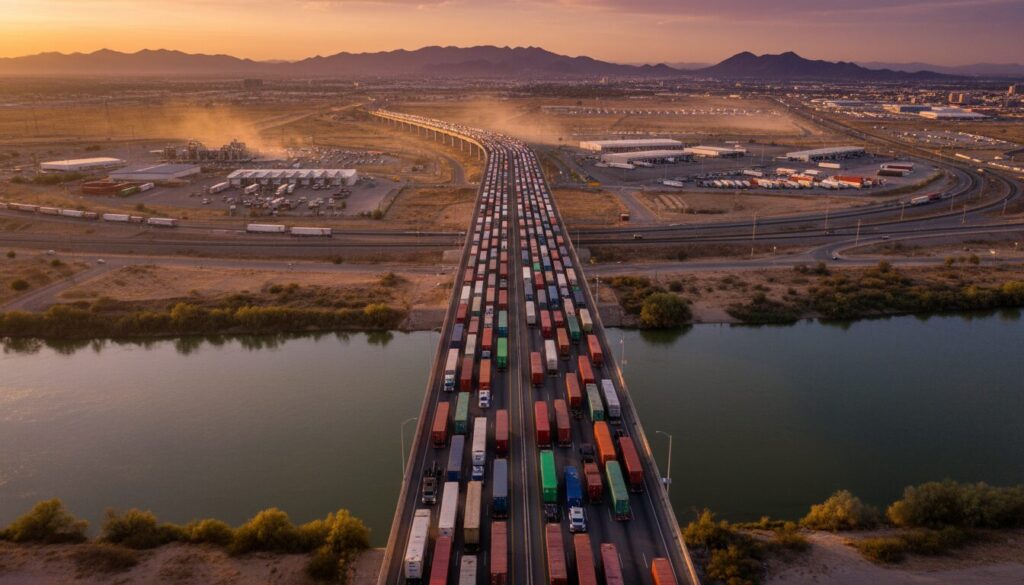
Chihuahua’s 38.3% export growth is straining Laredo and El Paso border crossings. Smart logistics strategies now involve diversifying crossing points or utilizing bonded warehouses to bypass congestion.
Comparison: Traditional vs. Nearshoring Logistics Model
| Feature | Traditional Model (Asia to US) | Nearshoring Model (Mexico to US) |
|---|---|---|
| Lead Time | 20–40 Days (Ocean) | 2–5 Days (Truck/Rail) |
| Inventory Strategy | Just-in-Case (High Safety Stock) | Just-in-Time (Lean) |
| Tariff Exposure | High (Sec 301) | Low (USMCA compliant) |
| Primary Risk | Geopolitical/Port Strikes | Cargo Theft/Border Congestion |
| Cost Driver | Ocean Freight & Fuel | Cross-Border Transfer & Security |
| Liability | Standard Marine Cargo | Complex Cross-Border Gaps |
Future Outlook: The Road to USMCA 2026
The trajectory for the next 18 to 24 months is defined by political renegotiation and infrastructure scaling.
The 2026 Review
The upcoming scheduled review of the USMCA in 2026 is the “Sword of Damocles” hanging over the region. The “Borderless Coverage” conversations highlight a growing anxiety: Will the US demand tighter Rules of Origin to prevent Mexico from becoming a transshipment hub for Asian rivals?
Companies that establish a genuine, deep-tier supply chain within North America (sourcing raw materials locally) will be immune to these political shocks. Those merely assembling Chinese kits in Mexico will remain vulnerable.
Technology as the Bridge
We expect to see a surge in “BorderTech”—platforms that integrate Mexican SAT (Tax Administration Service) requirements with US CBP (Customs and Border Protection) data standards. The companies that master this digital handshake will move freight faster than those relying on paper.
Conclusion
The $76.5 billion export boom in Chihuahua is a signal, not an anomaly. As Mark Vickers and Reliance Partners have demonstrated, success in this new borderlands economy requires a combination of aggressive investment and sophisticated, localized intelligence. The podcast series focuses on high-stakes US–Mexico trade conversations because the stakes—billions in inventory and market share—have never been higher.