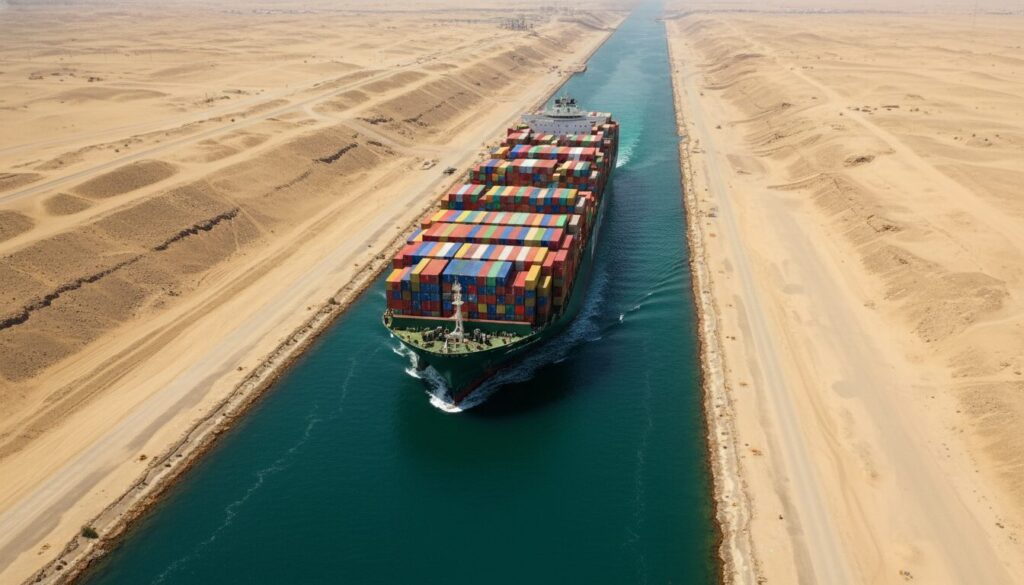
The global logistics landscape witnessed a pivotal moment recently when the CMA CGM Jacques Saade, a 23,000-TEU LNG-powered behemoth, successfully transited the Suez Canal. This event marks a significant departure from the operational status quo that has defined the last two years of Red Sea instability.
Joined by the first Maersk Group vessel to navigate the Bab el-Mandab strait since November, this transit is not merely a logistical maneuver; it is a geopolitical and economic signal. For innovation leaders and strategy executives across the US, EU, and Asia, this development represents a calculated test of supply chain resilience and a potential turning point in the restoration of the world’s most critical trade artery.
While the Suez Canal Authority (SCA) projects that full traffic and rate normalization may not occur until the second half of 2026, the return of these mega-vessels offers immediate insights into the future of strategic routing, sustainability commitments, and high-stakes risk management.
Why It Matters: The Strategic Pivot in Global Trade
For the past 24 months, the “Red Sea Crisis” has forced major carriers to divert vessels around the Cape of Good Hope. This detour added approximately 10 to 14 days to transit times between Asia and Europe, consumed significantly more fuel, and disrupted container availability globally.
The return of the CMA CGM Jacques Saade matters for three critical reasons:
- Restoring Efficiency: The Suez Canal creates the shortest maritime route between Asia and Europe. Reopening this lane is essential for reducing inflationary pressures caused by high freight rates and extended lead times.
- Validating Sustainability Investments: The Jacques Saade is the flagship of CMA CGM’s energy transition. For LNG-powered vessels to be truly effective, they require optimized routes. Taking the longer African route dilutes the carbon-saving benefits of LNG technology due to the sheer distance increase.
- Confidence Signaling: The maritime industry operates on confidence. When a top-tier carrier like CMA CGM, followed by Maersk, recommits assets worth hundreds of millions of dollars to a high-risk zone, it signals that security assessments and strategic agreements with authorities (like the SCA) have reached a maturity level that permits calculated risk-taking.
Global Trend: Regional Impacts of Route Restoration
The potential reopening of the Red Sea route—even if gradual—creates ripple effects across the major economic powerhouses. The shift from “avoidance” to “managed transit” changes the strategic calculus for supply chain executives in the US, Europe, and Asia.
The Diverging Strategies of Major Markets
The following table outlines how the potential normalization of the Suez route impacts global logistics strategies:
| Region | Primary Strategic Impact | Supply Chain Focus |
|---|---|---|
| Europe (EU) | High Impact: Direct restoration of the Asia-Europe lifeline. immediate reduction in inventory holding costs and transit times. | Inflation Control: Lowering logistics costs to ease consumer price inflation. Focus on securing slots on early Suez transits. |
| Asia (China) | High Impact: Improved export velocity. Alleviates container shortages caused by long vessel rotations around Africa. | Export Competitiveness: Ensuring goods reach Western markets faster than competitors relying on slower routes. |
| North America (US) | Medium Impact: primarily affects US East Coast imports via Suez. Eases pressure on the Panama Canal alternatives. | Diversification: US strategists are using this to balance East Coast vs. West Coast port volumes, reducing reliance on overland rail. |
The Shift to “Calculated Resilience”
The prevailing trend in 2023-2024 was “Total Avoidance.” Innovation leaders are now observing a shift toward Calculated Resilience.
Rather than a blanket ban on the Red Sea, companies are utilizing advanced risk modeling. They are segmenting shipments based on urgency and value. High-priority, time-sensitive goods are increasingly being considered for vessels that utilize the Suez shortcut (often with naval escorts or specific security guarantees), while lower-priority bulk goods may continue to use the Cape of Good Hope to avoid insurance premiums.
This dual-track approach allows logistics directors to balance cost, speed, and risk dynamically, rather than relying on a static “safe route” policy.
Case Study: CMA CGM Jacques Saade & The Suez Return
The centerpiece of this shift is the transit of the CMA CGM Jacques Saade. As the world’s first ultra-large container ship powered by Liquefied Natural Gas (LNG), its movement is a masterclass in combining sustainability with geopolitical strategy.
The Vessel and the Stakes
- Capacity: 23,000 TEUs (Twenty-foot Equivalent Units).
- Technology: LNG propulsion, reducing sulfur oxides and fine particles by 99% and nitrogen oxides by 85%.
- The Hiatus: This vessel had avoided the route for nearly two years due to Houthi attacks.
The Strategic Agreement
The return was not accidental. The Suez Canal Authority (SCA) has engaged in what it describes as “intensive marketing and strategic agreements.”
1. The Negotiation
The SCA recognized that losing traffic to the Cape of Good Hope was an existential economic threat to Egypt. To lure back giants like CMA CGM and Maersk, the SCA likely leveraged:
- Volume Rebates: Financial incentives to offset the skyrocketing war-risk insurance premiums required for Red Sea transit.
- Security Assurances: Coordination with international naval coalitions (such as Operation Prosperity Guardian) to ensure the specific protection of these high-value assets.
2. The Execution
The transit of the Jacques Saade was executed with precision. By sending their flagship, CMA CGM made a public statement. The vessel’s LNG capabilities mean that saving 3,500 nautical miles (vs. the Cape route) exponentially increases its “green” credentials per container moved.
3. The Maersk Validation
Crucially, the Jacques Saade was not alone. The fact that a Maersk Group vessel also utilized the Bab el-Mandab strait—the first since the November agreement—validates the corridor. Maersk has historically been risk-averse regarding crew safety. Their participation suggests a systemic improvement in security protocols, likely involving private maritime security contractors or state-level naval escorts.
Comparative Analysis: The ROI of the Return
For a strategy executive, the decision to use the Suez Canal vs. the Cape of Good Hope comes down to data.
| Metric | Route A: Cape of Good Hope (Detour) | Route B: Suez Canal (Restored) | Strategic Advantage |
|---|---|---|---|
| Transit Time | ~35-40 Days (Asia-Europe) | ~25-28 Days (Asia-Europe) | Speed: 10+ days gained for inventory turnover. |
| Fuel Consumption | High (Extended steaming) | Medium (Direct route) | Cost: Significant reduction in bunker fuel spend. |
| Carbon Footprint | High (More miles = more CO2) | Low (Optimized for LNG efficiency) | ESG: Aligns with Scope 3 emission reduction goals. |
| Risk Profile | Low (Piracy/War risk minimal) | High (War risk insurance premiums) | Trade-off: High insurance costs vs. operational savings. |
Key Takeaways: Lessons for the Logistics Industry
The transit of the CMA CGM Jacques Saade offers actionable lessons for global leadership teams.
1. Dynamic Routing is the New Standard
Static supply chain maps are obsolete. Executives must implement systems that allow for dynamic routing changes. The ability to switch between the Cape and Suez routes based on weekly risk assessments and spot rates is now a competitive necessity.
2. The “Green Premium” Requires Short Routes
Sustainability strategies are inextricably linked to geopolitical stability. The Jacques Saade proves that investing in green tech (LNG) is only half the battle; you also need access to efficient infrastructure. If a green ship has to sail the long way around, the environmental ROI diminishes. Leaders must lobby for secure trade lanes to protect their ESG investments.
3. Collaboration with Authorities is Key
The SCA’s role in this case study highlights the importance of public-private partnerships. Logistics leaders should not view canal authorities or port operators merely as service providers but as strategic partners who can offer incentives and security guarantees in times of crisis.
4. Preparedness for a Long Recovery
Despite this positive signal, the SCA’s own forecast predicts that full rate and traffic normalization will not happen until late 2026. Companies must plan for a “hybrid normal” for the next 24 months, where volatility remains high, and capacity is constrained.
Future Outlook
The transit of the CMA CGM Jacques Saade is the “canary in the coal mine”—but in a positive sense. It indicates that the mechanisms for navigating the Red Sea crisis are maturing.
The Road to 2026
While the immediate reopening of the floodgates is unlikely, we expect a tiered recovery:
- Phase 1 (Current): Flagship vessels and strategic transits by major carriers (CMA CGM, Maersk) to test security protocols.
- Phase 2 (2025): increased traffic of “lower value” bulk carriers and gradual return of container scheduled services, likely heavily escorted.
- Phase 3 (2H 2026): Full normalization of traffic volumes and stabilization of freight rates, as predicted by the SCA.
Technology’s Role
In the immediate future, we will see an explosion in Maritime Domain Awareness (MDA) technologies. Logistics providers will demand real-time visibility not just of their cargo, but of the security threats surrounding their vessels. Integration of AI-driven risk modeling with live satellite tracking will become standard for any shipment moving through the Suez.
Conclusion
The Jacques Saade crossing the Suez Canal is more than a ship moving from Point A to Point B. It is a declaration that the global supply chain refuses to be permanently severed. For innovation leaders, the message is clear: resilience is not about avoiding risk entirely, but about managing it through superior technology, strategic partnerships, and the courage to navigate turbulent waters.