The narrative surrounding autonomous trucking has long been dominated by a singular operational model: the “hub-to-hub” approach. For years, the industry consensus was that self-driving trucks would dominate the “easy” highway miles, while human drivers would handle the complex first and last miles.
However, a significant pivot is underway. Waabi, led by industry veteran Lior Ron, is challenging this orthodoxy by betting the company’s future on “door-to-door” autonomy. This isn’t just a technological boast; it is a fundamental economic argument. Waabi contends that the prevailing hub-and-spoke model is economically broken, burdening shippers with unrecoverable costs that erode the value proposition of autonomy.
For logistics executives, this shift signals a move from theoretical pilots to hard-nosed unit economics. If Waabi’s Generative AI-first approach succeeds, it renders the expensive transfer-hub infrastructure obsolete before it is fully built, potentially reshaping the timeline and capital requirements for autonomous vehicle (AV) adoption.
The Facts: Waabi’s Strategic Pivot
Waabi’s strategy relies on a combination of advanced Generative AI and strategic partnerships to bypass the industry’s reliance on transfer hubs.
The Economic Catalyst
The core of Waabi’s argument is financial, not just technological. According to COO Lior Ron, the “transfer tax” of the hub-and-spoke model is a dealbreaker for most shippers.
- The Cost of Complexity: Introducing a transfer hub adds approximately $200 to $300 per side (origin and destination) in operational friction and drayage costs.
- Customer Resistance: Shippers operating on thin margins are refusing to absorb these extra costs, which effectively negate the fuel and labor savings provided by the autonomous highway leg.
- Market Reality: Waabi predicts that only 5% to 15% of future logistics networks will support a true hub-to-hub model. The vast majority of freight (85%+) requires point-to-point delivery to be viable.
The Technology and Timeline
To achieve door-to-door autonomy, a truck must navigate complex surface streets, roundabouts, and distribution center yards—environments far more chaotic than interstate highways.
| Component | Strategy Details |
|---|---|
| Core Technology | Generative AI: Unlike traditional “if/then” code, Waabi uses GenAI to reason through edge cases on local roads, enabling the truck to generalize new situations without driving millions of physical validation miles. |
| Partnership | Volvo Autonomous Solutions (VAS): A long-term collaboration providing redundant chassis hardware designed specifically for autonomy, ensuring fleet reliability. |
| Target Date | 2026: Marked as the critical year for technological refinement and commercial deployment milestones. |
| Operational Model | OEM-integrated Driver: The “Waabi Driver” software is integrated directly into Volvo trucks at the factory level, aiming for a seamless asset rollout. |
Industry Impact: Dismantling the Middle Mile Myth
The shift toward door-to-door autonomy has profound implications across the supply chain ecosystem. It forces stakeholders to rethink infrastructure investments and operational workflows.
1. Impact on Carriers and Fleet Operators
For carriers, the removal of the transfer hub simplifies the asset lifecycle but increases the technological burden.
- Asset Utilization: In a hub model, carriers must manage two fleets: autonomous highway trucks and manual drayage trucks. A door-to-door model consolidates this into a single asset type, significantly improving utilization rates and reducing dwell time caused by trailer swaps.
- Labor Realignment: The “transfer hub driver” role disappears. The labor concern shifts from short-haul drayage to terminal operations—managing the interaction between autonomous trucks and warehouse docks.
2. Impact on Real Estate and Infrastructure
The real estate thesis for AVs changes drastically under Waabi’s model.
- Hub Obsolescence: Investors pouring capital into “AV Transfer Ports” near highway exits may face stranded assets if the industry pivots to direct delivery.
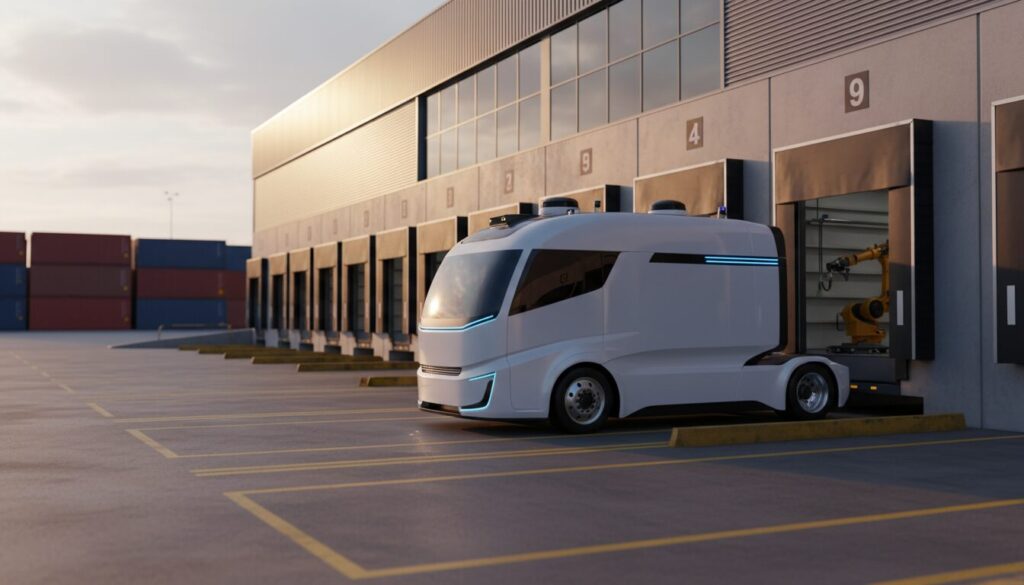
- Warehouse Retrofitting: Distribution centers (DCs) must become “AV-ready.” This includes digital mapping of yards, automated gate systems, and specific docking protocols that allow a robot to back into a bay without human spotters.
3. Impact on Shippers
For the shipper, this is the “Holy Grail” scenario—autonomous efficiency without the logistical headache of transfers.
- Supply Chain Velocity: Eliminating the stop-and-swap at a transfer hub can shave hours off transit times.
- Cost Transparency: Without the $200-$300 drayage surcharge, the ROI for adopting autonomous lanes becomes immediate rather than theoretical. Shippers can integrate AVs into existing lanes without re-engineering their network topology.
LogiShift View: The “So What?”
Why does this specific announcement matter in a sea of AV press releases? It represents the maturation of the industry from capability to viability.
The “Transfer Tax” is the Silent Killer
The logistics industry often ignores the hidden costs of friction. Early AV proponents assumed the savings on the long-haul leg (fuel, HOS removal) were so massive that they would subsidize the drayage costs. Waabi is calling this bluff. In a freight recession or a normalized market, a $600 round-trip surcharge for “first/last mile” drayage destroys the margin advantage of the robot.
GenAI as the Great Equalizer
Competitors like Aurora and Kodiak have spent years mapping highways and refining highway driving policies. By focusing on GenAI, Waabi is attempting to “leapfrog” the need for brute-force mapping and coding of surface streets.
- The Gamble: If GenAI can truly “generalize” driving behavior (i.e., understand a construction zone in Ohio based on training data from Texas), Waabi wins.
- The Risk: If the AI hallucinates or fails in complex urban environments, the door-to-door model collapses, and they have no hub network to fall back on.
A Bifurcated Future?
It is unlikely that one model will take 100% of the market. We predict a bifurcation:
- Ultra-Long Haul (2,000+ miles): Hub-to-Hub may still work here, where the immense savings of a cross-country driverless trip outweigh the drayage cost.
- Regional/Super-Regional (300-800 miles): This is where Waabi’s door-to-door model is lethal. On a 400-mile run, a $400 drayage cost makes autonomy non-viable. Direct delivery is the only way to automate the regional heavy-haul market.
Takeaway: Strategic Steps for Executives
The door-to-door reality is closer than the 2030 estimates many analysts provide. Waabi’s 2026 target suggests companies need to prepare now.
-
Audit Your Network Topology:
Analyze your lanes. Identify which are “Regional Point-to-Point” versus “Long-Haul Trunk.” If your network is heavy on regional distribution (e.g., factory to DC), the door-to-door model will be your primary entry point for autonomy. -
Evaluate Facility Readiness:
Do not wait for the truck to show up. Begin assessing your facility’s “digital readiness.”- Do you have high-fidelity maps of your yards?
- Are your gate processes digital or paper-based?
- Can your WMS communicate directly with a truck’s telematics system for dock assignment?
-
Monitor the “AI vs. Rules” Race:
Keep a close watch on the safety reports coming out of Waabi’s pilots versus traditional players. The success of the GenAI approach is the leading indicator for how quickly autonomy will move from the highway off-ramp to your warehouse door. -
Revisit ROI Calculations:
If you previously rejected AV pilots because the “hub transfer costs” were too high, recalculate using a direct-delivery model. The removal of the intermediate drayage step may flip the ROI from negative to positive.