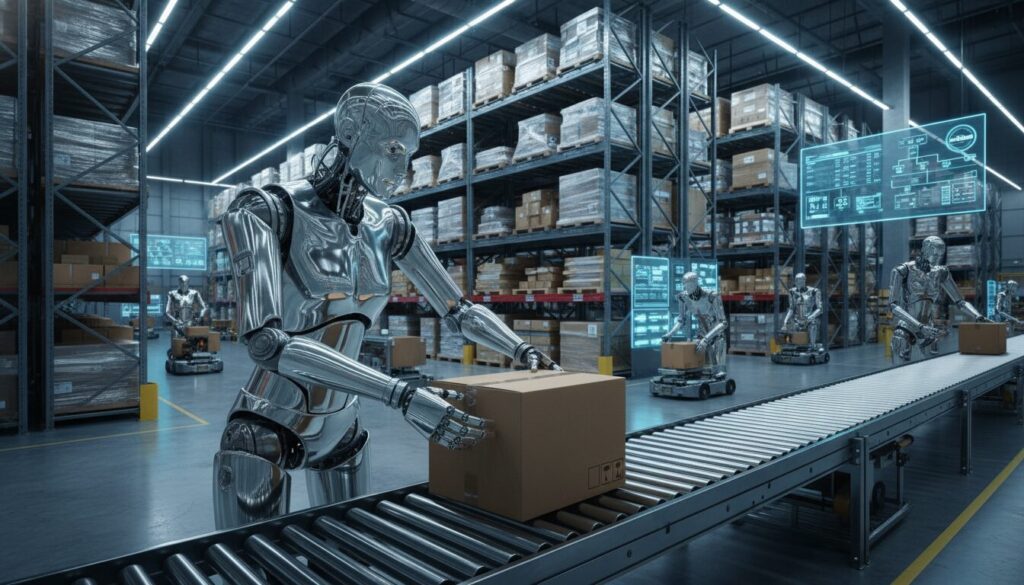
The logistics automation landscape just witnessed a disruptive pricing shockwave originating from Shanghai. In a move designed to dismantle the barriers to entry for advanced robotics, Qingtianzhu (Shanghai) Technology Co., Ltd. has launched a “1 RMB Flash Rental” campaign.
For the price of less than a quarter of a US dollar, logistics hubs in 10 major Chinese cities can now deploy humanoid robots. This is not merely a marketing stunt; it is a strategic signal marking the maturity of the Robot-as-a-Service (RaaS) model. For global innovation leaders and strategy executives, this development represents a pivotal shift from “automation as a luxury” to “automation as a utility.”
Why It Matters: The Demolition of the CapEx Wall
For the past decade, the primary friction point in supply chain automation has not been technology—it has been finance. The “Automation Paradox” has plagued potential adopters: companies that need automation the most (often mid-sized logistics providers facing labor shortages) are the ones least able to afford the massive upfront Capital Expenditure (CapEx) required to buy fleets of robots.
The global context amplifies the urgency of this model:
- Labor Scarcity: The US manufacturing and logistics sector faces a potential shortage of 2.1 million unfilled jobs by 2030. In Europe, Germany loses 400,000 workers annually to retirement. In Asia, Japan and China are racing against aging demographics.
- Volatility: Post-pandemic supply chains require flexibility. Purchasing a fixed automation system that takes 18 months to ROI is risky when consumer demand shifts quarterly.
Qingtianzhu’s initiative matters because it effectively reduces the cost of entry to zero. By utilizing a unified scheduling system and offering a “scan-to-rent” model, they are treating humanoid robots not as assets to be owned, but as temporary workers to be hired. This aligns perfectly with the operational reality of logistics: volume spikes are temporary, so workforce expansion should be flexible.
Global Trend: The Evolution of RaaS in Key Markets
While Qingtianzhu is making headlines with its aggressive pricing, the shift toward RaaS is a global phenomenon. However, the approach varies significantly across the triad of major economic zones.
United States: Specialized Efficiency
In the US, the RaaS model has primarily been driven by specialized Mobile Industrial Robots (AMRs). Companies like Locus Robotics and Fetch Robotics (now Zebra) pioneered the subscription model for warehouse bots.
- Focus: High throughput in structured environments.
- Form Factor: Wheeled carts and bin-carriers.
- Strategy: Augmenting human pickers rather than replacing them entirely.
Europe: Collaborative Precision
Europe, led by German and Danish innovation (e.g., Universal Robots), has focused on “Cobots” (Collaborative Robots). The RaaS trend here is often tied to manufacturing precision and safety compliance.
- Focus: Safety and human-robot interaction.
- Form Factor: Articulated arms.
- Strategy: Flexible manufacturing cells that can be re-tasked quickly.
China: Humanoid Scalability
China is currently leapfrogging the “specialized” phase and pushing hard into general-purpose humanoid robots. Supported by aggressive government incentives for “New Productive Forces,” companies are prioritizing speed of deployment and versatility.
- Focus: General-purpose labor replacement in unstructured environments.
- Form Factor: Bipedal humanoid robots (e.g., Unitree, Xiaomi, Qingtianzhu).
- Strategy: Massive scale and low-cost hardware to train AI models rapidly.
Comparison of Global RaaS Approaches
| Feature | US Model (Specialized) | EU Model (Collaborative) | China Model (Qingtianzhu/Humanoid) |
|---|---|---|---|
| Primary Unit | AMR / AGV (Wheeled) | Cobot Arms | Humanoid Bipeds |
| Key Capability | Transport & Picking | Assembly & Sorting | Multi-terrain, Multi-tasking |
| Pricing Model | Monthly Subscription | Lease-to-Own | Flash Rental / On-Demand |
| Integration Time | 4-8 Weeks | 2-6 Weeks | Immediate (Scan-to-Rent) |
| Core Barrier | Software Integration | Safety Certification | Hardware Durability & Balance |
Case Study: Qingtianzhu’s Aggressive Market Entry
Qingtianzhu (Shanghai) Technology Co., Ltd. has bypassed the traditional sales cycle entirely. By launching the “1 RMB Flash Rental,” they are executing a classic platform strategy: maximize user base to refine the product.
The Campaign Mechanics
The “1 RMB Flash Rental” allows businesses to rent a humanoid robot for a trial period for a nominal fee. This campaign is currently active in 10 core logistics and economic hubs, including:
- Beijing: Political and northern logistics center.
- Shanghai: Global shipping and finance hub.
- Shenzhen: The “Silicon Valley of Hardware” and electronics manufacturing base.
Users can access the service via a simple QR code, lowering the administrative friction usually associated with B2B procurement.
The Technology: Unified Scheduling System
The hardware is only half the story. The core value proposition is Qingtianzhu’s Unified Equipment Scheduling System.
In traditional automation, robots are siloed. Qingtianzhu’s platform treats the robots as a networked fleet.
- Centralized Command: The system manages the deployment, task allocation, and health monitoring of the robots remotely.
- Data Feedback Loop: By deploying robots into real-world logistics scenarios (warehouses, last-mile hubs) at a low cost, Qingtianzhu harvests invaluable data on unstructured environments. This data feeds back into the AI, improving the humanoid’s balance, object recognition, and path planning.
Why Humanoids?
Why push humanoid robots instead of stable, wheeled AGVs? The answer lies in Brownfield Adaptability.
Most existing warehouses are designed for humans—they have stairs, narrow aisles, uneven floors, and shelves at varying heights.
- AGVs: Require infrastructure changes (flat floors, magnetic strips, QR codes on floors).
- Humanoids: Can theoretically operate in environments built for humans without infrastructure retrofitting.
By offering these robots for 1 RMB, Qingtianzhu is essentially betting that once a logistics manager sees a robot climb a step or handle a package in a zone where AGVs fail, they will convert to a long-term contract.
Key Takeaways: Lessons for the Logistics Industry
The “1 RMB” campaign is a microcosm of a larger shift in how supply chains will consume technology. Here are the critical lessons for global executives:
1. OpEx is King
The era of heavy CapEx for automation is fading. Strategies must pivot to Operational Expenditure (OpEx) models. If your technology vendors do not offer RaaS or flexible leasing, you are locking your balance sheet into depreciating assets that may be obsolete in three years.
2. The “Land and Expand” Validation
Qingtianzhu is proving that the best way to validate technology is not in a lab, but in the field. Companies should look for technology partners willing to pilot in real-world conditions with low barriers to entry. If a vendor requires a million-dollar commitment before a pilot, they are not confident in their product’s immediate value.
3. General Purpose vs. Specialized
The rise of humanoids suggests a future where robots are “General Purpose Agents.” Instead of buying a robot that only wraps pallets, logistics centers will rent robots that can wrap pallets in the morning, unload trucks at noon, and clean floors at night. This versatility is the Holy Grail of ROI.
4. Software Define the Fleet
The hardware (the robot) is becoming a commodity. The competitive advantage lies in the scheduling system and the AI brain. When evaluating vendors, look at their fleet management software—can it integrate with your WMS? Can it optimize routes dynamically?
Future Outlook: The Commoditization of the Workforce
Qingtianzhu’s move signals the beginning of the commoditization of robotic labor.
In the near future (2025-2027), we expect to see:
- Dynamic Labor Pricing: Just as Uber employs surge pricing, RaaS providers might charge differently based on shift demand. Renting a robot during the Christmas peak season might cost more than in February.
- Global Expansion of Chinese Hardware: Just as Chinese EVs are entering global markets, expect low-cost, high-performance Chinese humanoid robots to enter EU and Asian supply chains, putting pressure on Western robotics firms to lower costs.
- Hybrid Workforces: The standard warehouse team will consist of humans for complex problem solving, specialized AGVs for heavy transport, and rented humanoids for repetitive, general labor—all coordinated by a single AI execution system.
The “1 RMB” robot is not just a discount; it is a glimpse into a future where automation is as accessible as electricity—available on-demand, scalable instantly, and paid for by consumption.