Why It Matters: The High-Stakes Logistics of the New Energy Map
The global energy map is being redrawn, and at the center of this transformation lies a massive logistics challenge in the Caribbean. While the world focuses on the geopolitical tensions in Eastern Europe and the Middle East, a quiet revolution is occurring in the Guyana-Suriname Basin. This region has emerged as the world’s hottest offshore oil exploration zone, with recoverable resources estimated at over 11 billion barrels in Guyana alone.
However, for innovation leaders and strategy executives, the story is not the oil itself—it is the supply chain required to extract it.
Deepwater operations are notoriously capital-intensive. A single drillship can cost upwards of $400,000 to $500,000 per day to operate. When ancillary services are included, the daily burn rate often exceeds $1 million. In this high-stakes environment, logistics efficiency is not merely an operational detail; it is the primary safeguard of project economics. A missing drill bit, a delayed chemical shipment, or a bottleneck in waste management can result in non-productive time (NPT) costing millions.
Historically, the Caribbean relied on Trinidad and Tobago as its established energy logistics hub. However, as production in Guyana is set to reach 750,000 barrels per day (bpd) by 2025, the industry is witnessing a massive nearshoring trend. Relying on cross-border logistics from Trinidad is no longer viable due to transit times and cost.
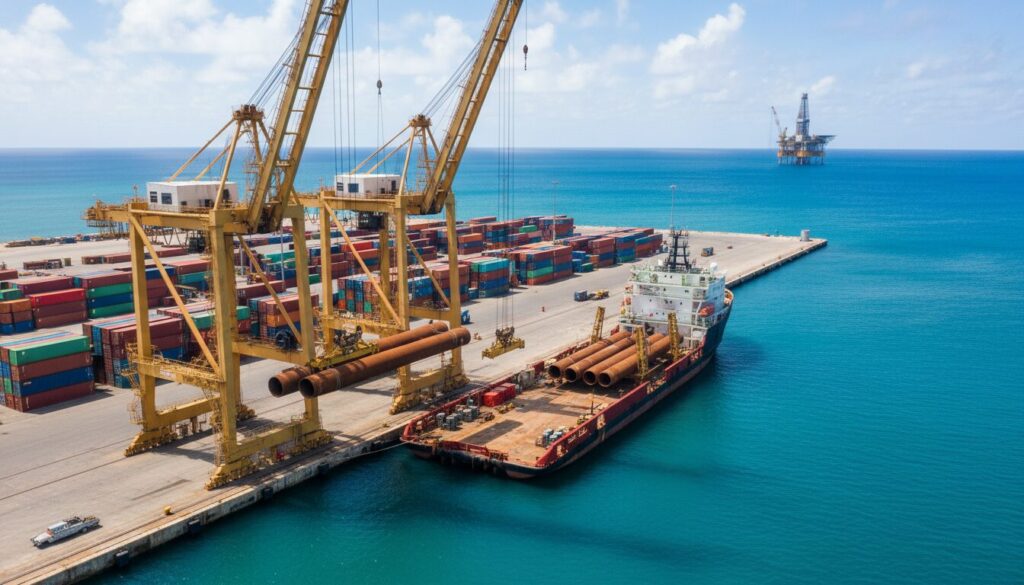
This has triggered a construction boom of specialized shore bases—logistics hubs designed specifically to support deepwater infrastructure. The implications extend far beyond the Caribbean; this is a masterclass in how emerging markets are leapfrogging legacy infrastructure to build state-of-the-art, purpose-built logistics ecosystems from scratch.
Global Trend: The Shift from Legacy Hubs to Frontier Bases
To understand the significance of the Caribbean logistics boom, one must contextualize it against established global norms in the US, Europe, and Asia. The offshore logistics sector is undergoing a bifurcation between managing decline in mature basins and rapid scaling in frontier regions.
United States: The Integrated Model
In the US Gulf of Mexico (GoM), the logistics model is mature and highly integrated. Port Fourchon in Louisiana serves as the gold standard. It services over 90% of the Gulf’s deepwater oil production. The infrastructure there has evolved over decades, featuring extensive pipeline networks, intermodal connectivity, and a dense ecosystem of service providers. The challenge in the US is modernization and digitalization rather than construction.
Europe: The Green Transition
In the North Sea (UK and Norway), hubs like Aberdeen and Stavanger are pivoting. The trend here is decommissioning logistics (removing old platforms) and repurposing infrastructure for offshore wind farms. Supply chains are being retooled to handle wind turbine blades rather than drill pipes. The logistics focus is on sustainability and circular economy principles.
China: Domestic Security and Scale
China’s offshore logistics, particularly in Bohai Bay and the South China Sea, are driven by state-mandated energy security. The trend is characterized by massive, state-owned engineering feats and heavy industrial integration. Unlike the Caribbean, which relies on foreign direct investment (FDI) and international consortiums, China’s model is insular and vertically integrated.
The Caribbean Frontier
In contrast, the Caribbean represents a “greenfield” logistics environment. There is no legacy infrastructure to retrofit. This allows for the implementation of modern, optimized layouts from day one, but it also presents the challenge of building on difficult terrain (often swampy coastal lands) with limited local supply chain depth.
The following table compares the logistics maturity and strategic focus of these key regions:
| Feature | US Gulf of Mexico (Port Fourchon) | North Sea (Aberdeen/Stavanger) | Caribbean Basin (Guyana/Suriname) |
|---|---|---|---|
| Primary Focus | Deepwater Production Maintenance | Decommissioning & Offshore Wind | Rapid Exploration & Production Ramp-up |
| Logistics Model | Highly Integrated, Hub-and-Spoke | Transitioning/Green Logistics | Greenfield, Direct-to-Rig Support |
| Key Challenge | Aging Infrastructure | Regulatory Pressure (emissions) | Infrastructure Gap & Local Content |
| Capital Flow | Sustaining Capital | Green Investment | Heavy Growth Capital ($300m+ projects) |
Case Study: Vreed-en-Hoop and the Rise of Specialized Shore Bases
The most compelling illustration of this trend is the rapid development of the Vreed-en-Hoop Shore Base (VEHSI) in Guyana. This project exemplifies how logistics infrastructure is being used as a strategic asset to unlock regional economic potential.
The Vreed-en-Hoop Shore Base (VEHSI)
Opened in early 2025, the Vreed-en-Hoop Shore Base represents a US$300 million investment aimed squarely at solving the logistical bottlenecks of the Stabroek Block (operated by an ExxonMobil-led consortium).
Strategic Partnership Structure
The project is a joint venture between NRG Holdings Inc. (a consortium of Guyanese entrepreneurs) and Jan De Nul Group (a Belgian maritime infrastructure giant). This structure is critical:
- NRG Holdings provides the “Local Content” compliance—a legal requirement in Guyana ensuring that oil revenues benefit the local economy.
- Jan De Nul brings the technical expertise required to dredge the Demerara River and construct heavy-load quays on soft soil.
Engineering a Logistics Island
The engineering feat behind VEHSI is a lesson in supply chain resilience. The site is located on an artificial island created by reclaiming land from the Demerara River. This was necessary because existing draft (water depth) was insufficient for the heavy supply vessels required for deepwater operations.
Key logistics capabilities include:
- Widened Navigation Channels: Dredging allows unrestricted access for vessels, eliminating tidal delays that previously hampered logistics flow.
- Specialized Zones: Dedicated areas for fabrication, waste management, and fuel bunkering reduce the “turnaround time” for supply vessels.
- Heavy Lift Capacity: The quays are reinforced to handle the immense weight of subsea trees and blowout preventers (BOPs).
The Suriname Counterpart: DP World Paramaribo
While Guyana grabs headlines, neighboring Suriname is mirroring this strategy. DP World, a global logistics heavyweight based in Dubai, has heavily invested in DP World Paramaribo.
Supporting operators like TotalEnergies and Apache (APA Corp) in Block 58, DP World has adapted its strategy:
- Integrated Solutions: Unlike a traditional port operator that simply loads/unloads, DP World Paramaribo offers “pit-to-port” logistics, managing the supply chain from the warehouse to the offshore rig.
- Resilience: They have invested in massive laydown yards to buffer against global supply chain disruptions, ensuring that critical drilling equipment is locally stockpiled.
Economic Impact of Onshore Logistics
The impact of these hubs is measurable. By moving logistics from Trinidad to Guyana/Suriname:
- Transit Time: Reduced from 2-3 days to under 12 hours.
- Fuel Consumption: Significant reduction in Scope 3 emissions for oil majors due to shorter supply vessel trips.
- Local Economy: Creation of thousands of jobs in warehousing, trucking, and crane operations.
Key Takeaways: Lessons for the Global Logistics Industry
The Caribbean offshore boom offers critical lessons for logistics strategists across all sectors, from manufacturing to retail.
1. Proximity is the Ultimate Efficiency
In an era of supply chain volatility, distance is risk. The push to build Vreed-en-Hoop proves that companies are willing to invest hundreds of millions in CapEx (Capital Expenditure) to reduce OpEx (Operational Expenditure) and risk in the long term. Lesson: Evaluate your network design—is your support infrastructure close enough to your critical operations to prevent downtime?
2. The Power of “Local Content” Supply Chains
The success of VEHSI relies on the blend of global expertise (Jan De Nul) and local ownership (NRG Holdings). For global companies entering emerging markets, attempting to import a 100% expatriate supply chain is no longer politically or operationally viable. Lesson: Build resilience by cultivating local partners who understand the regulatory and labor landscape.
3. Infrastructure Versatility
These new ports are being built with an eye on the future. The heavy-lift capabilities required for oil rigs are remarkably similar to those required for containerized cargo and wind turbines. Lesson: When designing logistics hubs, build for the current demand but engineer for future adaptability.
4. Privatization of Public Infrastructure
The Caribbean trend highlights a shift where private consortia are building national-scale infrastructure (ports, channels) that was traditionally the domain of governments. Lesson: Expect to see more Private-Private Partnerships where competing supply chain stakeholders pool resources to build shared infrastructure.
Future Outlook: Beyond 2025
The trajectory of the Caribbean logistics sector points toward deeper integration and technological sophistication.
The Rise of the “Guianas Shield” Hub
We expect to see the emergence of a unified logistics corridor connecting Guyana, Suriname, and Northern Brazil. As infrastructure matures, Vreed-en-Hoop and Paramaribo will likely compete to become the “Rotterdam of the Caribbean,” servicing not just oil, but agricultural exports and container transshipment for the entire region.
Digital Twins and Smart Ports
With the physical infrastructure now coming online (like the $300m VEHSI), the next phase of investment will be digital. Expect Guyana Shore Base Inc (GYSBI) and others to implement “Digital Twin” technology. By creating virtual replicas of the supply base, operators can simulate vessel movements and cargo flows to optimize turnaround times, further driving down the cost per barrel.
Sustainability Dilemma
The irony of building massive fossil fuel infrastructure in 2025 is not lost on the industry. To secure long-term financing and social license to operate, these logistics hubs will be forced to decarbonize. We anticipate a rapid integration of shore power (cold ironing) to allow supply vessels to plug into the grid while docked, and the eventual introduction of hybrid or electric tugs in these new harbors.
Conclusion
The offshore expansion driving the push for Caribbean logistics hubs is a definitive case study in modern supply chain engineering. It demonstrates that in high-value industries, logistics is not a cost center—it is a strategic enabler that dictates the pace of production. For global executives, the lesson is clear: if the infrastructure doesn’t exist to support your growth, you must be prepared to build it.