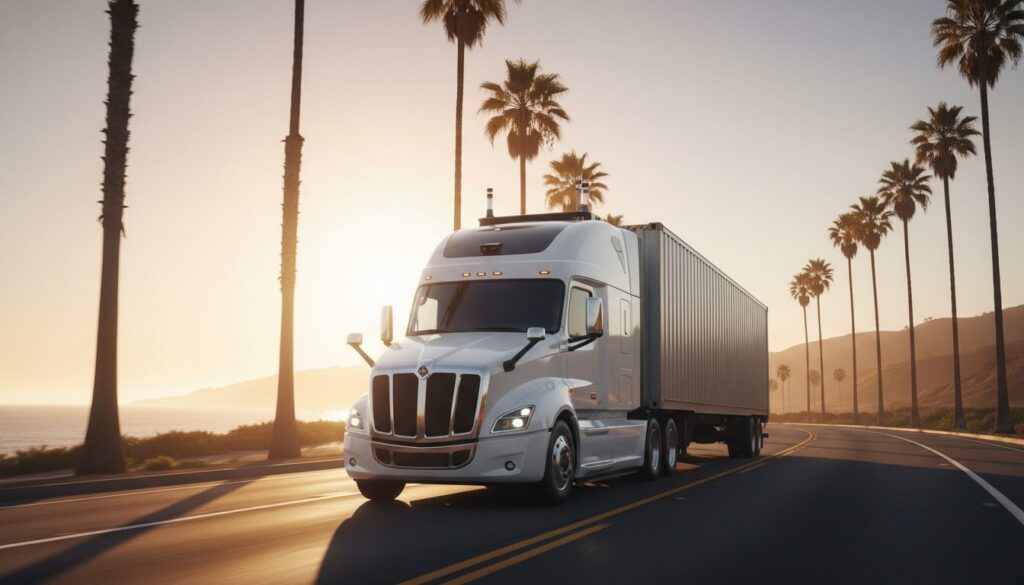
For years, the United States has operated as a fragmented map regarding autonomous freight. While Texas, Arizona, and Florida welcomed robotrucks with open lanes and favorable legislation, California—the nation’s unrivaled logistics heavyweight—stood as a regulatory fortress, effectively banning heavy-duty autonomous vehicles (AVs).
That fortress is finally lowering its drawbridge.
The California Department of Motor Vehicles (DMV) has released draft regulations that signal a definitive shift in policy. By proposing a structured, phased pathway for Class 8 autonomous trucks, the state is moving to close the gap between the chaotic reality of current supply chains and the automated future. For logistics executives, this is not merely a regional legal update; it is the unlocking of the “Golden Corridor”—the Interstate 10 freight artery linking the massive import hubs of Southern California to the distribution heartland of Texas.
California’s long wait for autonomous trucks may soon end, and with it, the artificial bottleneck that has stifled the development of a truly national autonomous freight network.
The Regulatory Shift: Breaking Down the New Rules
To understand the magnitude of this shift, one must look at the specific hurdles California is proposing. Unlike the “wild west” approach of early AV testing in other states, California is leveraging its reputation for strict safety standards to create a high barrier to entry.
The DMV’s proposal replaces the previous legislative stalemate with a clear, albeit rigorous, roadmap. The days of indefinite bans are over, replaced by a data-driven meritocracy.
The 5W1H of California’s AV Proposal
| Factor | Detail |
|---|---|
| Who | California DMV, impacting AV developers (e.g., Plus, Aurora, Kodiak) and major carriers. |
| What | A phased permitting process ending the heavy-duty AV ban. |
| Where | California highways, specifically targeting connections to Arizona and Nevada borders. |
| When | Testing Permits: Expected Q3 2026. Commercial Ops: Targeted for 2027. |
| Why | To integrate California’s massive port volumes into the national AV network and improve safety/efficiency. |
| How | By requiring 1 million cumulative testing miles (minimum 500k with safety drivers) before full driverless deployment. |
The “One Million Mile” Moat
The most critical component of the new draft is the mileage requirement. The DMV is proposing that manufacturers must demonstrate 1 million cumulative testing miles to qualify for deployment.
Crucially, at least 500,000 of these miles must be driven with a safety driver behind the wheel. This requirement serves two purposes:
- Public Assurance: It placates safety advocates and labor unions (such as the Teamsters) who have vehemently opposed rapid automation.
- Market Consolidation: It creates a massive barrier to entry. Only well-capitalized players with existing fleets and extensive data history will be able to clear this hurdle quickly.
Impact on the Logistics Landscape
The integration of California into the autonomous fold will send shockwaves through the industry, fundamentally altering fleet strategies, real estate demands, and shipping economics.
Unlocking the I-10 Corridor
The immediate impact is geographic. Currently, an autonomous truck can haul freight from Dallas to Phoenix but must stop at the California border. There, a human driver must take over to navigate the final leg to the Inland Empire or the Ports of Los Angeles and Long Beach.
This “modal handoff” introduces friction, cost, and scheduling inefficiencies. When California’s regulations align with Arizona and Texas, carriers can run a seamless “Texas Triangle to West Coast” loop.
- Efficiency Gains: Autonomous trucks do not suffer from Hours of Service (HOS) limitations. A trip from Los Angeles to Dallas, which currently takes a human driver roughly 22 to 24 hours of driving time (spanning 2-3 days with mandatory breaks), could be completed by an AV in under 24 hours straight.
- Asset Utilization: Trucks that can run nearly 24/7 (stopping only for fuel and maintenance) double the utility of the asset, drastically lowering the cost per mile over the vehicle’s lifespan.
The Rise of the Transfer Hub
As the regulations take shape, we will see an accelerated investment in Autonomous Transfer Hubs.
Strategic Real Estate Shifts
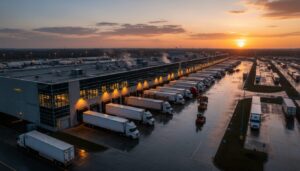
We are likely to see a boom in Industrial Outdoor Storage (IOS) and cross-dock facilities located at the edges of major metropolitan areas.
- The Model: AVs handle the “Middle Mile” on the open highway. Human drivers handle the “First/Last Mile” in complex urban environments.
- The Location: Expect real estate prices to spike in areas like Barstow, Indio, and Blythe. These locations will serve as the switch-points where robotrucks drop trailers for human drayage drivers to take into the dense Los Angeles basin.
Carrier and Shipper Economics
For shippers, the equation is simple: reliability and cost. The driver shortage—whether structural or cyclical—creates volatility in spot rates and capacity. AVs offer a predictable, fixed-cost alternative.
For carriers, the transition requires a pivot in capital expenditure (CapEx). The investment moves from recruiting and retaining long-haul sleeper teams to acquiring high-tech assets and maintaining the digital infrastructure to manage them.
LogiShift View: The Strategic “So What?”
While the news cycle focuses on the permission to drive, the real story is the consolidation of the industry.
The Death of the AV Startup
The requirement for 1 million cumulative testing miles is a filter. It essentially hands the market to the incumbents who have been testing in Texas for years—companies like Aurora, Kodiak, and Plus (and potentially Waymo via Via, though their strategy is evolving). Small startups hoping to enter the space will burn through their cash runways before they can legally move a pallet of freight in California without a safety driver.
Prediction: We will see a wave of M&A activity where smaller tech firms are bought not for their IP, but for their accumulated testing miles and safety data.
The “Safety Driver” as a Political Tool
California’s insistence on the 500,000-mile safety driver phase is a calculated political maneuver. It allows the state to approve the technology while tossing a bone to labor unions, ensuring that human jobs aren’t liquidated overnight.
However, executives should not view this as a permanent state. The data from these 500,000 miles will almost certainly validate the safety of the systems. Once that data is codified by the DMV, the argument for keeping human drivers in the cab on interstate highways will evaporate. The “Safety Driver” phase is the final sunset of the long-haul human trucker era in California, likely lasting from 2026 to 2029 before fully driverless permits become the norm.
The Timeline Reality Check
While the target is Q3 2026 for permits and 2027 for operations, logistics planners should build a buffer. California’s regulatory process is notoriously litigious. Expect challenges from labor groups to delay the timeline by 6 to 12 months. A realistic commercial deployment at scale—where shippers can actually book capacity—is likely a 2028 story.
Takeaway: What Companies Should Do Next
The end of California’s ban is the starting gun for the next phase of logistics modernization. Waiting until 2027 to react is a failing strategy.
1. Audit Your Lanes
Analyze your current freight volume moving between the West Coast and the Texas/Midwest regions. Identify what percentage of this is “middle mile” highway freight suitable for automation. These are the lanes where you will see the first cost reductions.
2. Partner with Winning Tech
If you are a carrier, do not bet on unproven startups. Align your fleet strategy with AV developers who already have significant testing miles in other states. They are the only ones who will clear the California DMV’s 1 million mile hurdle in a relevant timeframe.
3. Rethink Real Estate
If you manage distribution centers, consider the value of proximity to highway interchanges on the outskirts of LA and the Bay Area. The value of a facility in the Inland Empire isn’t just about storage anymore; it’s about its ability to serve as a handover point for the AV network.
4. Prepare for 24-Hour Operations
Warehouses receiving autonomous loads need to be ready for them. AVs don’t sleep. If your receiving dock operates 9-to-5, you negate the speed advantage of an autonomous truck that drove through the night. Moving to 24/7 receiving capabilities will be essential to capturing the value of this technology.
California’s long wait for autonomous trucks may soon end, but the race to capitalize on it has just begun. The barriers are high, the timeline is tight, and the winners will be those who prepare their infrastructure today for the automated highways of tomorrow.