
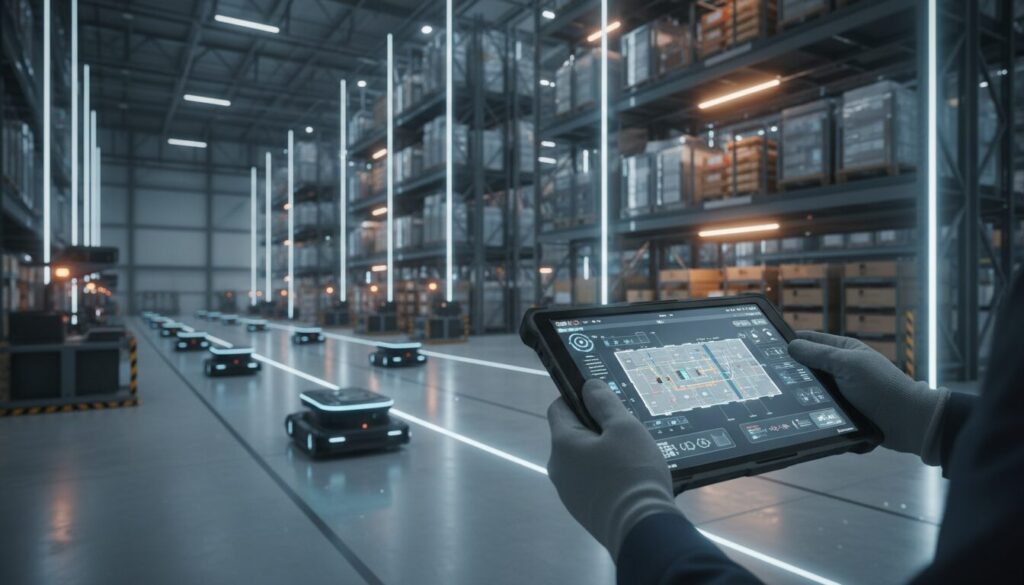
Introduction: The “Lights-Out” Illusion and Operational Stagnation
In the rush toward Digital Transformation (DX), many warehouse managers fell into a specific trap between 2020 and 2024. The industry buzzwords promised a “lights-out” warehouse—a facility running entirely on robotics, AI, and conveyors, devoid of human intervention. Managers invested heavily in Automated Storage and Retrieval Systems (AS/RS) and Autonomous Mobile Robots (AMRs), expecting labor costs to vanish and efficiency to skyrocket.
However, the reality on the warehouse floor tells a different story.
While throughput for standard items increased, the system became brittle. A single non-conforming package, a smeared barcode, or a sudden shift in consumer demand caused massive bottlenecks. The automation was fast, but it was “dumb.” It lacked the nuance to handle exceptions. Consequently, managers found themselves hiring expensive consultants to fix rigid code or forcing human workers to act as “robot babysitters,” intervening constantly to clear jams.
This created a disjointed operational environment:
- High CapEx utilization, low flexibility: You have expensive robots that cannot adapt to seasonal shifts.
- Worker burnout: Staff feel devalued, acting merely as backups to machines rather than skilled operators.
- Exception handling paralysis: When the system fails, it fails hard, halting the entire line.
The industry has reached an inflection point. We are moving away from Industry 4.0 (total automation) toward Industry 5.0 (human-centric automation). To fix the rigidity of current systems, we must look at the strategy outlined in Opinion: The human advantage in the age of automation – a 2026 blueprint for manufacturing and aerospace. This blueprint suggests that the future isn’t about replacing humans, but about elevating them to “pilots” of the logistical process.
Solution: The 2026 Blueprint for Human-Centric Logistics
The core philosophy behind Opinion: The human advantage in the age of automation – a 2026 blueprint for manufacturing and aerospace is simple yet revolutionary: Automation handles the repetition; Humans handle the variation.
For a warehouse manager, this means shifting focus from “How many people can I remove?” to “How can I equip my people to solve the problems robots can’t?”
In high-stakes sectors like aerospace and advanced manufacturing, error rates must be effectively zero. A robot can tighten a bolt to a specific torque, but it cannot sense if the metal feels “soft” or cross-threaded in a way that implies a structural defect. That is the human advantage: intuition, tactile feedback, and complex decision-making.
By applying this 2026 blueprint to general warehousing, we create a “Bionic Supply Chain.” This approach combines the relentless stamina of machines with the cognitive flexibility of humans.
Core Principles of the Blueprint
- Cognitive Offloading: Machines take over memory and heavy lifting, leaving decision-making to humans.
- Symbiotic Interfaces: Using AR (Augmented Reality) and Wearables to allow humans to “speak” to the WMS (Warehouse Management System) fluidly.
- Exception-First Workflow: Designing the warehouse so that the “Happy Path” is automated, but the “Exception Path” is a streamlined, high-priority human workflow.
The following table contrasts the old automation model with the new 2026 Blueprint approach.
| Feature | Traditional Automation (Industry 4.0) | The 2026 Human Advantage Blueprint |
|---|---|---|
| Goal | Eliminate human labor. | Augment human capability. |
| Exception Handling | System stops; alarms sound; manual override required. | Seamless hand-off to human operator; system learns. |
| Worker Role | Machine tender/Manual laborer. | Process “Pilot” and Exception Manager. |
| Flexibility | Low (Requires reprogramming). | High (Humans adapt immediately). |
| ROI Focus | Headcount reduction. | Throughput velocity and error elimination. |
Process: Implementing the 2026 Blueprint in 4 Steps
To operationalize Opinion: The human advantage in the age of automation – a 2026 blueprint for manufacturing and aerospace, you do not need to rip out your existing WMS. Instead, you need to layer a human-centric protocol over your current operations.
Here is the step-by-step implementation guide.
Step 1: The Cognitive Audit and “Gap” Mapping
Before buying new tech, you must identify where your current automation fails. You are looking for the “Cognitive Gap”—the moment where a machine’s logic ends and human judgment is required.
Action:
Review your downtime logs and error reports from the last quarter. Categorize stoppages into “Mechanical Failure” vs. “Logic Failure.”
- Mechanical Failure: Motor broke, belt snapped (Maintenance issue).
- Logic Failure: Barcode unreadable, box crushed, wrong SKU picked by robot (Cognitive issue).
The Blueprint Strategy:
Identify the top 3 Logic Failures. These are the specific areas where you will re-insert the “Human Advantage.” Do not try to program the robot to fix a crushed box; assign a human “Traffic Controller” to intervene before it jams the sorter.
Step 2: Deploying Collaborative Interfaces (Cobots & Wearables)
The blueprint emphasizes that humans shouldn’t just work next to robots; they should work with them. This requires shifting from caged robots to Collaborative Robots (Cobots) and equipping staff with data visibility.
Implementation:
- Wearable Data: Equip pickers and quality control (QC) staff with ring scanners or HUD (Heads-Up Display) glasses. They should see what the WMS sees.
- Cobot Assist: Instead of a conveyor belt that moves at one speed, use AMRs that follow the picker. The human picks (complex grasping), places it on the bot (heavy transport), and the bot runs it to shipping.
Why this works:
The human does not waste energy walking or pushing carts (low value). The human focuses entirely on identifying the correct item and inspecting it for damage (high value/human advantage).
Step 3: The “Pilot-in-Command” Training Protocol
This is the cultural shift required by the Opinion: The human advantage in the age of automation – a 2026 blueprint for manufacturing and aerospace. You must stop training employees as “operators” and start training them as “pilots.”
In aerospace, a pilot relies on autopilot for 90% of the flight but is highly trained for the critical 10% (takeoff, landing, turbulence). Your warehouse staff must be the same.
Training Modules:
- Data Literacy: Teach staff how to read the dashboard logic of the WMS.
- Exception Authority: Give floor staff the authority to override the system without manager approval if they spot a safety or quality risk.
- Cross-Functional Agility: Train staff to move between Inbound, QC, and Outbound based on where the “automation bottlenecks” are occurring.
Step 4: Establishing the Feedback Loop (The Digital Twin)
The final step is ensuring that human insights feed back into the automation logic. If a human worker consistently overrides a robot’s packing decision because the box is too small, the system must “learn” this.
Action:
- Create a “Snag List” digital button on scanners.
- When a worker fixes an automation error, they press the button.
- Analyze this data weekly.
- Update the WMS parameters based on human intuition.
Example: The WMS says 10 items fit in Box A. The packer knows they only fit if arranged like Tetris, which takes too long. The packer overrides to Box B. After 10 overrides, update the master data to default to Box B. This is the human teaching the machine.
Results: The Impact of Human-Centric Automation
Implementing Opinion: The human advantage in the age of automation – a 2026 blueprint for manufacturing and aerospace transforms the warehouse from a rigid mechanism into an organic, adaptive system.
By 2026, facilities that have adopted this hybrid model can expect significant divergence from those sticking to traditional automation.
Quantitative Improvements
The following table illustrates the expected KPI shifts 6-12 months after implementation.
| Metric | Before (Rigid Automation) | After (2026 Blueprint Model) |
|---|---|---|
| Exception Resolution Time | 15–20 Minutes (Requires Manager) | < 2 Minutes (Frontline Authority) |
| Picking Accuracy | 98.5% (Systemic errors repeat) | 99.9% (Human catches edge cases) |
| Employee Turnover | High (Repetitive, low agency) | Reduced by 30% (High engagement) |
| Seasonal Scalability | Low (Hard to add robots quickly) | High (Humans augment bottlenecks) |
| Total Throughput | High Average, Low Peak | High Average, Sustained Peak |
Qualitative Wins
The “Zero-Error” Aerospace Standard
By applying aerospace-level scrutiny (the human eye) to general logistics, returns due to damaged packaging or incorrect kitting drop precipitously. The human advantage allows for a “sanity check” that sensors miss.
Operational Resilience
When the WMS goes down or a conveyor breaks, a team trained under this blueprint adapts. They revert to manual protocols seamlessly because they understand the logic of the flow, not just the button they usually push.
Employee Retention
Workers are no longer treated as cogs. They are “Logistics Pilots” using advanced tech. This elevation in status leads to pride in work, better retention, and a culture of continuous improvement.
Summary: Success Keys for the 2026 Manager
The era of viewing humans as a “cost to be eliminated” is ending. The complexity of modern supply chains—driven by e-commerce customization and aerospace-grade precision demands—requires the adaptability that only the human brain provides.
To succeed with Opinion: The human advantage in the age of automation – a 2026 blueprint for manufacturing and aerospace, remember these three keys:
- Don’t Automate the Exception: Let robots do the boring work; let humans handle the complex, messy, and critical decisions.
- Elevate the Worker: Change job titles and descriptions. Move from “Picker” to “Fulfillment Specialist.” Invest in their ability to interpret data.
- Invest in Symbiosis: Choose technology (exoskeletons, AR, collaborative AMRs) that extends human capability rather than replacing it.
By leveraging the unique strengths of both biology and silicon, your warehouse will not only survive the demands of 2026 but will set the standard for efficiency and resilience. The future isn’t lights-out; it’s spotlighting the human element.