For decades, the holy grail of warehouse automation has been the ability to replicate the dexterity and adaptability of the human hand and eye. While industrial robots have mastered repetitive tasks in structured environments, they have historically failed the “chaos test.” Put a part in a slightly different position, change the lighting, or pile items randomly in a bin, and traditional automation grinds to a halt. This rigidity has forced logistics leaders to choose between expensive, complex vision systems or reliable but costly manual labor.
Inbolt’s recent launch of a “human-like bin picking solution” marks a significant turning point in this narrative. By shifting vision processing from fixed, ceiling-mounted cameras to an AI-driven, on-arm architecture, Inbolt is not just upgrading robot vision; they are democratizing adaptability. With processing speeds under one second and a 95% success rate, this technology addresses the critical bottleneck of unstructured picking. For executives, this matters now because the era of “High-Mix, Low-Volume” fulfillment demands automation that can think on its feet—or in this case, on its arm.
The Facts: Deconstructing Inbolt’s Breakthrough
To understand the strategic value of this development, we must look beyond the buzzwords and examine the technical and operational realities. Inbolt has introduced a system that effectively gives industrial robot arms a localized “brain,” allowing them to navigate 3D space with near-human intuition.
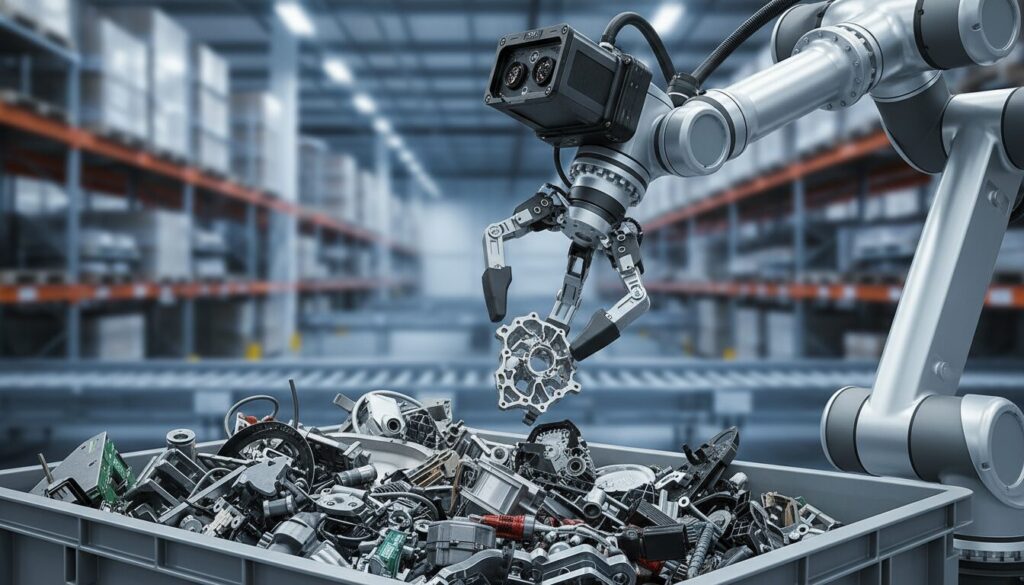
The core differentiator is the shift from “global” vision to “local” vision. Traditional systems rely on fixed cameras that require complex calibration to map the entire workspace. Inbolt’s solution mounts the 3D camera directly on the robot arm, utilizing proprietary AI to perform real-time “in-hand localization.”
Executive Summary of Key Metrics
| Metric | Specification | Operational Benefit |
|---|---|---|
| Processing Speed | < 1 second (average) | Maintains high throughput rates comparable to human picking. |
| Success Rate | 95% | drastic reduction in error handling and manual intervention. |
| Architecture | On-Arm 3D Camera | Eliminates “blind spots” and reduces calibration downtime. |
| Deployment | 5+ Factories Operational | Proven viability in live industrial environments, not just R&D. |
| Infrastructure | No Fixed Cameras | Lower CapEx; no need for rigid gantries or complex external lighting. |
The “5W1H” of the Trend
- Who: Inbolt, a pioneer in real-time robot guidance software.
- What: A hardware-agnostic, AI-driven bin picking solution that mimics human visual adaptability.
- When: The system is currently deployed and scaling, signaling immediate market readiness.
- Where: Unstructured industrial environments, specifically manufacturing lines and logistics fulfillment centers.
- Why: To solve the high cost and complexity of traditional random bin picking, which often prevents ROI in SME (Small and Medium Enterprise) environments.
- How: By utilizing massive datasets to train AI models that can recognize parts regardless of orientation, occlusion, or lighting changes, processed locally on the arm.
Industry Impact: The Ripple Effect on Supply Chains
The introduction of robust, on-arm AI vision extends far beyond the factory floor. It fundamentally changes how facilities are designed, how inventory is managed, and how logistics networks handle variability.
Impact on Warehousing and Fulfillment Operations
The most immediate impact will be felt in the picking aisles. E-commerce has driven an explosion in SKU counts, making it impossible to create dedicated fixtures for every product.
-
Elimination of Jigs and Fixtures: Traditionally, parts had to be fed to robots in precise trays (blister packs) or vibrating bowls. Inbolt’s tech allows parts to be dumped into generic bins. This eliminates the cost of custom packaging and fixtures.
-
Dynamic Space Utilization: Because the vision system is attached to the robot, the robot becomes a self-contained unit. Managers can move a robotic cell from one dock to another without spending days recalibrating external cameras.
Impact on Manufacturing Supply Chains
For shippers and manufacturers, particularly in automotive and electronics, “line-side” efficiency is critical.
-
Just-in-Time (JIT) Resilience: Supply chain disruptions often mean parts arrive from different suppliers with different packaging. A “human-like” picker can adapt to a new supplier’s slightly different part arrangement instantly, whereas legacy systems might require reprogramming.
-
Reduction in Changeover Time: In high-mix manufacturing, downtime during product changeovers kills margins. On-arm AI significantly reduces the setup time required when switching from Product A to Product B, as the system re-indexes the new environment in real-time.
Impact on Logistics Hardware Investment
The financial model of automation is shifting.
- Lower Barrier to Entry: By removing the need for complex peripheral vision infrastructure, the total cost of ownership (TCO) for a robotic cell drops. This puts advanced automation within reach of mid-sized 3PLs who previously found the ROI period too long.
LogiShift View: The Shift from Automation to Autonomy
While the specifications of Inbolt’s release are impressive, the strategic implication is what demands executive attention. We are witnessing a fundamental shift in the philosophy of industrial robotics: the transition from Automated execution to Autonomous adaptation.
The “Cognitive Hand” Theory
In the past, robots were blind machines following strict coordinates. If the world changed by a millimeter, the robot failed. Inbolt’s approach represents the “Cognitive Hand.” The robot is no longer just executing a path; it is perceiving and reacting.
This distinction is crucial because the supply chain of the future is unstructured. As logistics moves toward the “Segment of One” (ultra-personalization), the environment will never be perfectly standardized.
- Prediction: We predict that within 3-5 years, “blind” robots will become obsolete for any task other than simple palletizing. On-arm vision will become the industry standard spec, much like backup cameras became standard in automobiles.
The Death of Calibration
One of the hidden costs of robotics is calibration drift. Thermal expansion, vibration from forklifts, or accidental bumps can misalign fixed cameras, leading to downtime.
- Insight: By placing the eye on the hand, Inbolt creates a closed feedback loop. The robot constantly verifies its position relative to the object. This “self-healing” accuracy removes a massive maintenance headache for operations managers. It transforms the robot from a delicate instrument into a rugged worker.
Data at the Edge
This technology also signifies the rise of Edge AI in logistics. Processing is happening locally, <1 second per pick. This reduces reliance on cloud bandwidth and latency issues. For a warehouse running 24/7, network independence is a security and reliability asset.
Takeaway: Strategic Next Steps for Leaders
Inbolt’s launch is a signal that the technology gap for unstructured picking has closed. The excuse that “robots aren’t flexible enough” is no longer valid. Logistics executives must now look at their operations through the lens of this new capability.
1. Audit Your “Unstructured” Bottlenecks
Identify areas in your operation where humans are used solely because parts are randomized (e.g., machine tending, kit assembly, order consolidation). These are now prime candidates for automation with on-arm AI.
2. Re-evaluate Brownfield Opportunities
You do not need to build a new warehouse to automate. Because this technology requires less external infrastructure (fixed gantries/lighting), it is highly deployable in existing “brownfield” facilities with limited space.
3. Pilot for Adaptability, Not Just Speed
When testing this technology, do not just measure picks per hour. Measure changeover time. How fast can the system switch from picking bolts to picking brackets? That flexibility is where the long-term ROI lies.
4. Update Your Vendor Requirements
If you are issuing RFPs for automation, mandate “dynamic bin picking” capabilities. Ask vendors how their solution handles unstructured inputs without expensive mechanical singulators.
The Bottom Line: Inbolt has brought the robot one step closer to the human operator’s greatest asset: the ability to see a mess and make sense of it instantly. For the logistics industry, this means the friction of unstructured data—and unstructured matter—is finally beginning to dissolve.