
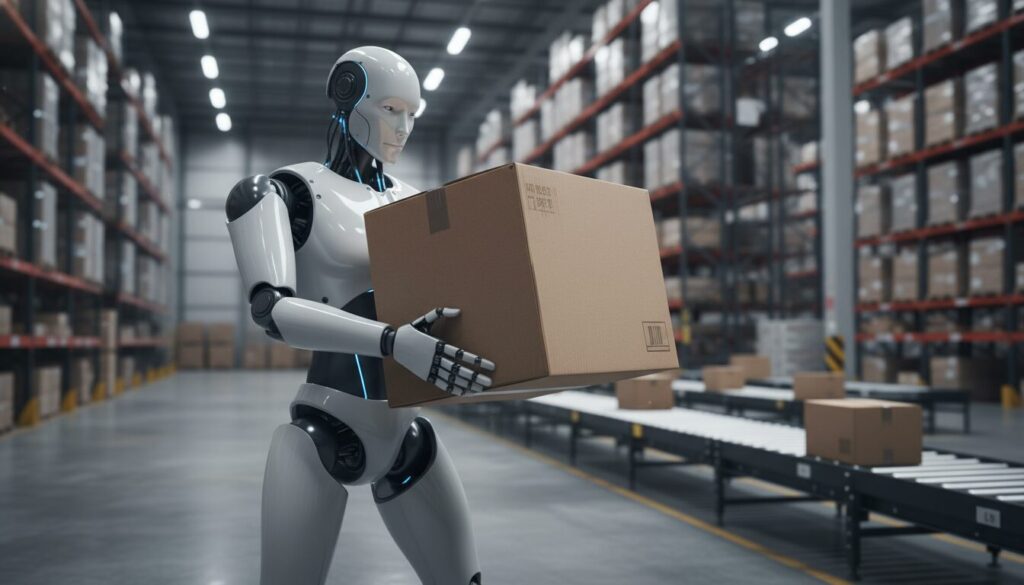
The global supply chain is facing a paradox. On one hand, demand for speed and resilience has never been higher; on the other, the labor force required to sustain this momentum is shrinking at an alarming rate. While Automated Guided Vehicles (AGVs) and robotic arms have automated structured tasks, the chaotic, unstructured environments of shipping docks and last-mile fulfillment centers remain stubbornly human-dependent.
Enter the era of Embodied AI—humanoid robots designed to think and move like workers. However, a critical bottleneck threatens to stall this revolution: the lack of high-quality training data.
In a move set to reshape the landscape of industrial automation, Noitom Robotics has secured hundreds of millions of RMB in Pre-Series A funding. Their mission? To build global “Data Factories” that generate the high-precision motion data required to teach humanoids how to work. For logistics leaders, this signals a shift from hardware-centric automation to a data-first strategy in the race for the warehouse of the future.
Why It Matters: The “Moravec’s Paradox” in Warehousing
For decades, logistics automation followed a rigid script: if you could bolt it down or put it on rails, you could automate it. However, the industry is now hitting the “unstructured barrier.”
The Unstructured Challenge
Humans excel at tasks that are computationally nightmare-inducing for robots. Picking a crushed box off a pallet, navigating a cluttered loading dock, or handling items of varying fragility require a level of dexterity and adaptive intelligence that traditional code cannot provide. This is known as Moravec’s Paradox: high-level reasoning requires very little computation, but low-level sensorimotor skills require enormous computational resources.
To solve this, the industry is turning to General Purpose Robots (GPRs) powered by Embodied AI. Unlike traditional robots programmed with explicit coordinates, these machines learn via neural networks. They need to “watch” and “feel” a task thousands of times to master it.
The Data Deficit
This creates a massive new supply chain problem: the supply of data.
- Simulation isn’t enough: While digital twins (Sim-to-Real) are powerful, they struggle to accurately model complex contact physics—like the friction of a cardboard box or the deformation of a plastic bag.
- Real-world data is scarce: Teleoperating robots to collect data is slow and expensive.
Noitom Robotics is addressing this specific gap. By industrializing the collection of human motion data, they are essentially building the “textbooks” from which the next generation of warehouse robots will learn.
Global Trend: The Arms Race for Embodied AI
To understand the significance of Noitom’s “Data Factories,” one must look at the intense global competition to deploy humanoids in logistics facilities. The race is currently tri-polar, dominated by the US, China, and emerging players in Europe.
United States: Big Tech Integration
In the US, the strategy is defined by deep integration with massive logistics networks.
- Agility Robotics & Amazon: Amazon is testing “Digit” humanoids for tote recycling. The focus is on safety and coexistence with human workers.
- Figure AI & BMW/OpenAI: Figure has partnered with BMW for manufacturing logistics and OpenAI for intelligence, aiming for end-to-end cognitive processing.
- Tesla Optimus: Leveraging Tesla’s massive manufacturing footprint to train robots in their own factories (“eating their own dog food”).
China: Speed and Manufacturing Scale
China is leveraging its hardware supply chain dominance to drive down costs rapidly.
- Unitree & Fourier Intelligence: These companies are rapidly iterating on hardware, producing highly agile robots at a fraction of the cost of US competitors.
- The “Brain” Bottleneck: While Chinese hardware is top-tier, the software “brains” require massive datasets to catch up with the generalized intelligence models seen in the West. This is where Noitom’s intervention is critical for the Asian market.
Europe: Precision and Collaborative Robotics
European contenders like Sanctuary AI (though Canadian-based, heavily tied to European industrial partners) focus on high-precision manipulation for complex assembly and sorting tasks, prioritizing task success rates over pure speed.
Comparative Landscape of Humanoid Logistics
The following table illustrates the strategic divergence in the global market:
| Feature | US Approach (e.g., Figure, Agility) | China Approach (e.g., Fourier, Unitree) | Noitom’s “Data Factory” Solution |
|---|---|---|---|
| Primary Focus | General Intelligence & Integration | Cost Reduction & Hardware Scale | High-Fidelity Training Data |
| Data Strategy | Proprietary, closed-loop (Sim + Teleop) | Rapid iteration, seeking data sources | Data-as-a-Service (DaaS) for all |
| Logistics Application | End-to-end fulfillment, trailer unloading | Patrol, simple transport, picking | Enabling complex manipulation |
| Key Barrier | High cost per unit | Software/AI generalization | N/A (Enabler for above) |
Case Study: Noitom Robotics and the “Data Factory”
Noitom Robotics is not a typical robotics startup. It is a spin-off from Noitom Technology, a company that commands approximately 70% of the global market share in motion capture technology. This pedigree provides an unfair advantage: they already possess the precise tools needed to digitize human movement.
The “Data Factory” Concept
With the newly raised hundreds of millions of RMB (tens of millions of USD), Noitom is constructing physical facilities dedicated to data generation. These are not warehouses for storing goods, but warehouses for capturing motion.
1. Industrial-Grade Motion Capture
Unlike standard optical mocap used in Hollywood (which requires line-of-sight and studio conditions), Noitom utilizes advanced inertial and hybrid sensor systems. This allows them to capture workers performing actual logistics tasks—lifting heavy crates, sorting mail, operating pallet jacks—in realistic, occluded environments without losing data fidelity.
2. Multi-Modal Data Fusion
The Data Factories do not just capture skeletal movement. They record:
- Kinematic Data: Joint angles and velocities.
- Tactile Data: Forces exerted during gripping (critical for not crushing packages).
- Visual Data: What the human (and future robot) “sees” during the task.
3. Solving the “Cold Start” Problem
For a humanoid robot, the first 10 hours of training are the hardest. Noitom provides a library of “foundational movements.” Instead of teaching a robot to walk or grasp from scratch (which takes millions of simulation cycles), developers can license Noitom’s data to give the robot a baseline competency instantly.
Market Traction
Noitom is already collaborating with dozens of global humanoid and embodied AI companies. By positioning themselves as the “arms merchant” of data in the robot war, they are capitalizing on the industry’s growth regardless of which specific hardware manufacturer wins the race.
Real-World Application Scenario:
Consider a 3PL (Third Party Logistics) provider needing to automate a decanting line (removing items from boxes).
- Without Noitom: The 3PL must buy a robot, hire AI engineers, and spend months teleoperating the robot to “teach” it to recognize different box types.
- With Noitom: The 3PL (or the robot vendor) downloads a “Decanting Data Pack” from Noitom. The robot enters the facility pre-trained on 10,000 hours of human decanting motion. Deployment time drops from months to weeks.
Key Takeaways for Logistics Leaders
For strategy executives in the logistics sector, the rise of Data Factories implies a shift in procurement and operational strategy.
1. Data is the New Infrastructure
Stop viewing automation solely as a hardware purchase (CapEx). The performance of your future robotic fleet will depend on the data pipeline that feeds it. Companies should begin auditing their own operations to see if their internal workflows can be digitized into training data.
2. The Rise of “Motion-as-a-Service” (MaaS)
We are moving toward a model where specific robotic skills can be subscribed to. Just as you download an app, you may soon download a “Trailer Unloading v2.0” skill pack for your humanoid fleet, powered by data aggregators like Noitom.
3. Supply Chain Resilience via Generalization
Traditional automation is brittle; if the box size changes, the machine jams. Embodied AI trained on Noitom’s diverse human data is resilient. It adapts. Investing in this technology is an investment in supply chain continuity against unforeseen disruptions.
Future Outlook: The path to Autonomy
The funding of Noitom Robotics marks a turning point where the industry acknowledges that hardware is no longer the primary bottleneck—data is.
Short Term (1-3 Years):
We will see a surge in “human-in-the-loop” deployments. Data Factories will churn out base models, but human remote operators will still handle edge cases in warehouses, simultaneously generating more training data.
Mid Term (3-5 Years):
As the volume of high-quality motion data reaches critical mass, we will witness the “ChatGPT moment” for robotics. Robots will begin to generalize, understanding how to handle a package they have never seen before based on the physics principles learned from millions of other interactions.
Long Term (5+ Years):
The “Data Factory” model will evolve into a real-time feedback loop. Every robot deployed in a global supply chain will feed data back into the central model, creating a collective intelligence. Noitom’s role may shift from a data generator to a data governor, managing the quality and safety standards of industrial motion.
Conclusion:
In the rush to deploy humanoid workers, the hardware grabs the headlines, but the data confers the competence. Noitom Robotics’ strategy to industrialize the creation of this data is a vital infrastructure play. For global logistics networks, the message is clear: the future workforce is digital, and it is being trained right now in a Data Factory.