
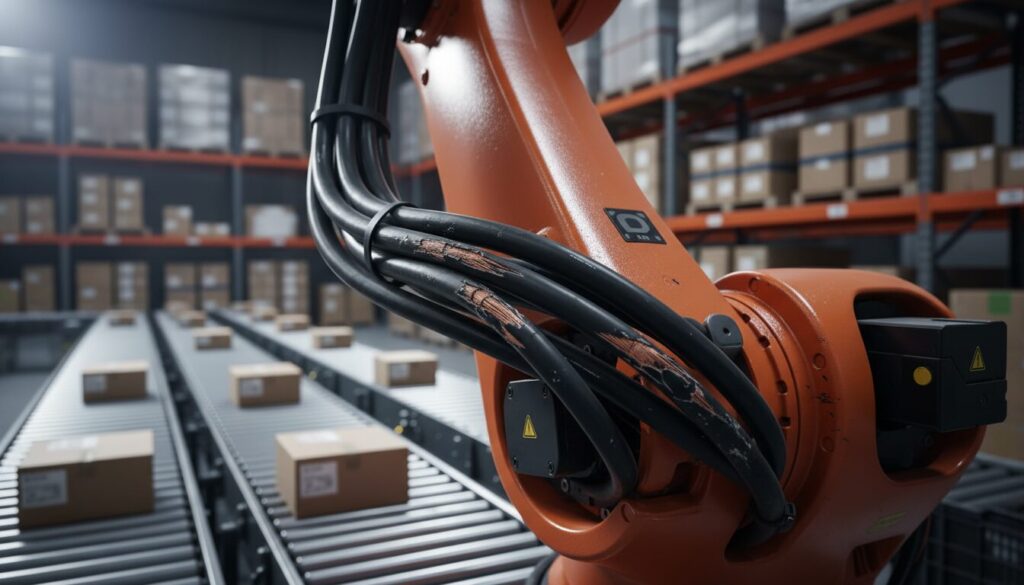
In the rapidly automating world of logistics, the weakest link in your high-tech warehouse is often the lowest-tech component: the cable.
The Hidden Cost of the “Spaghetti” Problem
Imagine this scenario: It is Black Friday week. Your automated palletizing arm is moving at full speed. Suddenly, the system throws a critical error and freezes. It’s not a software bug. It’s not a cyberattack. A single $20 data cable inside the robotic elbow has snapped due to repetitive stress.
For warehouse managers, this is a nightmare. The downtime costs thousands of dollars per minute in delayed fulfillment.
Why Do Cables Fail in Logistics Robots?
The logistics environment is uniquely hostile to cabling for three reasons:
- High-Cycle Repetition: Picking arms and palletizers perform millions of identical flexes. Standard cables are designed for static installation, not dynamic motion.
- Complex Motion Profiles: Modern robots, especially 6-axis arms and humanoid joints, do not just bend; they twist (torsion). Torsion is the number one killer of standard copper cabling.
- Space Constraints: AGVs (Automated Guided Vehicles) and AMR (Autonomous Mobile Robots) are compact. Cables are often forced into tight bend radii that exceed their physical limits, leading to internal strand breakage and “corkscrewing.”
If you are asking, “What’s the best way to reduce cable failures in moving robots (Arms, AGVs, and Humanoid Joints)?” the answer requires shifting from a reactive “replace it when it breaks” mentality to a proactive Dynamic Cable Management Strategy.
Solution: The Dynamic Cable Management Strategy
The “best way” isn’t a single product; it is a methodology combining High-Flex Engineering with Predictive Protection.
To achieve zero errors and maximum uptime, we must treat cabling not as an accessory, but as a machine component—a “lifeline” that requires specific engineering for motion.
Core Components of the Solution
To solve failures across Arms, AGVs, and Humanoid joints, we implement three pillars:
- High-Continuous-Flex Cables: Unlike standard cables, these use specialized stranding techniques (short pitch length) and abrasion-resistant jackets (like TPE or PUR) to survive millions of cycles.
- Energy Chains (Cable Carriers): These are protective plastic or steel “vertebrae” that guide cables, ensuring they never bend below their minimum radius.
- Slip Rings & Wireless Transfer: For continuous rotation (like AGV turrets or humanoid waists), physical cables are replaced with rotary joints or inductive power transfer to eliminate mechanical stress entirely.
Comparison: Static vs. Dynamic Cabling
| Feature | Standard “Static” Cable | High-Flex “Dynamic” Cable |
|---|---|---|
| Stranding | Long pitch, bunched strands | Short pitch, bundled around a tensile core |
| Jacket Material | PVC (stiff, cracks easily) | PUR/TPE (flexible, oil/abrasion resistant) |
| Motion Type | Fixed installation only | Rolling flex, torsion, and high acceleration |
| Life Expectancy | $Minimum Radius (R) = Factor \times Cable Diameter (d)$ |
- Standard Data Cable: $R \approx 10 \times d$ (e.g., 8mm cable needs 80mm radius).
- High-End Flex Cable: $R \approx 4-5 \times d$ (Allows for much tighter spaces).
Action: Measure the available space in your AGV or Robot Arm. If the space is too tight for the cable’s spec, you must upgrade to a high-flex alloy cable designed for tight radii.
Step 3: Implement Proper Strain Relief
A cable that is loose at the connection point will pull on the connector pins until they break or arc.
Action: Install strain relief clamps at both ends of the moving energy chain.
- The Clamp Rule: The cable must be clamped firmly enough so it doesn’t slip, but not so tight that it crushes the insulation.
- Position: Strain relief should be placed immediately before the cable enters the flexible chain and immediately after it exits. This isolates the movement to the chain, protecting the sensitive connectors.
Step 4: Separation and Weight Distribution
“Spaghetti cabling” leads to friction. When power cables (heavy) and data cables (light) are thrown together loosely, the heavy cables crush the data cables during movement.
Action: Use interior separators within the cable carrier/chain.
- Vertical Separation: Use shelves to separate layers.
- Horizontal Separation: Use dividers to keep power and data apart (this also helps reduce electromagnetic interference).
- Space Fill: Ensure cables occupy only 80-85% of the carrier’s internal space. They need room to “breathe” as they flex.
Step 5: Integration of Smart Monitoring (DX)
To truly modernize, move from preventative to predictive maintenance.
Action: Install “Smart Plastics” or breakage detection sensors.
- Tension Sensors: These measure the push/pull force on the cable chain. If an AGV runs over debris and jams the chain, the sensor stops the machine before the cable snaps.
- Abrasion Monitoring: Specialized wires run along the cable jacket. If the jacket wears thin, a signal is sent to the WMS (Warehouse Management System) flagging the robot for maintenance during the next off-shift.
Results: The Impact of Optimized Cabling
By answering “What’s the best way to reduce cable failures in moving robots?” with this engineered approach, warehouse managers can expect drastic improvements in operational metrics.
Before and After Comparison
The following table illustrates the operational shift after upgrading a fleet of 20 Picking AGVs and 5 Palletizing Arms.
| Metric | Before (Reactive Approach) | After (Dynamic Strategy) |
|---|---|---|
| Mean Time Between Failures (MTBF) | 3 – 6 Months | 24 – 36 Months |
| Unplanned Downtime | 12 hours/month | < 1 hour/month |
| Cable Replacement Cost | High (Frequent cheap replacements) | Low (Infrequent investment quality) |
| Connector Damage | Frequent due to tension | Zero (due to strain relief) |
| Maintenance Strategy | “Fix it when it smokes” | “Replace during scheduled PM” |
Case Study: The Humanoid Joint Challenge
A logistics center piloting humanoid robots faced constant failures in the knee joints. The cables were snapping every 2 weeks due to the extreme walking motion.
The Fix:
- Replaced standard PVC cables with TPE-jacketed torsion-rated cables.
- Installed a micro-energy chain to guide the cable behind the knee cap.
- Result: The robots have now surpassed 2 million walking cycles with zero cable failures.
Summary: Keys to Success
Reducing cable failures in robotics is not about finding a “stronger” cable; it is about finding the right cable management system for the motion profile.
As a Warehouse Manager driving Digital Transformation (DX), remember these three takeaways:
- Respect the Radius: Never force a cable to bend tighter than its specification. This is the #1 cause of silent data loss.
- Guide, Don’t Hide: Use proper energy chains and separators. A neat robot is a reliable robot.
- Invest in “High-Flex”: The upfront cost of a robot-grade cable is 20% higher, but the cost of downtime is 1000% higher.
By implementing these steps, you transform your automated workforce from a maintenance liability into a reliable asset, ensuring your goods keep moving even during peak demand.