
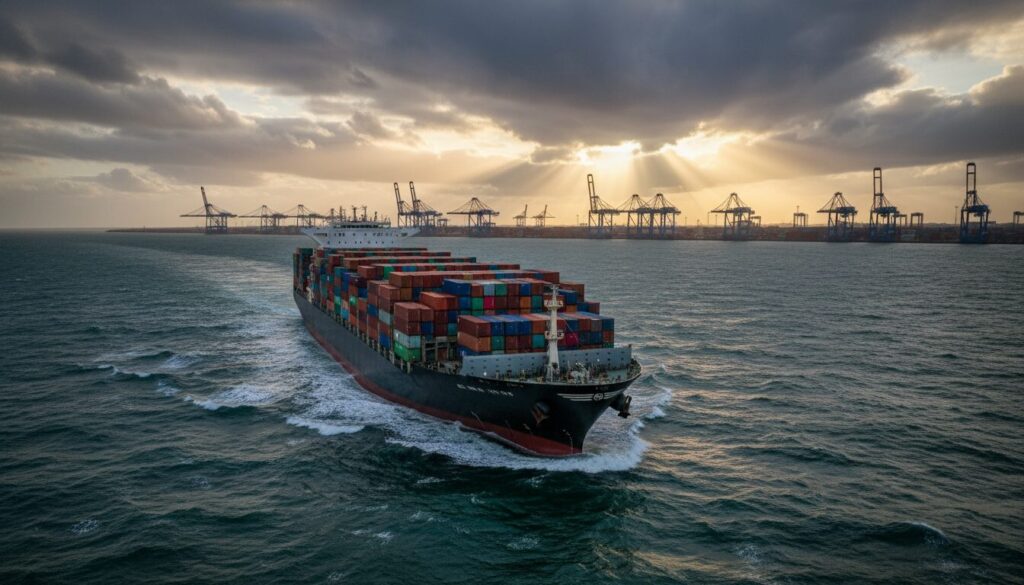
The narrative of global logistics in 2025 has shifted dramatically from the supply chain paralysis of the early 2020s. We have entered an era defined not by scarcity, but by “Failed Control.”
For Strategy Executives and Innovation Leaders, the current market presents a paradox. Ocean carriers are deploying massive amounts of new capacity, which logically should drive rates into the ground. Yet, freight rates remain stubbornly volatile, characterized by sudden, policy-driven “spikes” followed by rapid “slumps,” resulting in uneasy “standoffs” between shippers and carriers during contract negotiations.
The defining theme of Q1 2025 was “discipline theatre”—a performance where carriers attempted to manage capacity to prop up rates, only to see market forces and competitive undercutting erode their pricing power. This article explores how global leaders are navigating this volatile landscape.
Why It Matters: The End of Long-Term Predictability
For the past decade, supply chain strategy oscillated between “Just-in-Time” efficiency and “Just-in-Case” resilience. In 2025, neither model is fully sufficient. The market is witnessing a structural decoupling of rate direction from fundamental demand.
The implications for the C-Suite are profound. In previous cycles, a drop in consumer demand reliably led to cheaper shipping. Today, despite sluggish global GDP growth, geopolitical shocks (such as lingering Red Sea diversions and renewed tariff complexities in the US) allow carriers to implement short-term General Rate Increases (GRIs).
However, because the order book for new vessels has hit historic highs—with huge deliveries from MSC, CMA CGM, and COSCO—carriers cannot maintain these high rates. They lose control, prices slump, and the cycle repeats.
The Strategic Impact on Procurement
- Budgetary Variance: Logistics budgets can no longer be fixed with high certainty. CFOs must accept a wider variance in landed costs.
- Contract Strategy: The traditional annual fixed contract is losing its protective allure. Shippers locking in rates in January often find themselves paying above spot market rates by April due to the “slump” phase of the cycle.
- Inventory Positioning: Volatility means lead times are unpredictable, not because of congestion, but because of “blank sailings” (cancelled voyages) used by carriers to artificially manipulate supply.
Global Trend: The Anatomy of “Failed Control”
The 2025 logistics landscape is a story of three regions, each dealing with the “Spikes, Slumps, and Standoffs” dynamic differently.
North America: Policy Shocks and Labor Hangovers
In the United States, the logistics market is heavily influenced by non-market forces. The lingering effects of the ILA (International Longshoremen’s Association) labor negotiations on the East Coast created a “spike” in early 2025 as shippers front-loaded cargo to the West Coast.
However, once the immediate threat subsided, a massive “slump” occurred. The oversupply of Transpacific capacity, driven by carriers like ONE and HMM deploying larger vessels, caused spot rates to collapse below break-even points for carriers.
Europe: The Red Sea “Floor” and Green Costs
Europe remains the most complex theater. The Red Sea crisis effectively absorbed a significant portion of the new vessel capacity entering the market.
- The Floor: The diversion around the Cape of Good Hope acts as a floor for rates, preventing a total market collapse.
- The ETS Factor: The EU Emissions Trading System (ETS) has added a surcharge layer that complicates “all-in” rate calculations.
- The Standoff: European shippers are resisting long-term contracts, preferring quarterly deals, betting that the “slump” caused by overcapacity will eventually outweigh the “spike” caused by longer transit times.
Asia: The Capacity Tsunami
China and Southeast Asia are the epicenter of the “failed control” phenomenon. Shipyards in China and South Korea delivered record tonnage in late 2024 and early 2025.
Carriers hoped to deploy this capacity into a growing market. Instead, they are fighting for market share. This has led to aggressive spot market pricing out of Shanghai and Ningbo, forcing carriers into a standoff where they refuse to lower contract rates while simultaneously undercutting themselves on the spot market.
Comparison of Logistics Cycles
The following table illustrates the shift in market dynamics facing executives today compared to the pandemic era.
| Feature | 2021-2022 (Pandemic Era) | 2025 (The Era of Failed Control) |
|---|---|---|
| Primary Driver | Severe Capacity Shortage | Structural Overcapacity |
| Rate Trajectory | Consistently High / Rising | Volatile Spikes & Rapid Slumps |
| Carrier Power | Absolute Dictation | Temporary Bursts, Long-term Weakness |
| Shipper Strategy | “Get space at any cost” | “Agile arbitrage between spot & contract” |
| Reliability Risk | Port Congestion | Blank Sailings (Artificial reduction) |
| Key Variable | Consumer Demand | Geopolitical & Policy Shocks |
Case Study: IKEA’s Agile Response to Market Volatility
To understand how to thrive in the “Spikes, slumps, and standoffs” environment of 2025, we look to IKEA, the global furniture retailer. IKEA has historically been a pioneer in logistics, even going so far as to buy its own containers and charter ships during the 2021 crisis.
In 2025, IKEA faced the same “standoff” as other major BCOs (Beneficial Cargo Owners). Carriers demanded higher contract rates to offset their investment in green methanol vessels and new alliances (such as the Gemini Cooperation between Maersk and Hapag-Lloyd).
The Challenge
IKEA needed to lower prices for consumers to stimulate demand in a high-inflation environment. However, carriers were attempting to institute a “Spike” via GRIs in Q1 2025, citing Red Sea disruptions.
The Strategy: Decoupling and Diversification
IKEA deployed a three-pronged strategy to exploit the “Failed Control” of carriers:
-
Spot-Contract Hybrids:
Instead of locking 100% of volume into fixed annual contracts, IKEA reportedly shifted a significant percentage (estimated 30-40%) to index-linked or short-term spot mechanisms. This allowed them to capitalize on the “Slumps” when carriers lost pricing discipline and undercut each other. -
Regional Near-Shoring (Turkey & Poland):
To bypass the “Spikes” of the Asia-Europe trade lane (affected by the Red Sea), IKEA accelerated production in existing clusters in Turkey and Poland. By shortening the supply chain, they reduced exposure to deep-sea freight rate volatility for their European market. -
Low-Emission Prioritization:
IKEA leveraged the overcapacity to demand better service. With too many ships on the water, IKEA prioritized carriers offering green corridors (biofuel/methanol options). Because carriers were desperate to fill their new, expensive green vessels, IKEA secured favorable terms on sustainable shipping that would have commanded a premium in a tight market.
The Result
By refusing to accept the “Spike” narrative as a long-term reality, IKEA successfully managed its landed costs. While competitors panicked during the Q1 rate flutter, IKEA utilized the subsequent “Slump” to average down their logistics spend, contributing to their announced global price reductions in 2025.
Key Takeaways for Logistics Leaders
The era of “Failed Control” requires a fundamental shift in how organizations approach freight procurement and supply chain design.
1. Adopt “Portfolio Procurement”
Stop treating freight as a monolithic annual negotiation. Build a portfolio:
- Core Volume (50-60%): Fixed annual contracts for security.
- Floating Volume (20-30%): Index-linked contracts that adjust with the market.
- Opportunistic Volume (10-20%): Spot market bookings to capture “slumps.”
2. Monitor “Discipline Theatre”
Carriers will announce massive rate hikes (GRIs). Do not panic. In 2025, these are often theatrical moves to test the market. Data shows that in an oversupplied market, these hikes rarely stick for more than 4-6 weeks. Use data aggregators (like Xeneta or Drewry) to see the real transacted price, not the announced price.
3. Resilience over Loyalty
The alliance landscape has fractured (breakup of 2M, formation of Gemini). Operational disruptions are inevitable as carriers reshuffle networks. Loyalty to a single carrier is dangerous in 2025. Diversify across different alliances to ensure that if one alliance blanks sailings to create a “spike,” you have options with another.
Future Outlook
Looking beyond 2025, the “Spikes, slumps, and standoffs” dynamic is likely to persist until at least 2027.
The order book for new container ships remains deep, meaning overcapacity is structural, not temporary. Carriers will continue to lose long-term pricing power. Their only weapon remaining is volatility—creating artificial scarcity through blank sailings and slow steaming to trigger short-term revenue bursts.
For the savvy Innovation Leader, this is good news. It signifies a buyer’s market, provided you have the agility to navigate the waves. The days of carriers dictating the survival of your supply chain are over; the days of algorithmic procurement and strategic hedging have begun.
The verdict for 2025: Do not fear the spike. Wait for the slump. Win the standoff.