
The global logistics landscape is currently navigating a paradoxical crisis. On one hand, the demand for speed and precision has never been higher; on the other, the labor force required to execute these demands is shrinking rapidly across developed economies. For years, the barrier to solving this through automation has been the “CAPEX Wall”—the massive upfront capital expenditure required to modernize warehousing.
However, a significant shift is underway. The recently announced capital and business alliance between Mitsubishi HC Capital and Cuebus represents a pivotal moment in logistics strategy. By launching a subscription service for “CUEBUS,” the world’s first linear motor-driven 3D robotic warehouse, these partners are not just introducing new hardware; they are re-engineering the financial architecture of supply chain automation.
For innovation leaders in the US, Europe, and Asia, this alliance signals the maturity of Robotics-as-a-Service (RaaS). It demonstrates how financial heavyweights are stepping in to lower the entry barriers for cutting-edge technology, shifting the paradigm from asset ownership to operational flexibility.
Why It Matters: The Financial Friction of Automation
To understand the magnitude of the Mitsubishi HC Capital and Cuebus alliance, one must look at the macro-economic headwinds facing the global supply chain.
The CAPEX vs. Agility Dilemma
Traditionally, installing an Automated Storage and Retrieval System (AS/RS) was a 10-to-15-year commitment. Companies had to predict their volume needs a decade in advance, secure millions in financing, and construct rigid infrastructure that could not easily be moved or modified.
In today’s volatile market—defined by fluctuating e-commerce demand and geopolitical supply shocks—such rigidity is a liability.
- Investment Risk: If volumes drop, the expensive hardware sits idle.
- Obsolescence: Technology evolves faster than the depreciation schedule of heavy machinery.
- Rising Hardware Costs: As discussed in our analysis of Toyota L&F Price Hikes: The Automation Tipping Point, the era of cheap industrial hardware is ending. Rising material and labor costs are pushing up the price of forklifts and traditional automation, making the initial buy-in even harder for SMEs.
The Labor Vacuum
The labor shortage is no longer a prediction; it is a structural reality.
In Japan, the “2024 Problem” limits driver hours, increasing pressure on warehouse efficiency. In the US and Europe, warehouse turnover rates frequently exceed 40%, making the retention of skilled labor nearly impossible. Automation is the only viable exit strategy, but the financial barrier prevents widespread adoption.
Global Trend: The Rise of Modular RaaS
The move by Mitsubishi HC Capital aligns with a broader global trend where logistics is moving away from “monolithic” systems toward “modular” and “service-based” models.
From Silos to Grids
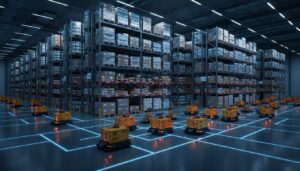
We are witnessing a technological migration from aisle-based cranes (traditional AS/RS) to grid-based robotic systems. Leaders like AutoStore (Norway) and Exotec (France) popularized the idea of high-density storage where robots traverse a grid.
- US Market: Amazon and Ocado have set the standard for proprietary, high-speed grids, but these remain largely inaccessible to third-party logistics (3PLs) providers due to cost.
- European Market: Brownfield automation is key. Companies are trying to fit robots into centuries-old buildings or constrained urban spaces.
- Asian Market: High-density vertical storage is critical due to expensive real estate.
The “Aisle-less” Revolution
The ultimate goal of modern warehousing is Zero Space Waste. Traditional warehouses waste up to 60% of their floor space on aisles for forklifts and humans.
As highlighted in our report on Boozt & Cognibotics, the industry is aggressively pursuing technologies that eliminate aisles entirely to maximize picking density. The Mitsubishi-Cuebus alliance targets this exact niche but adds a crucial financial layer: the subscription model.
Case Study: Mitsubishi HC Capital & Cuebus
This alliance is a textbook example of how financial engineering can accelerate technological adoption. Mitsubishi HC Capital is not merely funding Cuebus; they are entering a Capital and Business Alliance to co-create a new market standard.
The Technology: What is CUEBUS?
CUEBUS distinguishes itself from competitors like AutoStore or traditional shuttles through its propulsion mechanism and architecture.
- Linear Motor Drive: unlike systems that use belts, chains, or tire-based traction, CUEBUS uses linear motors. This implies fewer moving parts, lower maintenance (no dust from tire friction), and potentially higher speeds.
- Aisle-less 3D Structure: The robots move horizontally and vertically on a stackable grid. It creates a dense cube of inventory, similar to a Rubik’s cube of logistics.
- Modularity: The system is composed of “tiles” or blocks. A warehouse manager can physically resize the warehouse by adding or removing blocks, making it highly adaptable to seasonal peaks.
The Strategic Alliance Structure
The core innovation here is the business model, spearheaded by Mitsubishi HC Capital’s “Robotics Business Development Department.”
- End-to-End Subscription: Instead of selling the robots, the alliance offers the entire system—planning, installation, hardware, and maintenance—as a monthly service.
- Risk Transfer: The financial risk of the hardware sits with Mitsubishi HC Capital, not the logistics operator. This converts a massive CAPEX hurdle into a predictable OPEX line item.
- Asset Lifecycle Management: Because Mitsubishi HC Capital is a leasing giant, they possess the infrastructure to refurbish and redeploy CUEBUS modules returned by one client to another. This circular economy approach lowers costs for everyone involved.
Comparison: Traditional vs. CUEBUS Model
To understand the strategic advantage, we can compare the CUEBUS proposition against traditional automation.
| Feature | Traditional AS/RS | Typical Grid Robots (e.g., AutoStore) | CUEBUS (Subscription Model) |
|---|---|---|---|
| Financial Structure | Heavy CAPEX (Purchase) | CAPEX + Maintenance Fees | 100% OPEX (Subscription) |
| Deployment Time | 12–24 Months | 6–9 Months | Rapid (Modular Assembly) |
| Flexibility | Low (Bolted to floor) | Medium (Grid expansion possible) | High (Reconfigurable Modules) |
| Propulsion | Cranes/Conveyors | Wheels/Belts | Linear Motor (Non-contact) |
| Target User | Large Enterprises | Mid-to-Large Enterprises | SMEs to Large Enterprises |
Addressing the Brownfield Challenge
One of the hidden strengths of the CUEBUS system is its suitability for brownfield sites—existing warehouses that were not designed for robots. Because the system is built from modular blocks, it can be shaped to fit around columns, low ceilings, or irregular floor plans.
See also: Aptiv & Vecna: Redefining Global Warehouse Automation for more on how autonomous solutions are adapting to existing facility constraints.
Key Takeaways
For global strategy executives, the Mitsubishi HC Capital and Cuebus alliance offers several critical lessons.
1. Finance is the New Feature
In the Industry 4.0 era, the “feature” that closes the deal isn’t always speed or payload—it’s the payment term. By shifting to a subscription model, Mitsubishi HC Capital is democratizing access to enterprise-grade automation. Logistics leaders should look for partners who offer financial flexibility alongside technical capability.
2. The Shift from “Permanent” to “Fluid” Infrastructure
The days of building a warehouse for 20 years are over. Supply chains must be fluid. The ability to install a robotic system for a 3-year contract and then return or resize it allows companies to bid on short-term logistics contracts without fear of stranded assets.
3. Linear Motors Enable Next-Gen Durability
Technically, the shift to linear motors is significant. By removing friction-based components (gears, belts, tires), CUEBUS reduces the “mean time between failures” (MTBF). For global operations, this means less downtime and lower maintenance costs—a critical factor when labor for repairs is scarce.
Future Outlook
The partnership between a financial giant and a robotics startup forecasts the future trajectory of the logistics industry.
The “Leasing-First” Mental Model
We expect more financial institutions to follow Mitsubishi HC Capital’s lead. Just as software moved to SaaS (Software as a Service) and aircraft engines moved to “Power by the Hour,” warehouse automation is undeniably moving toward RaaS. By 2030, purchasing robotic fleets outright may become the exception rather than the rule for 3PLs.
Sustainability through Circular Logistics
The modular nature of CUEBUS combined with a leasing model creates a circular economy. When a subscriber cancels, the modules are not scrapped; they are retrieved, inspected, and deployed to the next customer. This aligns with global ESG goals, reducing the carbon footprint associated with manufacturing new steel and electronics for every new warehouse project.
Conclusion
The Mitsubishi HC Capital and Cuebus alliance is more than a local Japanese news item; it is a global template for how logistics automation will scale. By removing the CAPEX barrier and utilizing advanced linear motor technology, they are providing a pragmatic solution to the labor crisis. For supply chain leaders, the message is clear: the future of warehousing is not just automated—it is subscribed, modular, and financially agile.