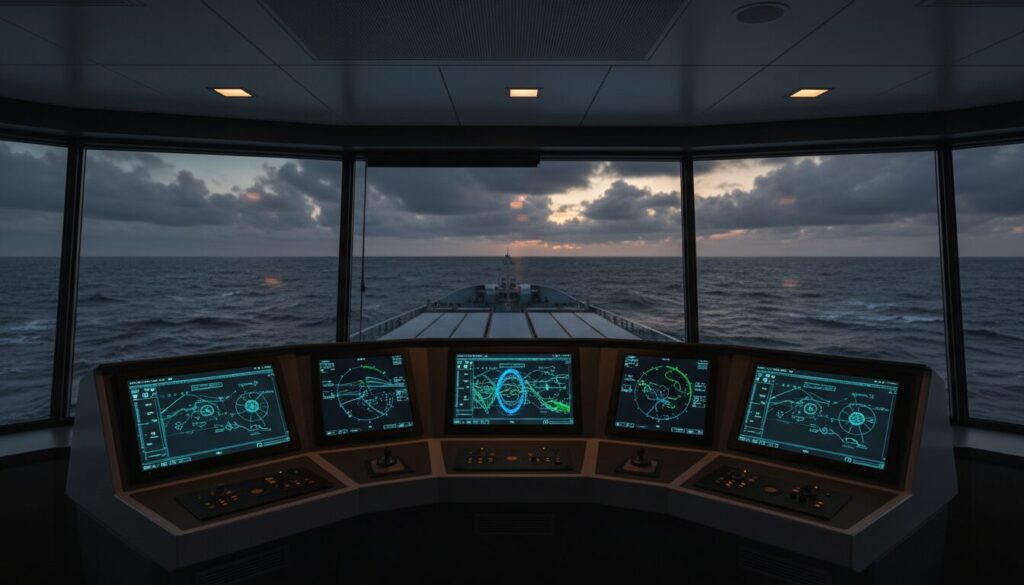
The maritime industry, often characterized by its adherence to tradition and the immense isolation of the open ocean, is currently undergoing a radical digital transformation. While the headlines often focus on the distant future of fully autonomous “ghost ships,” a more immediate and impactful revolution is happening inside the bridge of today’s vessels.
Weathernews Inc. has launched “SeaNavigator for Master,” a service that claims to be the world’s first interactive AI navigation support system. By replacing static, legacy communication methods with an “AI Agent,” this innovation addresses a critical bottleneck in global logistics: the information gap between the shore and the ship.
For innovation leaders and strategy executives, this development signals a pivot from top-down command to edge-empowered decision making. This article explores why this shift matters, how it fits into the global maritime tech landscape, and what logistics leaders can learn from Weathernews’ latest deployment.
Why It Matters: The Ship-to-Shore Disconnect
To understand the magnitude of this innovation, one must first understand the limitations of current maritime operations. For decades, the captain’s decision-making process regarding route selection—vital for safety and fuel efficiency—has been tethered to shore-based operators.
The Legacy Bottleneck
Traditionally, weather routing involves a cumbersome cycle:
- Shore-based operators analyze weather data.
- They generate heavy data files or PDF reports.
- These are emailed to the ship (often via slow, expensive satellite connections).
- The captain reviews the static data and requests changes if conditions shift.
This latency creates a “decision lag.” In an era defined by volatile climate events, a four-hour delay in communication can mean the difference between bypassing a storm or sailing into it.
The Dual Pressure: Safety and Sustainability
Two forces are squeezing global shipping:
- Climate Volatility: As discussed in our previous coverage of supply chain risks, extreme weather events are becoming more frequent.
- Decarbonization (CII & EEXI): The International Maritime Organization (IMO) has implemented strict Carbon Intensity Indicator (CII) ratings. Every extra mile sailed or inefficient engine load due to heavy weather directly impacts a vessel’s commercial viability.
The industry needs tools that provide real-time agility. This is where the transition from “Static Reporting” to “Interactive AI” becomes a game-changer.
Global Trend: The Race for the “Smart Bridge”
Weathernews is not operating in a vacuum. The digitization of the maritime bridge is a fierce battleground involving startups and industrial giants across the US, Europe, and Asia.
The “Great Bifurcation” in Maritime Tech
As analyzed in our outlook for 2025, the logistics technology sector is witnessing a “Great Bifurcation” between Full Autonomy and Human Augmentation.
See also: 2025 AI vs Risk: The Good, Bad, and Ugly
1. The Full Autonomy Camp (US & Nordics)
Companies like Sea Machines Robotics (USA) and Kongsberg (Norway) are heavily investing in autonomous command systems. Their vision is to eventually remove the crew, or at least the bridge watchkeepers, relying on computer vision and sensor fusion to navigate. While revolutionary, regulatory and insurance hurdles make this a long-term play.
2. The Human Augmentation Camp (Global)
This trend focuses on “Super Captains”—using AI to enhance human decision-making rather than replace it.
- Orca AI (Israel/Global): Uses computer vision to act as a digital lookout, providing thermal and visual risk detection to the captain.
- ZeroNorth (Denmark): Focuses on fuel optimization platforms that unify data for shore and ship, though often still reliant on dashboard analytics rather than interactive dialogue.
- Weathernews (Japan): With SeaNavigator for Master, they are pushing the boundary of “Augmentation” by introducing natural language interaction.
Comparison: Approaches to Maritime Navigation
| Feature | Legacy Weather Routing | Dashboard Analytics (ZeroNorth, etc.) | Interactive AI (Weathernews) | Autonomous Systems (Sea Machines) |
|---|---|---|---|---|
| Primary Interface | Email / PDF | Web Dashboard | Chat / Natural Language | Sensor Feeds / API |
| Decision Maker | Shore Operator | Shore & Captain | Captain (AI Assisted) | Algorithm |
| Response Time | Hours (High Latency) | Minutes | Real-Time | Milliseconds |
| Data Usage | Static Snapshots | Visualized Data | Conversational Query | Sensor Fusion |
| Implementation | Standard | High Bandwidth Required | Low Bandwidth Optimized | Hardware Heavy |
Case Study: Weathernews Inc. and the “AI Agent”
Weathernews Inc., a global giant in meteorological data, has leveraged its massive historical dataset to create “SeaNavigator for Master.” This is not merely a software update; it is a restructuring of the command chain.
The Core Innovation: “SeaNavigator for Master”
The service introduces an “AI Agent” that resides on the ship’s navigation system. Instead of waiting for email attachments, the captain interacts with the system via a chat interface, similar to using a sophisticated version of ChatGPT specialized for maritime logistics.
1. Instant Risk Assessment
A captain can type a query: “What are the risks of maintaining current heading for the next 24 hours regarding the developing low-pressure system?”
The AI analyzes the ship’s specific performance model against real-time weather data and responds instantly, flagging potential hull stress or cargo damage risks.
2. Onboard Route Simulation
Previously, requesting a new route simulation required emailing the shore team. Now, the captain can ask the AI: “Simulate a route deviating 50 miles south to avoid the swell.”
The AI runs the simulation using Weathernews’ proprietary logic and returns fuel consumption, ETA, and safety metrics immediately.
The Data Moat
The effectiveness of any AI is determined by its training data. Weathernews claims a significant advantage here:
- 1 Million Voyages: The system is grounded in the historical data of over one million voyages.
- Performance Modeling: It doesn’t just know the weather; it understands how specific vessel types (Tankers vs. Container ships) react to that weather.
Operational Impact
By moving the simulation capability from the shore to the ship (Edge Computing), Weathernews achieves two critical goals:
- Reduced Latency: Decisions are made in the moment, utilizing the captain’s immediate situational awareness combined with global data.
- Bandwidth Efficiency: Chat text is incredibly light compared to heavy graphical files, making it ideal for satellite communications.
This aligns perfectly with the need for resilience in a “permacrisis” environment, where rapid response is the only defense against disruption.
See also: Spectee’s AI Upgrade: Visualizing Supply Chain Risk
Key Takeaways for Logistics Leaders
The launch of SeaNavigator for Master offers strategic lessons applicable beyond just the maritime sector. It highlights how Generative AI and Interactive Agents are reshaping supply chain management.
1. Democratize Data to the Edge
The traditional model of “Centralized Intelligence, Distributed Execution” is failing. Weathernews shows the power of “Distributed Intelligence.”
- Lesson: Give your frontline decision-makers (drivers, warehouse managers, captains) access to the same high-level AI tools that headquarters uses. Don’t make them wait for approval to save fuel or avoid risk.
2. Conversational Interfaces Lower Barriers
Complex dashboards with hundreds of toggles often suffer from low adoption rates. By using a chat interface, Weathernews lowers the cognitive load on captains who are already multitasking.
- Lesson: When deploying supply chain tech, consider Natural Language Processing (NLP) interfaces. “Ask the data” is often more effective than “Analyze the dashboard.”
3. Historical Data is the New Gold
The AI is only as good as the 1 million voyage records backing it.
- Lesson: Your logistics data (past routes, delay reasons, fuel usage) is not just archival “exhaust.” It is the training fuel for your future AI agents. Companies that have not been structuring their data will struggle to deploy these tools.
4. Bridge the Shore-Ship Cultural Gap
Technology often fails due to culture. Shore teams like control; captains value autonomy. This tool bridges the gap by giving the captain autonomy while using data parameters set by the shore/company policy.
- Lesson: Use AI to foster collaboration, not surveillance. The AI Agent acts as a neutral third party providing objective data to both sides.
Future Outlook: The Connected Captain
The introduction of interactive AI on the bridge is just the beginning. We expect three major evolutions in the next 18 to 24 months based on this trend.
1. Integration with Port Ecosystems
Currently, SeaNavigator focuses on the voyage. The next step is integrating Port Call Optimization. Imagine the AI Agent not only avoiding a storm but also calculating that slowing down (to arrive just-in-time for a berth) saves more fuel than rushing to wait at anchor. This requires API connections between the ship’s AI and the port’s Terminal Operating System (TOS).
2. The Rise of “Hybrid Autonomy”
We will see a move away from the binary “Man vs. Machine” debate. The future is “Man + Machine.” Captains will become “System Managers,” overseeing multiple AI agents handling navigation, engine diagnostics, and cargo monitoring.
3. Liability and Insurance
As AI agents like Weathernews’ begin suggesting routes, a new legal question arises: If an AI suggests a route that leads to damage, who is liable? The industry will need to define the legal framework for AI-assisted navigation, likely retaining the “Master’s Discretion” as the ultimate legal authority for the foreseeable future.
Conclusion
Weathernews Inc. has set a new benchmark with SeaNavigator for Master. By successfully applying interactive AI to the complex, high-stakes world of maritime navigation, they have proven that the future of logistics isn’t just about faster ships, but about smarter conversations. For global logistics leaders, the message is clear: empower the edge, or risk being left in the wake of those who do.