
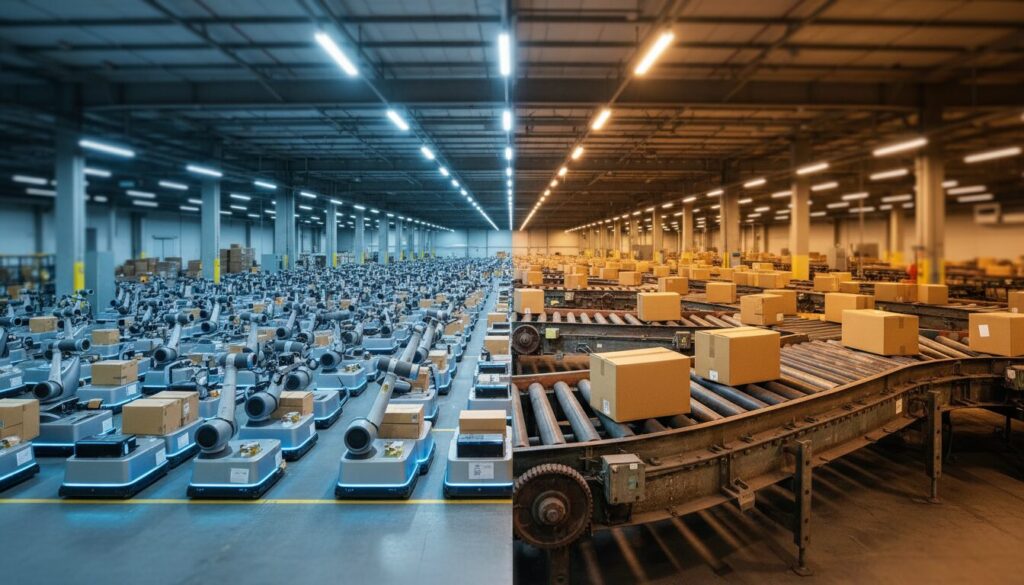
2025 will be remembered as the year of the “Great Bifurcation” in global logistics. The divide between the digitally native giants and the legacy carriers widened into a chasm. It was a year where artificial intelligence ceased to be a buzzword and became an operational imperative for players like Amazon and Apple, while traditional titans like UPS and ZIM navigated a minefield of legal risks and takeover speculations.
For strategy executives and innovation leaders, the retrospective of 2025 offers a critical roadmap. The industry did not move in a uniform direction; rather, it polarized. Efficiency skyrocketed for the tech-enabled (“The Good”), while regulatory friction and asset volatility plagued the unprepared (“The Bad and The Ugly”).
Why It Matters: The Polarization of Global Supply Chains
The context of 2025 was defined by volatility disguised as opportunity. While global trade volumes stabilized in certain corridors, the underlying infrastructure underwent a radical stress test. The Loadstar’s 2025 retrospective highlights a landscape where strategic M&A and AI integration were the only true safeguards against market turbulence.
This polarization matters because it redefines “competitiveness.” It is no longer enough to own ships or trucks; one must own the data that directs them. The 2025 landscape proved that agility—driven by predictive analytics—is the new currency.
As we witnessed with the regulatory crackdown earlier in the year, the era of frictionless trade is over. The tightening of borders has forced companies to rethink their entire logistical footprint.
Global Trend: The Good, The Bad, and The Ugly
The narrative of 2025 played out differently across the major economic zones of the US, Europe, and Asia. The trends were distinct, yet interconnected by the themes of technology and geopolitical friction.
The Good: Innovation and Stabilization
The “Good” of 2025 was characterized by the maturation of logistics technology and the stabilization of key players.
- Maersk’s Strategic Upgrade: Maersk successfully navigated a year of upgrades, shedding some of the volatility that plagued it in 2023-2024. By focusing on integrator strategies, Maersk managed to stabilize its service offerings, positioning itself as a reliable backbone amidst chaos.
-
The Rise of 4PLs: With tariffs reshaping logistics, companies moved away from transactional 3PL relationships toward strategic 4PL partnerships to manage complexity.
-
See also: Gartner Debuts 4PL Magic Quadrant: Tariffs Reshape Logistics
The Bad: Market Corrections and Legal Headwinds
The “Bad” represented the inevitable corrections in a post-pandemic market.
- Profit-Taking at Forwarders: Major forwarders like DHL and DSV engaged in significant profit-taking. While financially prudent for shareholders, this signaled a tightening of margins for shippers and a shift toward cost-protection over expansion.
- UPS Legal Risks: UPS faced a challenging year marked by significant legal risks. These battles distracted from operational improvements and highlighted the vulnerabilities of legacy labor and compliance models in a rapidly changing environment.
The Ugly: Volatility and Hostile Speculation
The “Ugly” refers to the destabilizing forces that threatened supply chain continuity.
- ZIM’s Takeover Speculation: ZIM Integrated Shipping Services faced intense takeover speculation. For shippers relying on ZIM, this introduced uncertainty regarding long-term contracts and route stability.
-
Geopolitical Fragmentation: The need to bypass conflict zones led to the rise of alternative routes, such as the Trans-Caspian corridor, but these shifts came with high implementation costs and new security risks.
2025 Market Snapshot
The following table summarizes the polarized nature of the 2025 logistics landscape.
| Category | Key Players/Events | Impact on Supply Chain |
|---|---|---|
| The Good (Innovation) | Amazon, Apple | AI-driven deal-making and “Smart Shipments” reduced latency and cost. |
| The Good (Stability) | Maersk | Service upgrades provided a stable alternative to spot market volatility. |
| The Bad (Financials) | DHL, DSV | Profit-taking signaled a harder negotiation environment for shippers. |
| The Bad (Regulation) | US CBP | End of De Minimis created a $1B duty shock, slowing cross-border e-commerce. |
| The Ugly (Instability) | ZIM | Takeover rumors created contract uncertainty for global shippers. |
| The Ugly (Risks) | Global Carriers | Increased risk of ship fires and physical assets necessitated new insurance models. |
Case Study: The Tech-First Triumph (Amazon & Apple)
While traditional carriers fought for market share, Amazon and Apple redefined the playing field through the aggressive deployment of Artificial Intelligence.
Amazon: AI-Driven Deal Making
In 2025, Amazon did not just use AI for route optimization; they used it for commercial negotiation. By leveraging predictive algorithms that analyzed global capacity in real-time, Amazon’s logistics arm was able to secure freight rates and capacity allocations with a precision that human brokers could not match.
- The Innovation: Automated procurement logic that predicts spot rate bottoms.
- The Result: Amazon insulated itself from the profit-taking behaviors of forwarders like DHL and DSV, maintaining margin stability even when the broader market faced inflation.
Apple: “Smart Shipments”
Apple introduced what analysts are calling “Smart Shipments.” This involves embedding active tracking and environmental sensing at a granular SKU level, managed by a central AI control tower.
- The Innovation: Real-time rerouting capabilities based on geopolitical risk data (e.g., bypassing a blocked Suez or a congested Panama Canal instantly).
-
The Result: While competitors faced delays due to ZIM’s volatility or Red Sea issues, Apple’s supply chain remained fluid. This resilience is partly due to diversifying manufacturing hubs, including increased reliance on nearshoring in Mexico.
-
See also: Borderlands Mexico: The $71B Shift in Global Logistics
Key Takeaways for Industry Leaders
The events of 2025 provide clear lessons for strategy executives planning for 2026 and beyond.
1. Technology is a Defense Mechanism
Amazon and Apple proved that AI is not just about efficiency; it is a defensive moat. In a year where UPS faced legal struggles and ZIM faced corporate raids, tech-enabled supply chains were the only ones that remained insulated from external shocks.
2. Consolidation is Inevitable
The volatility of standalone carriers suggests that further consolidation is coming. The industry is moving toward “Mega-Carriers” and 4PLs that can control end-to-end movements. We saw this domestically with rail mergers, and we are seeing it globally with ocean liners.
3. Physical Risk Management is Back
The Loadstar’s report highlights a renewed focus on “resilience against ship fires.” As lithium-ion battery transport increases, the physical safety of cargo has returned to the forefront. Digital twins and AI monitoring are now essential for safety, not just speed.
4. Regulatory Agility is Non-Negotiable
The “Bad” of 2025 was defined by regulatory shock. The end of the De Minimis exemption in the US caught many e-commerce platforms off guard. Future supply chains must be built with the flexibility to adapt to sudden tariff changes or trade barrier enforcements.
Future Outlook: The Road to 2026
As we look toward 2026, the logistics industry will focus intensely on Resilience. The “profit-taking” phase of 2025 suggests that carriers are building war chests to survive the next downturn or to fund massive technological overhauls.
What to Watch in 2026:
- The Fate of ZIM: Will it be acquired, or will it restructure? Its trajectory will signal the health of the mid-sized carrier market.
- AI Standardization: Following Amazon’s lead, expect mid-tier 3PLs to adopt “AI-Lite” procurement tools to remain competitive.
- The “Safety” Premium: Shippers may soon pay a premium for carriers with superior safety records regarding ship fires and cargo loss, bifurcating the market into “Safe/Premium” and “Risky/Economy” tiers.
2025 was a year of harsh lessons. The “Good” companies adapted; the “Bad” struggled with the status quo; and the “Ugly” faced existential threats. For the global logistics leader, the message is clear: Innovate immediately, or risk becoming a casualty of the next great shift.