
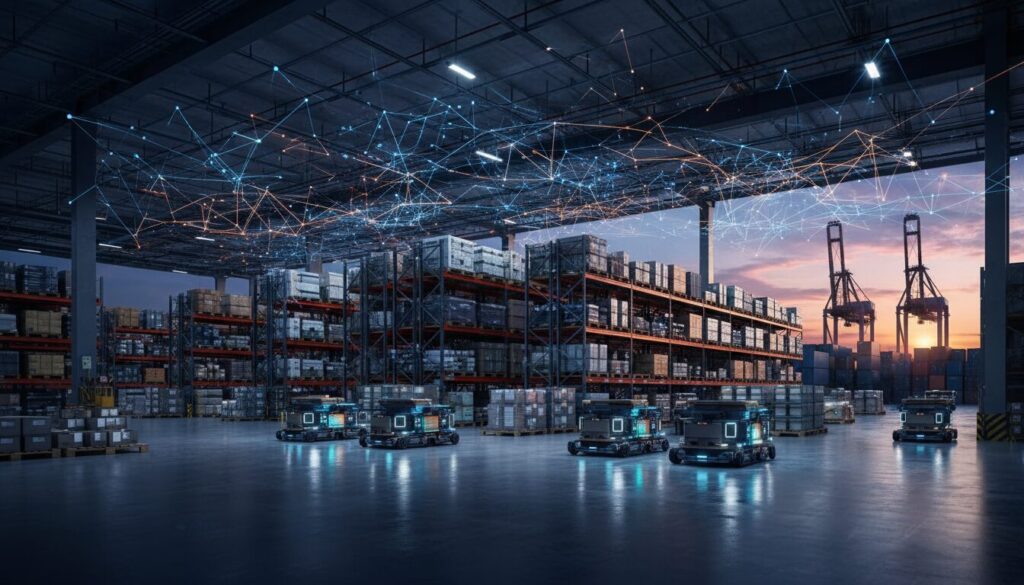
The global supply chain is no longer a linear conveyer belt; it is a volatile web of geopolitical maneuvering, tariff wars, and permanent disruption. In a move that validates this structural shift, Gartner has released its inaugural 2025 Magic Quadrant for Fourth-Party Logistics (4PL).
For decades, the logistics industry has operated on the back of 3PLs (Third-Party Logistics)—execution-focused providers moving goods from Point A to Point B. However, the debut of a dedicated 4PL Magic Quadrant signals a critical turning point. It acknowledges that in an era defined by trade barriers and volatility, execution is not enough. The market now demands Orchestration.
This article explores why Gartner’s new classification matters, how leaders like Kuehne+Nagel and Redwood Logistics are redefining resilience, and what strategy executives must do to survive the “permanent crisis” mode of global trade.
Why It Matters: From Task Execution to Outcome Ownership
The timing of Gartner’s release is not coincidental. As global trade fractures under the weight of new tariff regimes and regional conflicts, the traditional “Control Tower” model—which simply visualizes problems—has become obsolete. Knowing your shipment is stuck at a border is useless if you lack the leverage to move it.
The 2025 Magic Quadrant defines the modern 4PL not as a vendor, but as an outcome owner. Unlike 3PLs, which are often incentivized to fill their own trucks or warehouses, 4PLs are asset-light or asset-agnostic integrators that manage the entire supply chain ecosystem.
The Strategic Pivot
The core differentiator in the 2025 report is the shift from Visibility to Accountability.
* Old Model: The provider offers a dashboard showing a delayed shipment (Task completion).
* New Model: The provider re-routes the shipment via a secondary carrier, adjusts inventory allocation in the destination warehouse, and handles the customs documentation for the new route—automatically (Outcome ownership).
As discussed in our analysis of Borderlands Mexico: The $71B Shift in Global Logistics, supply chains are physically relocating. Managing this fragmentation requires a “general contractor” approach to logistics, which is exactly the gap the new 4PL leaders are filling.
Global Trend: The Rise of the Orchestrator
The 4PL concept is evolving differently across major economic zones, influenced by local pressures. However, the universal thread is the integration of technology and talent to manage complexity.
United States: Tech-First Integration
In the US market, the driving force is fragmentation. With the explosion of nearshoring in Mexico and the reliance on multi-modal transport, US-based firms are seeking “Visionary” partners who can integrate disparate tech stacks.
- Key Driver: High labor costs and the complexity of cross-border trade (US-Mexico-Canada).
- Trend: The move toward “Open Ecosystems.” Companies are rejecting proprietary “black box” systems in favor of platforms that connect via API to any carrier or WMS.
- Leaders: C.H. Robinson and RXO are leveraging massive datasets to predict pricing and capacity, moving beyond brokerage into managed transportation services that function as 4PLs.
Europe: Sustainability and Resilience
In Europe, the 4PL mandate is heavily influenced by the Corporate Sustainability Reporting Directive (CSRD) and geopolitical instability (Red Sea crisis, Ukraine).
- Key Driver: Mandatory Scope 3 emissions reporting and the need to bypass conflict zones.
- Trend: 4PLs are being hired to design networks that are not just efficient, but carbon-compliant and redundant.
- Leaders: Kuehne+Nagel and DHL Supply Chain dominate here. Their ability to blend physical network density with digital oversight allows them to offer “Green 4PL” services—optimizing routes not just for cost, but for carbon footprints.
Asia: Diversification and Agility
For Asian markets, particularly those navigating the “China Plus One” strategy, the focus is on agility.
- Key Driver: Rapidly changing tariff structures and the relocation of manufacturing to Vietnam, India, and Thailand.
- Trend: Shippers need 4PLs that can spin up new logistics corridors in weeks, not months.
- Role of Visibility: As noted in Nippon Express Launches “Operation Insight”, Asian logistics giants are investing heavily in visualizing operations to combat labor shortages. 4PLs take this a step further by acting on that data across borders.
Comparison: 3PL vs. Legacy 4PL vs. 2025 Orchestrator
| Feature | 3PL (Traditional) | Legacy 4PL (Control Tower) | 2025 4PL Orchestrator |
|---|---|---|---|
| Primary Focus | Execution (Moving assets) | Visibility (Seeing data) | Outcomes (Solving problems) |
| Asset Strategy | Asset-Heavy (Owns trucks) | Asset-Light | Asset-Agnostic / Ecosystem |
| Tech Role | Internal Efficiency | Reporting / Dashboards | iPaaS / Open Integration |
| Accountability | Task-based (Did the truck arrive?) | SLA-based (Is the data accurate?) | KPI-based (Did margin improve?) |
| Response to Disruption | Reactive | Reactive (Notification) | Proactive (Auto-correction) |
Case Studies: Innovation in the Magic Quadrant
The Gartner report highlights specific companies that exemplify different approaches to the 4PL model. We analyze two distinct archetypes: the Resilience Specialist and the Tech Visionary.
Case Study 1: Unilog – The “Challenger” with 100% Disruption Management
Unilog, identified as a Challenger in the report, garnered significant attention for achieving a rare 100% score in disruption management.
- The Model: Unilog operates an asset-free model. Unlike DHL or Kuehne+Nagel, they do not own the planes or ships. This neutrality eliminates conflict of interest—they never prioritize their own assets over the client’s needs.
- The Strategy: Unilog focuses on “high-touch” orchestration. Their systems are designed to treat disruption as the norm, not the exception.
- Real-World Application: When tariffs spiked or a port strike occurred, Unilog’s system didn’t just flag the delay. It immediately activated pre-negotiated contingency carriers and rerouted inventory to alternative distribution centers.
- Why It Wins: In a volatile market, agility beats scale. Unilog’s ability to pivot without the baggage of heavy assets allows for faster reaction times.
Case Study 2: Redwood Logistics – The “Visionary” of Open Ecosystems
Redwood Logistics was recognized as a Visionary, largely due to its proprietary integration platform, RedwoodConnect.
- The Problem: Most shippers use a patchwork of software: an ERP (like SAP), a WMS, and multiple carrier portals. Getting these to talk to each other is a nightmare.
- The Solution: RedwoodConnect acts as a supply chain iPaaS (Integration Platform as a Service). It allows shippers to “plug and play” different vendors. If a specific carrier is underperforming, the shipper can swap them out digitally without rebuilding their entire IT infrastructure.
- Strategic Advantage: This approach future-proofs the supply chain. As new technologies (like AI or autonomous trucking) emerge, Redwood’s clients can integrate them instantly. It represents the shift from “Logistics Provider” to “Logistics Tech Enabler.”
Case Study 3: The Global Giants (DHL & Kuehne+Nagel)
While challengers innovate, the Leaders quadrant remains populated by giants like DHL Supply Chain and Kuehne+Nagel. Their strength lies in Hybrid Orchestration.
- Scale + Tech: They combine the massive buying power of a 3PL with the digital oversight of a 4PL.
- Arvato & 4flow: These European powerhouses were also noted for their specialized approaches—Arvato for its e-commerce fulfillment integration and 4flow for its engineering-led network optimization.
Key Takeaways for Strategy Executives
For innovation leaders and C-suite executives, the debut of the 4PL Magic Quadrant offers critical lessons for the 2025 strategic planning cycle.
1. The “Disruption Tax” is Permanent
Volatility is no longer a temporary state; it is a feature of the global economy. Companies must budget for resilience. Hiring a 4PL is essentially buying insurance against supply chain failure. The cost of a 4PL orchestration fee is negligible compared to the cost of a shut-down production line.
2. Neutrality is a Strategic Asset
The Unilog case study proves that asset ownership can be a liability in a 4PL relationship. When selecting a partner, executives must ask: Does this provider make decisions based on my best interest, or based on filling their empty containers? The best 4PLs are indifferent to who moves the freight, as long as it meets the outcome.
3. Integration Capabilities > Operational Scale
In the past, you chose a logistics partner based on how many trucks they had. Today, you should choose them based on how well their API connects to your ERP. The Redwood Logistics example demonstrates that the ability to ingest and normalize data from disparate sources is the new competitive advantage.
4. Visibility Must Lead to Action
As we saw in the Nippon Express analysis, visualizing the “black box” of warehouse operations is step one. However, a 4PL must take that visibility and execute. If your “Control Tower” requires a human to manually phone a carrier when a delay happens, it is not a 4PL; it is a call center.
Future Outlook: The Autonomous Supply Chain
Gartner’s 2025 report is just the beginning. As we look toward 2030, the definition of a 4PL will evolve further, driven by Artificial Intelligence and financial integration.
AI Agents as Dispatchers
The next frontier for leaders like GEODIS and C.H. Robinson is the deployment of AI agents. We will move from “Automated Alerts” to “Autonomous Negotiation,” where AI agents negotiate spot rates with carriers in real-time to solve disruptions without human intervention.
FinTech Convergence
We expect 4PLs to increasingly become financial intermediaries. By sitting in the middle of all transactions, 4PLs are perfectly positioned to offer trade finance, dynamic payment terms, and currency hedging for cross-border logistics—solving the cash flow challenges inherent in global trade.
The Sustainability Audit
Finally, 4PLs will become the de facto auditors of supply chain sustainability. As EU regulations tighten, the 4PL’s data platform will be the “source of truth” for carbon accounting, forcing carriers to comply with green standards to remain in the network.
Conclusion:
The Gartner 2025 4PL Magic Quadrant is a wake-up call. The era of managing logistics via spreadsheets and emails is over. To survive the tariff wars and geopolitical shifts of tomorrow, companies must embrace Orchestration—partnering with providers who own the outcome, not just the truck.
See also:
* Borderlands Mexico: The $71B Shift in Global Logistics
* Nippon Express Launches “Operation Insight” to Visualize Warehouse Operations