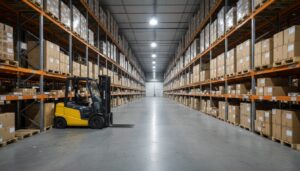

The era of cheap industrial hardware is officially ending. Toyota Industries Corporation (Toyota L&F), a global bellwether for material handling equipment, has announced a significant price revision for its industrial vehicles in Japan, effective March 2026.
Citing persistent raw material inflation and the inexorable rise of labor costs, the company will increase prices for forklifts by 10% to 15% and other transport equipment (shovel loaders, towing tractors) by 5% to 20%. While this specific announcement targets the Japanese domestic market, it serves as a critical signal for global supply chain leaders: physical asset costs are under sustained upward pressure.
For logistics executives, this is not merely a procurement headache; it is a strategic turning point. As discussed in our previous analysis, AGV Systems 2024: The Pivot to Warehouse Automation, the rising cost of manual machinery is rapidly accelerating the ROI parity point for automation.
Why It Matters: The End of Deflationary Hardware
For the past two decades, logistics strategies often relied on the availability of relatively low-cost mechanical equipment. Managers could solve capacity issues by simply buying more forklifts and hiring more drivers. The Toyota L&F announcement dismantling this assumption.
This price hike is driven by structural, not transitory, factors. The volatility of steel and rare earth metals required for electrification, combined with the surging cost of skilled manufacturing labor, has forced OEMs to pass costs downstream.
The Multiplier Effect on OPEX
The impact extends beyond the initial Capital Expenditure (CAPEX). A 15% rise in asset costs correlates with higher insurance premiums, lease financing rates, and replacement parts pricing. When physical hardware becomes more expensive, the efficiency of how that hardware is utilized becomes the primary metric of success.
Table 1: The Shift in Logistics Cost Structures
| Cost Component | Traditional Landscape (Pre-2024) | The 2026 Reality | Strategic Implication |
|---|---|---|---|
| Asset Acquisition | Stable pricing; predictable depreciation. | +10-20% inflation; volatile lead times. | Higher hurdle rates for CAPEX approval. |
| Labor | Available, moderate wage growth. | Structural shortages; high wage inflation. | Manual equipment becomes a liability without high utilization. |
| Technology | Viewed as a premium add-on. | Deflationary relative to hardware. | Automation software becomes the primary cost-saver. |
| Energy | Fossil fuel dominance. | Electrification mandates. | Higher upfront battery costs but lower TCO (Total Cost of Ownership). |
Global Trend: How Major Markets Are Reacting
While Toyota L&F’s announcement centers on Japan, the trend is mirroring developments in the US, Europe, and China. The response, however, varies by region, creating a fragmented landscape for global supply chain directors.
United States: The Automation Acceleration
In the US, the “reshoring” of manufacturing has created a demand surge for material handling equipment. However, with unemployment rates remaining low in the logistics sector, companies are finding that buying a forklift is the easy part—finding a driver is the crisis.
Major US distributors are responding not by absorbing the hardware costs, but by leapfrogging manual equipment entirely. Data from the Association for Advancing Automation (A3) indicates a record shifting of budget from traditional forklifts to Automated Guided Vehicles (AGVs) and Autonomous Mobile Robots (AMRs). The price hike in manual trucks makes the business case for AMRs—which have seen software costs stabilize—far more attractive.
Europe: Sustainability as a Cost Driver
In the EU, the inflation in equipment costs is heavily tied to the “Green Deal” and ESG mandates. Kion Group (parent of Linde and STILL) has noted that the transition to lithium-ion technology and energy-efficient drives raises the unit cost of forklifts.
European logistics leaders are mitigating these costs through Fleet Management Systems (FMS). By utilizing telematics, companies like DHL Supply Chain in Europe are optimizing fleet sizes—reducing the total number of units needed by 10-15% through better utilization data, effectively neutralizing the unit price increase.
China: The “China Plus One” Impact
China remains a dominant producer of cost-effective forklifts (e.g., Hangcha, Heli). However, even Chinese OEMs face raw material pressure. Furthermore, as global supply chains diversify via “China Plus One” strategies (moving into Vietnam, India, Mexico), the logistics cost in these emerging markets is rising. The cheap equipment that once fueled Asian logistics expansion is becoming scarcer, forcing Asian 3PLs to adopt Western-style efficiency metrics earlier in their maturity cycle.
Case Study: IKEA’s Tech-Forward Fleet Strategy
To understand how to navigate rising asset costs, we look to IKEA. As a company obsessed with cost-efficiency (“we hate waste”), IKEA faced the same headwinds: rising labor costs and inflating equipment prices.
Instead of simply paying more for traditional forklifts and scissor lifts for inventory management, IKEA invested in a radical shift in asset mix.
The Innovation
In 2023 and 2024, IKEA aggressively rolled out inventory drones powered by Verity across its European and US distribution centers.
* The Old Way: Manual workers using scissor lifts or order pickers (machines that are seeing 5-20% price hikes) to visually check stock.
* The New Way: Autonomous drones fly through the racking during non-operational hours to scan barcodes.
The Results
- Reduced Fleet Dependence: By offloading the inventory checking task to drones, IKEA reduced the necessary fleet size of man-up trucks and scissor lifts. They essentially “deleted” the need for the most expensive, labor-intensive hardware for this specific task.
- Labor Optimization: Employees who previously drove machines for stock counting were redeployed to value-added picking tasks, mitigating labor shortages.
- Accuracy & Speed: The drones operate faster and more accurately than manual operators, improving stock visibility.
Lesson: When the cost of the “Tool A” (Forklift) rises, do not just negotiate the price of Tool A. Innovation leaders ask if “Tool B” (Drone/AGV) can eliminate the need for Tool A entirely.
Key Takeaways for Logistics Leaders
The Toyota L&F price hike is a wake-up call. Innovation leaders and Strategy executives must adjust their 2026 budget planning now.
1. Re-calculate Total Cost of Ownership (TCO)
The “+10-15%” sticker price is just the beginning. Update your TCO models to reflect higher interest rates on leasing these assets.
* Action: Review your fleet replacement cycle. Does it make sense to extend the life of current assets by 1-2 years through enhanced maintenance rather than buying new in 2026?
2. The Pivot to “Process Automation”
As highlighted in AGV Systems 2024: The Pivot to Warehouse Automation, the gap between manual and automated costs is closing.
* Action: If you were holding off on AGVs because they were “too expensive” compared to a standard Toyota forklift, run the numbers again using the projected 2026 pricing. The ROI timeline has likely shortened by 6-12 months.
3. Embrace Telematics and FMS
If you must pay more for hardware, you must extract more value from it.
* Action: Mandate telematics on all new industrial vehicle purchases. Data on idle time, battery usage, and impact detection allows you to right-size the fleet. Most warehouses have 10-20% more forklifts than they actually need due to poor utilization visibility.
Future Outlook: The Rise of “Logistics Hardware as a Service”
Looking beyond March 2026, the relationship between OEMs and logistics providers will fundamentally change.
We predict a shift away from CAPEX-heavy purchasing models toward Hardware-as-a-Service (HaaS) or Robotics-as-a-Service (RaaS). In this model, Toyota Industries and its competitors will not just sell a forklift; they will sell “pallet movements.”
As hardware costs inflate, the risk of asset ownership becomes higher. Logistics companies will prefer variable cost models where they pay for uptime and throughput rather than steel and rubber. This aligns incentives: OEMs will build more durable machines to reduce their own maintenance costs, and logistics operators will be shielded from raw material volatility.
The Toyota L&F price hike is a constraint, but for the innovative supply chain leader, it is the necessary friction that sparks the next wave of modernization. The days of cheap forklifts are gone; the era of smart, optimized, and automated fleets has arrived.