
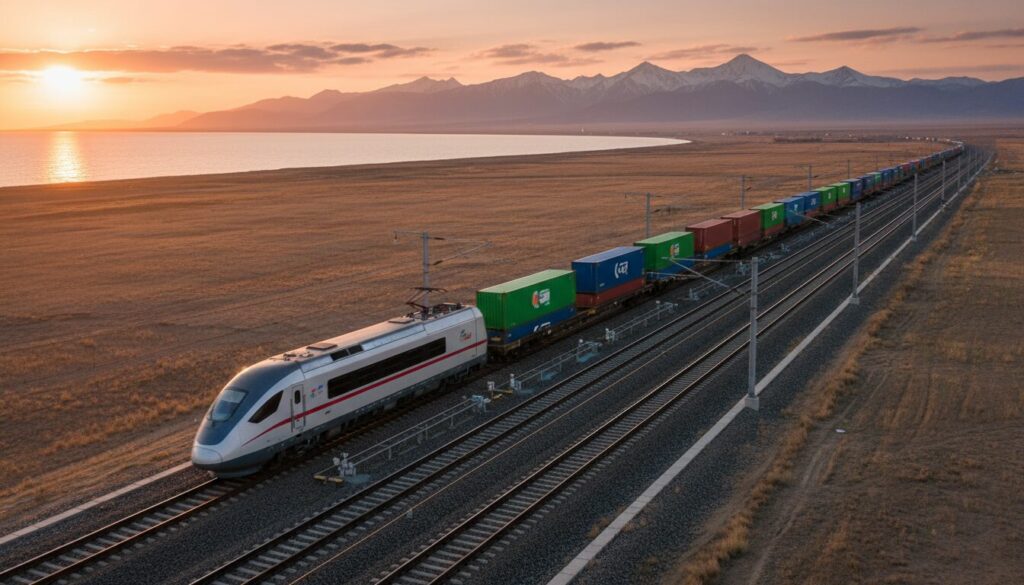
In a geopolitical landscape defined by volatility, the logistics map of Eurasia is being redrawn. The era of relying on single, dominant trade corridors is ending, replaced by a fragmented yet resilient network of alternative routes.
The most significant recent development in this shift is the Tokyo Declaration, an agreement forged between Japan and five Central Asian nations (Kazakhstan, Kyrgyzstan, Tajikistan, Turkmenistan, and Uzbekistan). This strategic pact aims to develop the Trans-Caspian International Transport Route (TITR)—colloquially known as the “Middle Corridor.”
For innovation leaders and strategy executives, this is not merely a diplomatic handshake. It represents a fundamental restructuring of the supply chain connecting Asia to Europe, designed specifically to bypass Russia. With the Japanese government pledging technology and industrial cooperation to ensure stable supplies of critical minerals, this move signals a decisive pivot toward supply chain resilience in a post-globalization world.
Why It Matters: The Geopolitical Logistics Shift
The logic behind the “Tokyo Declaration” is rooted in the harsh reality of the Russia-Ukraine conflict. For decades, the Northern Corridor (via the Trans-Siberian Railway) was the gold standard for rail freight between Asia and Europe, offering transit times of 14–18 days. However, sanctions and geopolitical risk have rendered this route radioactive for many Western and allied companies.
Simultaneously, the maritime route (via the Suez Canal) remains vulnerable to chokepoint disruptions, as evidenced by the Red Sea crisis. This leaves the global economy in desperate need of a “Plan C.”
The Strategic Value of Central Asia
Japan’s engagement with the “C5” nations focuses on two critical pillars:
1. Logistics Sovereignty: Establishing a route that does not rely on Russian or Chinese infrastructure dominance.
2. Critical Minerals: Central Asia is rich in rare earth elements and uranium, essential for the semiconductor and EV battery industries. Securing a route to export these resources without passing through adversaries is a matter of national economic security.
The Trans-Caspian Route is complex. It requires multimodal switching (Rail -> Sea -> Rail) across the Caspian Sea, traversing Kazakhstan, Azerbaijan, Georgia, and Turkey before reaching the EU. While historically slower and more expensive, Japan’s entry brings the capital and technological expertise required to make this route viable.
Global Trend: The Race for the “Middle Corridor”
Japan is not acting in a vacuum. The development of the Trans-Caspian Route aligns with a broader global trend where major economic powers are rushing to secure “friend-shored” infrastructure.
The EU’s “Global Gateway”
The European Union has already committed to investing €10 billion in sustainable transport connectivity in Central Asia. The European Bank for Reconstruction and Development (EBRD) released a study identifying the Central Trans-Caspian Network as the most sustainable transport connection between Central Asia and Europe.
* Goal: Reduce transit time from 50+ days to under 15 days through digitalization and hard infrastructure.
China’s Complicated Position
While the Middle Corridor was initially a component of China’s Belt and Road Initiative (BRI), Beijing views the current Japan-led acceleration with caution. The route allows Central Asian states to diversify their dependency away from Beijing and Moscow. However, China still utilizes the route to maintain trade with Europe amidst Russian sanctions, creating a paradoxical dynamic where competitors use the same tracks.
The US Stance: The C5+1 Diplomatic Framework
The United States has ramped up its diplomatic engagement via the C5+1 platform, supporting initiatives that bolster the sovereignty of Central Asian nations. The US views the Middle Corridor as a mechanism to prevent the region from becoming a vassal to the Russian/Chinese economic sphere.
Comparison of Eurasian Logistics Corridors
| Feature | Northern Corridor (Russia) | Middle Corridor (Trans-Caspian) | Southern Ocean Route (Suez) |
|---|---|---|---|
| Primary Transit Mode | Rail | Multimodal (Rail/Ferry) | Maritime Vessel |
| Transit Time (Asia-EU) | 14–18 Days (Historical) | 18–45 Days (Current Variance) | 30–45 Days (Dependant on route) |
| Cost Profile | Moderate | High (Multiple handling points) | Low (Economies of scale) |
| Geopolitical Risk | Critical (Sanctions/War) | Moderate (Regional stability) | Moderate (Red Sea/Piracy) |
| Carbon Footprint | Low (Electric Rail) | Moderate (Ferry emissions) | High (Heavy Fuel Oil) |
| Strategic Backer | Russia / China | EU / Japan / Turkey | Global Shipping Alliances |
Case Study: Nippon Express (NX Group) and the Multimodal Challenge
To understand the practical implications of the Tokyo Declaration, we must look at how logistics leaders are already navigating this terrain. A prime example is Nippon Express Holdings (NX Group), a top-tier global logistics provider.
The Challenge
Following the invasion of Ukraine, Japanese manufacturers (automotive and electronics) faced a crisis. Air freight was too expensive for heavy components, and ocean freight was too slow for “Just-in-Time” manufacturing schedules. The Russian rail route was politically and practically barred.
The NX Group Solution
NX Group accelerated the commercialization of a multimodal transport service utilizing the Middle Corridor.
* The Route: Cargo originates in China/Japan $\rightarrow$ Rail across China to Khorgos (border) $\rightarrow$ Rail across Kazakhstan to Aktau Port $\rightarrow$ Ferry across the Caspian Sea to Baku (Azerbaijan) $\rightarrow$ Rail to Poti (Georgia) $\rightarrow$ Feeder vessel to Constanta (Romania) or rail via Turkey to Europe.
Operational Innovation: Reducing Friction
The biggest bottleneck in the Middle Corridor is the “transloading” process—moving containers from trains to ships and back again.
* Designated Space: NX Group secured priority agreements with local operators in Kazakhstan and Azerbaijan to ensure container availability and slot space on Caspian ferries, which are notoriously scarce during peak seasons.
* Visualization: They implemented GPS tracking that functions across the fragmented telecom networks of five different countries, providing shippers with real-time visibility that was previously non-existent on this route.
Results and Data
- Transit Consistency: While initially volatile, NX Group has managed to stabilize transit times to approximately 25–30 days for specific express services, offering a viable middle ground between air and sea.
- Risk Mitigation: By bypassing Russia, clients in the high-tech sector (semiconductors) and automotive sector eliminated the risk of sanction violations or cargo seizure.
Lessons from Maersk
A.P. Moller – Maersk has also activated this corridor. In 2022, they launched an intercontinental rail service through the Middle Corridor. However, Maersk’s experience highlighted a critical lesson: Capacity Constraints. The Caspian Sea fleet is aging and small. Without the infrastructure investment promised in the Tokyo Declaration (e.g., Japan helping to modernize ports and vessels), the route cannot handle the volume of the Northern Corridor.
Key Takeaways for Logistics Leaders
The Japan-Central Asia agreement is a signal for executives to rethink their Eurasian strategies. Here are the actionable lessons:
1. Diversification is Costly but Mandatory
The era of optimizing solely for the lowest cost is over. The Middle Corridor is currently more expensive than the Northern Corridor due to multiple handling charges (Terminal Handling Charges at every border). Companies must price this “resilience premium” into their supply chain models.
2. Digitalization is the Glue
The Middle Corridor involves crossing five customs zones. Physical infrastructure is only half the battle; the other half is “soft infrastructure.”
* Action: Invest in platforms that support eTIR (electronic international road transport systems) and digital customs integration. The Tokyo Declaration emphasizes “Japanese technology,” which likely implies the export of automated cargo processing systems to streamline these borders.
3. The Rise of “Mini-Hubs”
Locations like Almaty (Kazakhstan), Baku (Azerbaijan), and Tbilisi (Georgia) are set to become critical logistics nodes.
* Strategy: Forward-thinking companies should consider establishing warehousing or assembly operations in these “Mini-Hubs” to serve both the European and emerging Central Asian markets, rather than just transiting through them.
4. Critical Mineral Supply Chains
For executives in EV and Tech, this route is the lifeline for non-Chinese rare earth supplies. The Tokyo Declaration explicitly links the logistics route to mineral security.
* Action: Audit your upstream supply chain. If your critical minerals are currently routed through Russia or solely dependent on China, investigate suppliers in Kazakhstan utilizing the Trans-Caspian route.
Future Outlook: The 2030 Vision
The Tokyo Declaration is the starting gun for a decade of infrastructure build-out. What can we expect by 2030?
Hard Infrastructure Evolution
We anticipate massive Japanese and EU investment in the ports of Aktau and Kuryk (Kazakhstan) and Baku (Azerbaijan). The current bottleneck—the shortage of rail-ferry vessels on the Caspian Sea—will likely be resolved through joint ventures between Japanese shipbuilders and Central Asian logistics firms.
The “Digital Silk Road” 2.0
Japan’s involvement suggests a push for high-tech customs corridors. By 2027, we expect to see a “Green Lane” for trusted traders along the Middle Corridor, utilizing blockchain for document verification to reduce border dwell times from days to hours.
Strategic Conclusion
The agreement to develop the “Caspian Sea Route” is more than a logistics upgrade; it is a geopolitical realignment. Japan and the “C5” nations are carving out a corridor of independence. For global companies, the Trans-Caspian route is no longer just an emergency backup; it is becoming a strategic imperative for a resilient, diversified future.
The message is clear: If your supply chain map doesn’t have a bold line drawn through the Caspian Sea, it is time to redraw it.