
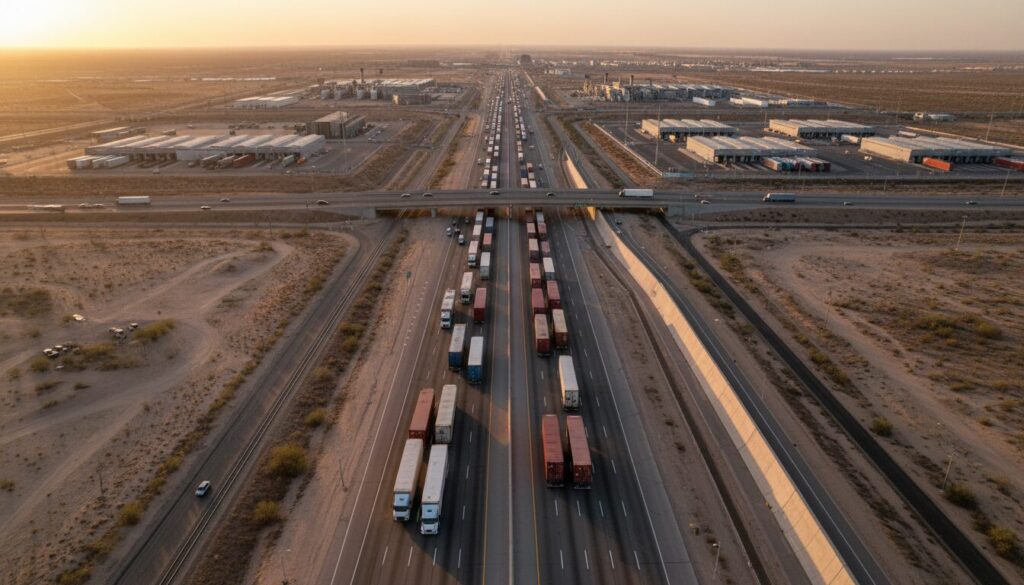
The global supply chain map is being redrawn, and the ink is drying fastest in North America. In September, Mexico not only retained its rank as the top trading partner of the United States but widened the gap with historical heavyweights like China and Canada. With trade reaching $71.8 billion in a single month and a Year-to-Date (YTD) total of $653 billion, the data confirms a structural shift in global logistics—not merely a temporary fluctuation.
For innovation leaders and strategy executives in Europe and Asia, this is more than a regional statistic. It is the definitive proof of concept for “nearshoring.” As the U.S. pivots away from trans-Pacific reliance, the logistical gravity is shifting toward the “Borderlands”—the industrial corridor spanning Northern Mexico and the Southern United States.
This article explores the mechanics behind this surge, the strategic investments from giants like Maersk, and what this Western Hemisphere consolidation means for global supply chain resilience.
Why It Matters: The Geopolitical Pivot
The dominance of U.S.–Mexico trade is the result of a deliberate reconfiguration of global value chains. For decades, the “Factory of the World” narrative centered on East Asia. Today, geopolitical friction, tariff volatility, and the post-pandemic need for resilience have accelerated the “China Plus One” strategy into a “North America First” reality.
For strategy executives, the implications are threefold:
- Speed to Market: The geographical proximity of Mexico allows for shorter transit times compared to trans-oceanic routes, a critical factor for the automotive and high-tech electronics sectors driving this growth.
- Regulatory Stability: Unlike the fluctuating tariff wars seen elsewhere, the USMCA (United States–Mexico–Canada Agreement) provides a stabilizing legal framework that encourages long-term capital expenditure (CapEx).
- Infrastructure Saturation: As volume shifts, traditional gateways (like LA/Long Beach) are seeing competition from land borders (Laredo) and Mexican ports (Manzanillo), forcing a reimagining of logistics networks.
The $71.8 billion September figure serves as a wake-up call: The infrastructure required to support this volume is the next great investment frontier.
Global Trend: The Great Regionalization
While the headlines focus on the U.S. and Mexico, this phenomenon is part of a broader global trend toward regionalization. Supply chains are shrinking physically to increase control and reduce carbon footprints.
The Three-Pole Supply Chain World
We are witnessing the solidification of three distinct industrial clusters, each striving for semi-independence:
- North America: Centered on the U.S. consumption market, fed by Mexican manufacturing and Canadian raw materials.
- Europe: German and French industrial cores increasingly relying on Eastern Europe (Poland, Hungary) and Turkey/North Africa to replicate the “Mexico Model.”
- Asia-Pacific: Intra-Asian trade is booming as Vietnam, Thailand, and India absorb manufacturing capacity leaving China, though China remains the primary supplier of raw components.
Comparative Advantage: Why Mexico is Winning
For a Global Logistics Director choosing where to allocate capacity, the comparison between traditional Asian hubs and the emerging Mexican powerhouse is stark.
Table 1: Manufacturing Hub Comparison 2024 (Logistics Perspective)
| Feature | Mexico (Nearshoring) | China (Traditional) | Vietnam (China +1) |
|---|---|---|---|
| Transit to US East/South | 2–6 Days (Truck/Rail) | 30–45 Days (Ocean) | 35–50 Days (Ocean) |
| Trade Barriers | Low (USMCA compliant) | High (Section 301 Tariffs) | Low (Generally) |
| Labor Costs | Rising, but stable | Rising rapidly | Low |
| Supply Chain Risk | Border congestion, Security | Geopolitical, IP risk | Infrastructure limits |
| Primary Mode | Road/Rail | Ocean/Air | Ocean |
The data confirms the trend: Road freight remains the backbone of the $71.8B trade volume, specifically driven by auto parts and electronics. This shift favors logistics providers who excel in cross-border trucking and intermodal rail over pure ocean freight forwarders.
Case Study: Maersk and the Manzanillo Expansion
To understand how logistics giants are adapting to this $71B monthly reality, we must look beyond the border itself to the “feeder” locations. The standout case study for this quarter is A.P. Moller – Maersk.
The Strategic Investment
While Port Laredo (Texas) creates the headlines as the #2 U.S. trade gateway (handling $29.6 billion in September alone), the pressure builds further upstream. Recognizing this, Maersk recently inaugurated a massive $15 million logistics depot near the Port of Manzanillo.
Project Specs and Strategy
- Location: Manzanillo, Colima (Mexico’s primary Pacific gateway).
- Size: 333,681 square feet (approx. 31,000 square meters).
- Function: Warehousing, distribution, and value-added services (labeling, sorting).
Why Manzanillo? The “Asia-to-Border” Link
This investment is strategic genius for three reasons:
- The Component Pipeline: While final assembly happens in Mexico (making it “Made in Mexico”), many raw components still originate in Asia. Manzanillo is the Pacific entry point for these goods.
- Decongesting the Port: Manzanillo has historically suffered from congestion due to the nearshoring boom. By building a depot near the port (but outside the terminal), Maersk allows customers to pull containers out of the port quickly, reducing demurrage and detention fees.
- End-to-End Control: Maersk is transitioning from a shipping line to an integrated logistics integrator. By controlling the depot, they manage the flow from the Asian factory $\rightarrow$ Ocean $\rightarrow$ Manzanillo Depot $\rightarrow$ Truck/Rail to Assembly Plant $\rightarrow$ US Border.
The Result
This facility directly supports the automotive and electronics supply chains that drove the September trade record. It acts as a shock absorber, holding inventory closer to the assembly plants in the Bajío region and Northern Mexico, ensuring that the Just-In-Time (JIT) lines in factories (like those of GM, Ford, or Kia) never stop due to port delays.
Key Takeaways: Lessons for Logistics Leaders
The $71.8 billion September record and Maersk’s simultaneous investment offer critical lessons for strategy executives worldwide.
1. Infrastructure Follows Volume (Eventually)
The surge in trade volume has outpaced infrastructure development. Port Laredo handling $29.6B is impressive, but it creates bottlenecks.
* Actionable Insight: Do not rely on public infrastructure alone. Follow Maersk’s lead and invest in private, “near-port” or “near-border” warehousing to create your own buffer zones.
2. The Hybrid Supply Chain
The Mexico story is not about abandoning Asia; it is about integrating Asia into a Mexican workflow. The components arriving in Manzanillo prove that global supply chains are becoming hybrid: Asian components + North American assembly = Regional Resilience.
* Actionable Insight: Audit your Bill of Materials (BOM). If your Tier 2 suppliers are in Asia and your Tier 1 is in Mexico, your critical choke point is the Mexican Pacific ports (Manzanillo/Lázaro Cárdenas). Secure capacity there.
3. Resilience over Lowest Unit Cost
Moving production to Mexico is often more expensive than Vietnam when looking strictly at labor. However, when total landed cost, speed to market, and tariff avoidance are calculated, Mexico wins for the U.S. market.
* Actionable Insight: Update your ERP logic. Shift optimization parameters from “Lowest Manufacturing Cost” to “Total Landed Cost + Risk Premium.”
4. Road and Rail Dominance
With road freight driving the bulk of this trade, the trucking sector in Mexico is under immense pressure (driver shortages, security concerns).
* Actionable Insight: Diversify modes. Strategy leaders must look at Intermodal Rail (e.g., CPKC’s new network connecting Mexico-US-Canada) to bypass volatile trucking markets.
Future Outlook
As we look toward 2025, the “Borderlands” trend shows no sign of cooling. The gap between Mexico and China as U.S. trading partners will likely ossify, establishing a permanent new order.
What to Watch
- The Semiconductor Shift: With the CHIPS Act, expect to see more electronics assembly moving to states like Jalisco and Baja California, driving high-value air freight and expedited trucking.
- Green Corridors: As companies report on Scope 3 emissions, the shorter distance of Mexico-US transport (vs. Trans-Pacific) will become a key sustainability metric. Expect the development of “Green Trade Corridors” at Laredo utilizing electric or hydrogen trucks.
- Digital Borders: The sheer volume ($71B/month) makes manual inspection impossible. The next investment boom will be in AI-driven customs clearance and non-intrusive inspection technology at Port Laredo and Otay Mesa.
The Verdict: The $71.8 billion September figure is not a peak; it is the new baseline. For global logistics leaders, the message is clear: The center of gravity has shifted. Whether you are based in Hamburg, Shanghai, or Chicago, your strategy must now account for the North American vertical axis.