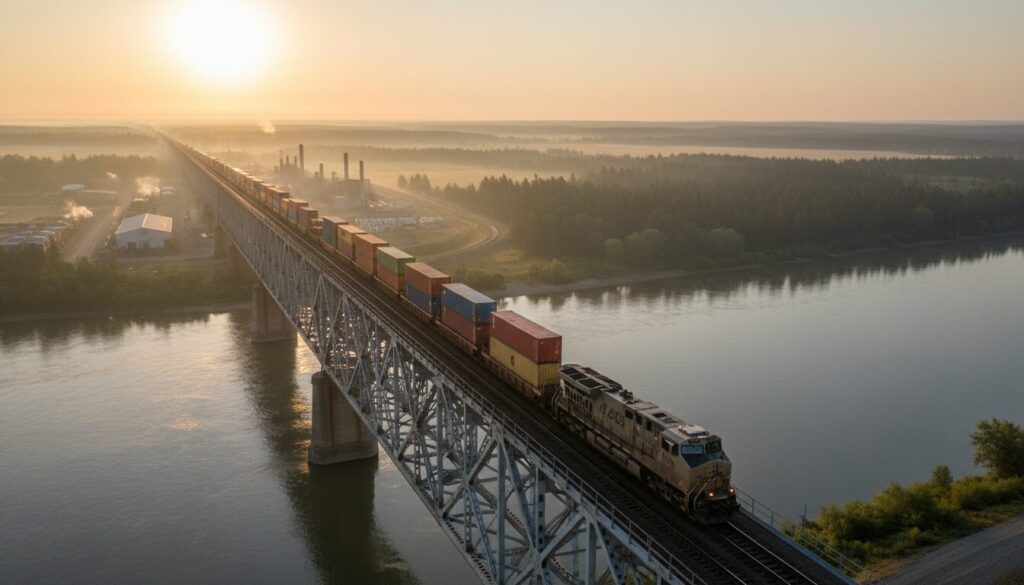
For decades, the United States logistics map has been divided by an invisible wall running roughly along the Mississippi River. Western railroads handled one side, Eastern railroads the other, and Chicago served as the congested, friction-heavy revolving door between them. Now, Union Pacific (UP) and Norfolk Southern (NS) are proposing to tear that wall down.
The announcement of a $72 billion merger to create the first true coast-to-coast rail network is not just a financial transaction; it is a fundamental restructuring of North American freight physics. Union Pacific, Norfolk say merger will take nearly 2 million truckloads off U.S. roads annually, a bold claim aimed at reversing a decade-long bleed of market share to the trucking industry.
For logistics executives, this proposal signals a potential shift in modal strategy, pricing power, and supply chain resilience. However, in an industry historically plagued by integration headaches and fierce regulatory scrutiny, the promise of a seamless transcontinental network requires a critical, analytical eye.
The Facts: Breaking Down the $72B Deal
Before assessing the strategic implications, it is essential to understand the structural components of this proposed combination. The rail sector has seen a market share decline of approximately 10% between 2014 and 2023, largely because trucks are faster and more reliable over shorter distances. This merger is the rail industry’s answer to that efficiency gap.
The core value proposition relies on eliminating the “interchange”—the physical and administrative handoff of cargo between two different railroad companies.
Deal Snapshot
| Metric | Details |
|---|---|
| Entities Involved | Union Pacific Corp. (West) & Norfolk Southern Corp. (East) |
| Deal Value | $72 Billion (Cash-and-Stock) |
| Primary Objective | Create a continuous U.S. coast-to-coast rail network |
| Projected Volume Shift | Removal of 2 million annual truckloads from highways |
| Operational Impact | Elimination of ~350 daily transfer trucks in Chicago |
| Market Context | Reversing a ~10% rail market share decline (2014-2023) |
The “Steel-Wheel” vs. “Rubber-Tire” Interchange
The most tangible operational change lies in Chicago. Currently, moving a container from a UP train to an NS train often involves offloading the container onto a truck chassis, driving it across the city to a different terminal (rubber-tire interchange), and reloading it.
This merger aims to facilitate “steel-wheel interchanges,” where railcars simply continue moving across the network without the cargo ever touching the ground. The companies estimate this will remove 350 transfer trucks daily from Chicago traffic alone, drastically reducing dwell time and friction costs.
For a summary of the initial announcement, see our previous coverage: UP & NS Merger: 2M Truckloads Off Roads?.
Industry Impact: Winners, Losers, and Shifters
If approved, the consolidation of Union Pacific and Norfolk Southern will send ripples through every vertical of the logistics industry. The impact goes beyond simple capacity; it changes the competitive calculus between road and rail.
Impact on Trucking Carriers
The trucking industry faces a dual-edged sword.
* The Threat to Long-Haul: The explicit goal of this merger is to recapture freight that migrated to long-haul trucking. Routes such as Los Angeles to New Jersey are prime targets. If the combined rail entity can offer higher reliability without the interchange delay, shippers may move less time-sensitive freight back to rail to save costs.
* The Drayage Opportunity: While long-haul miles may decrease, the demand for “first and last mile” drayage will likely stabilize or increase. As rail efficiency improves, the throughput at intermodal hubs in secondary markets may grow, requiring robust local trucking networks to service warehouses.
Impact on Shippers and Procurement
For logistics managers and procurement officers, a single-line service offers simplified administration but raises concerns about pricing power.
* Reduced Friction: Currently, shippers often deal with two invoices and two tracking systems for transcontinental moves. A unified network promises “one throat to choke,” streamlined billing, and end-to-end visibility.
* Pricing leverage: The historic concern with rail mergers is the reduction of competition. While UP and NS generally do not compete in the same geographic regions (making this an “end-to-end” merger rather than a “parallel” merger), the resulting entity will have immense market power. Shippers must watch closely to see if efficiency gains are passed down as savings or retained as margin.
Impact on Warehousing and Real Estate
The efficiency of the Chicago interchange is the pivot point here.
* Chicago’s Role: If the “rubber-tire” interchange is reduced, the necessity for cross-docking facilities explicitly positioned to handle rail-to-rail transfers in Chicago may diminish.
* Network Optimization: Conversely, distribution centers located along the continuous mainlines may see increased value. Executives might reconsider their Node strategy—placing DCs closer to the new unified rail hubs rather than optimizing for highway access alone.
LogiShift View: The “So What?” for Strategy
While the headline “Union Pacific, Norfolk Say Merger Will Take Nearly 2 Million Truckloads off U.S. Roads” is compelling, the path to realization is fraught with complexity. At LogiShift, we believe executives need to look past the marketing deck and focus on Regulatory Risk and Integration Friction.
The Regulatory Gauntlet
The Surface Transportation Board (STB) is the final arbiter, and the current regulatory climate is not friendly to consolidation. The STB’s mandate is to protect the public interest and ensure competition.
* The KCS Precedent: The recent Canadian Pacific Kansas City (CPKC) merger was approved partly because it was the smallest Class I combination and created a new competitor to the larger players.
* The UP-NS Challenge: A UP-NS merger creates a behemoth. The STB will heavily scrutinize whether this creates a duopoly that disadvantages shippers. Expect a grueling approval process that could take 18 to 24 months.
The Integration Trap
History teaches us that rail mergers rarely go smoothly in the first few years.
* Service Meltdowns: Previous large-scale mergers (like the UP/SP merger in the 90s) resulted in massive congestion, lost cars, and service failures as disparate IT systems and operating cultures collided.
* The “Valley of Despair”: Shippers should anticipate a period of operational instability if the merger proceeds. The promise of removing 2 million truckloads is a long-term goal (Year 3+), not an immediate benefit.
The Sustainability Variable
This merger is arguably the most significant ESG (Environmental, Social, and Governance) development in logistics this year. Rail is roughly 3 to 4 times more fuel-efficient than trucks. For Fortune 500 companies with aggressive Scope 3 emission reduction targets, shifting volume to a seamless coast-to-coast rail network is the fastest way to slash carbon footprints without reducing volume. This “green” argument will likely be the railroads’ strongest card during regulatory hearings.
Takeaway: Strategic Moves for Logistics Leaders
The proposed merger is a signal to re-evaluate your long-term transportation portfolio. While the deal is not yet closed, the direction of the market is clear: a push toward intermodal efficiency to combat labor shortages and emission targets.
1. Diversify, But Verify
Do not overhaul your routing guide yet. The regulatory review will be long. However, start benchmarking your current transcontinental truckload costs against intermodal rates. If the merger passes, the cost gap between road and rail on long lanes should widen in favor of rail.
2. Audit Your Intermodal Reliance
Assess your vulnerability to Chicago. If your supply chain relies heavily on the Chicago interchange, this merger could eventually eliminate your biggest bottleneck. Conversely, during the integration phase, Chicago could become a choke point. Have contingency truckload capacity ready.
3. Monitor the STB Hearings
The conditions the STB places on this merger will define the service levels. Watch for requirements regarding “open gateways” (allowing other railroads to use tracks) which would preserve competition and benefit shippers.
Final Thought: The promise to take 2 million truckloads off the road is a vision of a more efficient future, but in logistics, efficiency is rarely delivered without a turbulent transition.
See also: UP & NS Merger: 2M Truckloads Off Roads?