
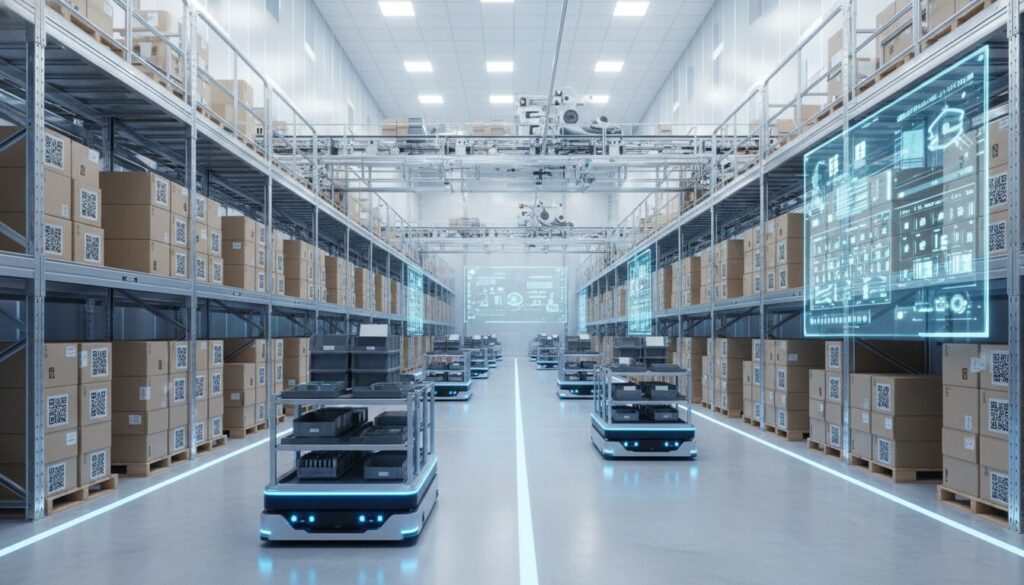
The era of the “Black Box” warehouse is rapidly coming to a close. For decades, supply chain visibility was largely confined to transport nodes—tracking a container across the ocean or a truck across a border. However, the moment inventory entered a distribution center, it often disappeared into an operational fog until it was scanned out for final delivery.
This opacity is no longer sustainable. In an age defined by labor shortages, inflationary pressures, and the demand for supply chain resilience, innovation leaders are turning their gaze inward, seeking granular transparency within the four walls of the warehouse.
The recent announcement by Nippon Express (NX Group) regarding their new “Operation Insight” service marks a significant milestone in this global transition. By integrating this feature into their DCX (Digital Commerce Transformation) platform, NX Group is not merely offering a dashboard; they are digitizing the Japanese philosophy of Kaizen (continuous improvement) for a global client base.
This article explores why this development matters, analyzes how it fits into the broader landscape of logistics technology in the US, Europe, and Asia, and details how NX Group’s specific innovation serves as a blueprint for the future of warehouse management.
Why It Matters: The Imperative for Operational Transparency
For strategy executives, the push for warehouse visualization is driven by three converging crises: the labor crisis, the resilience crisis, and the data deficit.
The Granularity Gap in Global Supply Chains
Traditionally, Warehouse Management Systems (WMS) tracked inventory. They could tell you that SKU A was in Bin B. However, they rarely tracked operations effectively. They could not easily answer questions such as: “Why did the picking process for Client X take 20% longer today?” or “Which specific workflow step is creating the bottleneck during peak season?”
This lack of operational granularity creates a “blind spot” where inefficiencies compound. Without data, managers rely on intuition or manual time-studies, which are slow and prone to bias.
Resilience Through Remote Management
The post-pandemic landscape has necessitated the ability to manage operations remotely. Supply chain resilience now implies the ability to diagnose a problem in a warehouse in Southeast Asia from a headquarters in London or New York.
Tools like “Operation Insight” bridge this gap by aggregating data automatically. This allows for:
* Process Standardization: Ensuring that a “pick and pack” process in Tokyo follows the same efficiency metrics as one in Rotterdam.
* Rapid Response: Identifying labor shortages or workflow disruptions in real-time rather than waiting for an end-of-month report.
Global Trend: The Race for Radical Visibility
While Nippon Express is making waves with its specific application of data toward Kaizen, it is part of a massive global trend. The approach to warehouse visualization, however, varies significantly by region.
United States: Automation-First Visibility
In the US, the drive for visualization is often coupled closely with robotics and automation. Companies like GXO Logistics and Amazon use visualization primarily to orchestrate machine-human collaboration.
- Trend: The use of “Control Towers” that integrate WMS data with robotics feeds.
- Key Player: GXO Logistics has deployed extensive modular technology, using AI to predict outbound volumes and adjust labor staffing automatically. Their visualization focuses on labor planning and peak volume management.
Europe: Sustainability and Compliance
In Europe, operational visualization is increasingly viewed through the lens of ESG (Environmental, Social, and Governance). Logistics leaders like DHL Supply Chain and Kuehne+Nagel leverage data to monitor energy usage and labor conditions alongside productivity.
- Trend: “Digital Twins” that model warehouse operations to optimize heating, lighting, and forklift routes to reduce carbon footprints.
- Key Player: DHL utilizes heat maps not just for congestion analysis, but to optimize the physical movement of goods to reduce energy consumption and improve worker safety.
China: The Smart Logistics Ecosystem
China’s approach, led by JD Logistics and Cainiao, is characterized by “Smart Logistics.” Here, visualization is total and often relies on proprietary hardware ecosystems.
- Trend: Full 5G integration where every pallet and forklift is a connected IoT device.
- Key Player: JD.com operates “Dark Warehouses” where visualization is used almost exclusively for system maintenance and anomaly detection, as human intervention is minimal.
Regional Comparison of Warehouse Visualization Strategies
The following table contrasts how different regions are prioritizing warehouse data visualization:
| Feature | United States (e.g., GXO, Amazon) | Europe (e.g., DHL, K+N) | Asia/Japan (e.g., Nippon Express) |
|---|---|---|---|
| Primary Driver | Labor Efficiency & Speed | Sustainability & Compliance | Process Quality (Kaizen) |
| Tech Focus | Robotics Integration & AI | IoT & Digital Twins | Data Aggregation & Workflow Analysis |
| Management Style | Automated Decision Making | Regulated & Standardized | Human-Centric Improvement |
| Data Goal | Throughput Maximization | Carbon & Cost Reduction | Continuous Process Refinement |
Case Study: Nippon Express “Operation Insight”
Against this global backdrop, the launch of “Operation Insight” by Nippon Express (NX Group) represents a distinct strategic play. It leverages the strengths of Japanese logistics—meticulous process management—and digitizes them for a global market.
The DCX Platform Context
Nippon Express has been aggressively pursuing Digital Commerce Transformation (DCX). The goal is to move beyond being a traditional freight forwarder to becoming a digital supply chain orchestrator. The DCX platform serves as the central hub for this, and the addition of “Operation Insight” fills the critical gap of “inside-the-warehouse” visibility.
How “Operation Insight” Works
According to the recent announcement, the core function of the service is the automatic aggregation and analysis of granular warehouse data.
From Opaque to Actionable
In a traditional setup, data regarding entry, picking, packing, and shipping is siloed in the WMS or recorded manually. “Operation Insight” pulls this data into a centralized web application that provides:
- Real-Time Visualization: Managers can see the status of operations as they happen, not just retrospectively.
- Productivity Metrics: The system analyzes productivity per process and per worker group, identifying variances.
- Workflow Analysis: It maps the flow of goods to identify physical bottlenecks in the warehouse layout.
The “Kaizen” Differentiator
What separates this from a standard PowerBI dashboard is the objective: Supporting on-site process improvement (Kaizen).
Most US-based systems are designed to enforce speed. The NX system is designed to reveal opportunities for improvement. By visualizing the data, NX empowers on-site managers to make data-driven proposals to clients.
- Example Scenario: Instead of simply telling a client “shipping costs went up,” an NX manager using Operation Insight can demonstrate, “Your new packaging requirement added 15 seconds to the packing workflow, reducing hourly throughput by 12%. Here is the data, and here is our proposal to fix it.”
This transforms the logistics provider relationship from a transactional vendor to a strategic consultant.
Key Takeaways: Lessons for the Logistics Industry
The launch of “Operation Insight” offers several critical lessons for innovation leaders and strategy executives, regardless of which 3PL they employ.
1. Data Hygiene is the New Foundation
You cannot visualize what you do not record. The success of NX’s platform relies on “accumulated operational data.” Companies must ensure their WMS and IoT devices are capturing clean, standardized timestamp data for every scan and movement. Without clean data, visualization is merely “digital noise.”
2. Visualization Must Empower, Not Just Monitor
The most successful implementations of warehouse technology are those that empower local teams. The “Operation Insight” tool is framed as a support mechanism for Kaizen. This encourages adoption. If visualization is perceived solely as a surveillance tool for labor, it often leads to resistance and morale issues.
3. The Shift to “White Box” Logistics
Clients are no longer satisfied with “Black Box” logistics where they hand over goods and hope for the best. They demand “White Box” transparency. Nippon Express is responding to this by opening the hood of their operations. Innovation leaders should demand this level of data granularity from their logistics partners to drive their own supply chain strategies.
Future Outlook: From Visualization to Prediction
The introduction of services like “Operation Insight” is merely the first step in a longer journey toward autonomous supply chain management.
Predictive Resource Allocation
As platforms like DCX accumulate historical data, the next logical step is AI-driven prediction. We can expect future iterations to move from “Here is what happened today” to “Here is what will happen next week.” Systems will predict labor shortages based on seasonal trends and suggest layout changes before a peak season begins.
The Rise of the “Glass Warehouse”
Ultimately, we are moving toward the concept of the “Glass Warehouse”—a facility where the digital and physical realities are perfectly synchronized. For Nippon Express, “Operation Insight” is the foundation of this vision. By combining the high standards of Japanese logistics operations with cutting-edge digital visualization, they are positioning themselves to lead the transition toward a more transparent, efficient, and resilient global supply chain.
For global strategy executives, the message is clear: If you cannot see your warehouse operations in real-time, you are already falling behind. The tools exist; the challenge now is integration and cultural adoption.