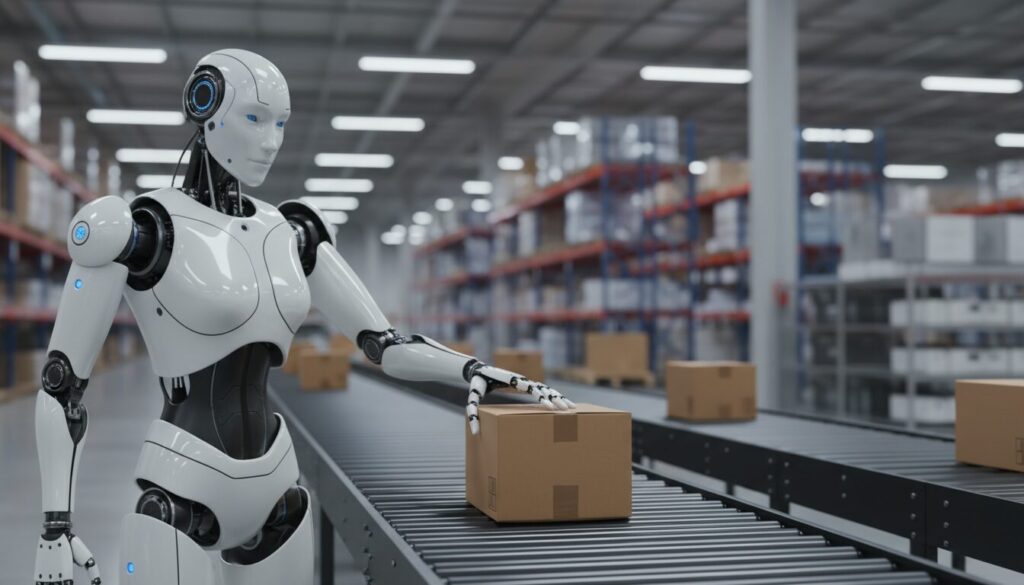
The global logistics and manufacturing landscape is witnessing a pivotal moment in the evolution of automation. While autonomous mobile robots (AMRs) and automated storage and retrieval systems have laid the groundwork, the “Holy Grail” of robotics—a general-purpose humanoid capable of working alongside humans in unmodified environments—has often felt like a distant sci-fi dream. That dream has now abruptly shifted into commercial reality.
Galbot, a leading maker of embodied AI humanoid robots, has successfully raised $300 million in a new funding round, propelling its valuation to $3 billion. This figure represents a record-breaking milestone for the embodied AI sector. However, the valuation is secondary to the operational reality: Galbot has secured orders for thousands of units from industrial giants such as Toyota, Bosch, and CATL.
For innovation leaders and strategy executives, this signals the transition from “pilot purgatory” to commercial scale. As we discussed in our analysis of Aptiv & Vecna: Redefining Global Warehouse Automation, the industry is hungry for solutions that can navigate complex brownfield sites. Galbot’s recent achievement of stable, continuous 24/7 autonomous operations in logistics warehouses for over a year suggests the technology is finally ready to meet that hunger.
Why It Matters: The Shift to General-Purpose Automation
The capitalization of Galbot underscores a fundamental shift in supply chain strategy: the move from specialized automation to general-purpose resilience.
Addressing the Global Labor Crisis
Across Europe, Asia, and North America, the logistics sector is facing an unprecedented labor shortage. The aging population in China and Japan, combined with labor volatility in the US and EU, has created a permanent gap in the workforce. Traditional automation handles repetitive, high-speed tasks well, but struggles with the dexterity and adaptability required for unstructured tasks.
The Brownfield Advantage
Most global supply chains operate in “brownfield” facilities—warehouses and factories designed for humans, with stairs, narrow aisles, and shelves at varying heights. Retrofitting these spaces for rigid automation is costly and disruptive.
Humanoid robots like those from Galbot are designed to fit into the human world, rather than forcing the world to adapt to the robot. This capability allows for:
* Rapid Deployment: No need to install rails, grids, or markers.
* Flexibility: The same robot can unload a truck in the morning and kit parts for assembly in the afternoon.
* Scalability: Fleets can be scaled up or down instantly based on seasonal demand without construction.
Global Trend: The Race for Embodied AI
While Galbot is capturing headlines with its $3 billion valuation, it is part of a fierce global competition between the US, China, and Europe to dominate the next generation of industrial workforce.
The US vs. China Dynamic
The “Embodied AI” race is currently a bipolar contest between American software innovation and Chinese supply chain speed.
- United States: Companies like Tesla (Optimus) and Figure AI are leveraging massive capital and advanced LLM (Large Language Model) integration to create “brains” for robots.
- China: Players like Galbot and Unitree are leveraging the world’s most efficient hardware supply chain to drive down costs while rapidly iterating on “full-stack” development (combining proprietary datasets, models, and hardware).
Comparative Landscape of Humanoid Commercialization
The following table illustrates how the major global regions are approaching this trend:
| Feature | US Approach (e.g., Tesla, Figure) | China Approach (e.g., Galbot, Unitree) | EU Approach (e.g., 1X – Norway) |
|---|---|---|---|
| Primary Focus | General Intelligence & Consumer Application | Industrial reliability & Supply Chain Integration | Collaborative Safety & Specialized Tasks |
| Development Model | Software-First (AI driving hardware) | Full-Stack Integration (Hardware + AI closely coupled) | Safety-First (human-robot interaction focus) |
| Commercial Strategy | Hype-driven, aiming for mass consumer market | B2B focused, targeting Logistics & Automotive giants | Niche high-value industrial applications |
| Key Advantage | Access to advanced Foundation Models (LLMs) | Speed of manufacturing & Cost reduction | strict adherence to EU safety/labor regulations |
Case Study: Galbot’s Commercial Breakthrough
Galbot’s recent $300 million raise brings its total funding to $800 million, but the true story lies in its operational metrics and commercial adoption.
Crossing the “Pilot Purgatory” Chasm
The primary skepticism surrounding humanoid robots has been reliability. Could a bipedal robot maintain balance, battery life, and task accuracy for a full shift?
Galbot has silenced many critics by achieving a significant milestone: stable, continuous 24/7 autonomous warehouse operations for over one year. This is not a controlled lab demo; it is a live deployment where robots handle real SKUs in real-time.
Full-Stack Advantage
Galbot distinguishes itself through the world’s first full-stack in-house development. By controlling the entire vertical—proprietary datasets, foundation models, and the physical hardware—Galbot avoids the integration latency that plagues competitors who mix third-party software with off-the-shelf hardware.
Technical Synergy
- Data Loop: The robots operating in Toyota and CATL facilities feed real-world physical data back into the foundation model, creating a “flywheel” effect where the fleet becomes smarter with every hour of operation.
- Hardware Optimization: By designing their own actuators and sensors, Galbot reduces the cost per unit significantly, making the ROI calculation attractive for logistics operators compared to expensive human labor in high-cost regions.
Commercial Scale with Industry Giants
The validation of Galbot’s technology is evident in its order book. Securing orders for thousands of units is a massive leap from the typical “pilot of 10 robots.”
* Toyota & Hyundai: Utilizing humanoids for flexible manufacturing and parts kitting, tasks that require high dexterity.
* CATL (Battery Giant): Likely deploying robots for hazardous material handling and heavy lifting in battery production lines.
* Bosch: Integrating humanoids into complex assembly lines where automation flexibility is key.
This mirrors the trend we observed in Boozt & Cognibotics: Advanced AutoStore Automation, where leading retailers are seeking solutions to solve specific bottlenecks like picking. Galbot takes this a step further by offering a mobile picking solution that isn’t confined to a grid.
Key Takeaways for Logistics Leaders
For strategy executives observing this $3 billion valuation, the lessons extend beyond investment figures.
1. The Era of “General Purpose” is Here
Stop evaluating robots solely on “picks per hour” in a vacuum. Evaluate them on “tasks per robot.” A humanoid that picks slower than a grid arm but can also handle returns, unload trucks, and clean spills offers higher overall utilization and ROI in a brownfield environment.
2. Supply Chain Resilience Requires Redundancy
Galbot’s deployment with battery and automotive giants highlights a move toward resilience. In the event of a pandemic, labor strike, or demographic shift, a fleet of embodied AI robots provides a baseline of operational continuity that human-only workforces cannot guarantee.
3. Data Infrastructure is a Prerequisite
Galbot’s success relies on its foundation models. For logistics companies to integrate these robots, their WMS (Warehouse Management Systems) must be capable of communicating with advanced AI agents. The robot needs to know not just where an item is, but what it is and how to grasp it.
4. Safety Standards Will Evolve
With thousands of units entering the market, global safety standards (ISO/OSHA) will face pressure to adapt. Executives must stay ahead of regulatory changes regarding human-robot collaboration in shared spaces.
Future Outlook
The $300 million raised by Galbot will likely be deployed to expand manufacturing capacity and further refine the “brain” of the robot.
2025-2027: The Deployment Phase
We expect to see the “thousands of units” ordered by Toyota and Bosch come online. This period will be characterized by integration challenges, WMS updates, and the establishment of “robot-friendly” standard operating procedures.
Cost Curve Disruption
As Galbot and its Chinese competitors scale production, the cost of a humanoid robot is predicted to drop below the cost of an annual salary for a warehouse worker in the US or Western Europe. Once this parity is reached—likely within 3 to 5 years—adoption will shift from “strategic innovation” to “operational necessity.”
The Convergence of Logistics
Ultimately, Galbot’s rise signifies the convergence of AI and Logistics. The warehouse is becoming a computing platform where physical atoms are moved by digital bits. Companies that view automation as merely “hardware” will be left behind by those who view it as “embodied intelligence.”
See also: Aptiv & Vecna: Redefining Global Warehouse Automation for more on how autonomous agents are transforming brownfield sites.