Introduction
Are your warehouse operations stalled because you are waiting for a specialized engineer to reprogram a robotic arm?
This is a common pain point for logistics leaders today. You have invested in automation to solve labor shortages and rising costs, yet you find yourself bottlenecked by the complexity of the technology itself. The traditional model of industrial robotics required expensive, hard-to-find experts fluent in proprietary coding languages. When a product line changed or a new SKU was introduced, production stopped until the “expert” arrived.
However, the landscape is shifting rapidly. The future of industrial robot programming: Easier, faster, more intuitive is not just a catchphrase—it is the technological standard that is democratizing automation.
In this article, we will explore how no-code platforms, AI-driven interfaces, and hand-guiding systems are removing the technical barriers to entry. We will explain how logistics managers can leverage these advancements to increase flexibility, reduce downtime, and empower their existing workforce to manage sophisticated automation.
What is the Future of Industrial Robot Programming?
To understand where we are going, we must briefly look at where we have been. Historically, programming an industrial robot involved a “teach pendant”—a complex handheld device with a confusing array of buttons—or writing raw code (such as C++ or vendor-specific languages like RAPID or KRL).
The future of industrial robot programming is defined by a shift from coding to configuring. It focuses on three core pillars:
- Easier: Removing the need for text-based programming languages.
- Faster: Reducing deployment time from weeks to hours.
- More Intuitive: Using interfaces that resemble smartphone apps or physical interaction.
The Shift to No-Code and Low-Code
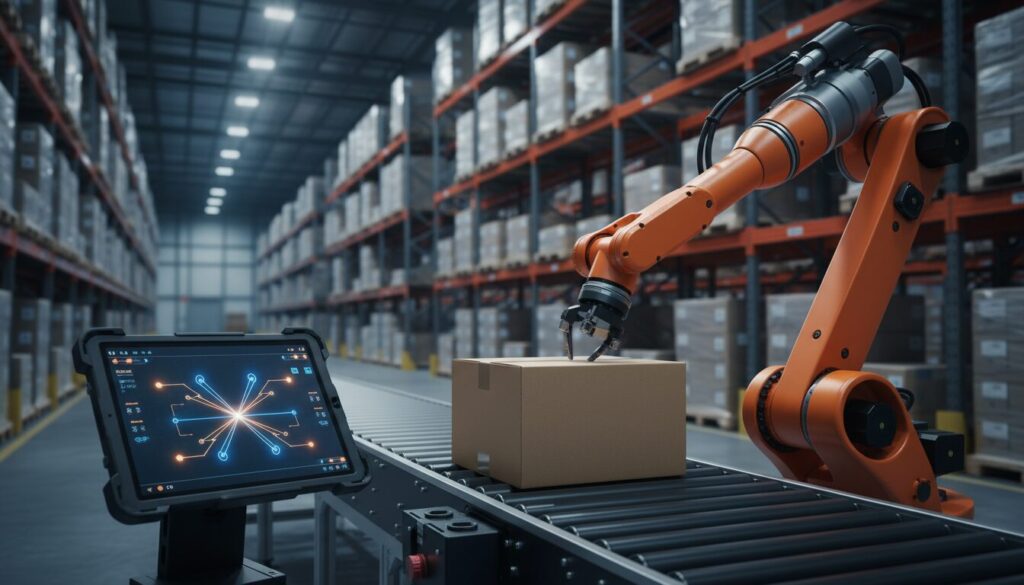
Modern logistics robots are increasingly controlled via “No-Code” platforms. These are graphical user interfaces (GUIs) running on tablets. An operator simply drags and drops blocks representing actions (e.g., “Pick,” “Move,” “Place”) into a sequence. The software handles the complex kinematics and logic in the background.
Hand-Guiding (Lead-Through Teaching)
Perhaps the most intuitive advancement is “Lead-Through” programming. Instead of pressing buttons to move the robot millimeter by millimeter, a human operator grabs the robot arm and physically guides it through the desired motion path. The robot records these waypoints. This method leverages human motor skills to teach the machine, making the process natural and incredibly fast.
Why Now? The Drivers Behind the Shift
The push for simpler programming is not merely a technological novelty; it is a response to critical global supply chain trends.
The Chronic Labor Shortage
The logistics and manufacturing sectors are facing a massive talent gap. According to industry reports, millions of manufacturing jobs could go unfilled by 2030 due to a skills gap. Warehouses cannot find enough roboticists to maintain complex systems. By making programming easier, companies can upskill their existing floor staff—pickers and packers—to become “robot operators,” effectively bypassing the engineer shortage.
The Rise of High-Mix, Low-Volume (HMLV)
E-commerce has changed the rules. Logistics centers no longer handle pallets of the same item for weeks. They handle thousands of different SKUs that change seasonally or even daily.
* Old Way: Reprogramming for a new box size took 2 days.
* New Way: An operator adjusts the parameters in 10 minutes.
This flexibility is essential for survival in a modern fulfillment center.
The Influence of Embodied AI
Artificial Intelligence is accelerating this transition. As robots become “smarter,” they require less explicit instruction. As discussed in Galbot’s $3B Valuation: Humanoid Robots at Commercial Scale, heavy investment in embodied AI is driving robots that can understand general commands rather than strict coordinate programming. This commercial scaling of AI is a primary catalyst for making interfaces more intuitive.
Operational Gains from Simplified Programming
Adopting easier and faster programming methods delivers measurable benefits to logistics operations.
Quantitative Improvements
| Metric | Traditional Programming | Intuitive Programming | Impact |
|---|---|---|---|
| Setup Time | 2–4 Weeks | 1–2 Days | Faster ROI realization |
| Changeover Time | Hours to Days | Minutes | Higher throughput for HMLV |
| Training Time | Months (Specialized) | Hours (On-the-job) | Reduced labor overhead |
Flexibility and Agility
In a traditional setup, robots were bolted down and fenced off, performing one task for years. With intuitive programming, a Collaborative Robot (Cobot) can be a palletizer in the morning and a box erector in the afternoon. The ability to redeploy assets quickly allows logistics leaders to respond to peak season demands without buying new machinery.
Democratization of Automation
When programming is intuitive, the “fear factor” of technology disappears. Warehouse associates feel empowered rather than replaced. They become the masters of the tool. This cultural shift often leads to higher retention rates and better engagement from the workforce.
Key Technologies Enabling Intuitive Programming
Three specific technologies are making “The future of industrial robot programming: Easier, faster, more intuitive” a reality.
1. Offline Programming (OLP) & Digital Twins
OLP allows engineers to program the robot in a 3D simulation on a computer without stopping the physical production line.
* Benefit: You can test distinct scenarios and collision detection virtually.
* Intuitive aspect: Modern OLP software generates the complex code automatically once the simulation is verified.
2. Augmented Reality (AR) and VR
Imagine wearing a headset and seeing a virtual path overlaying the real world. Operators can use AR to visualize the robot’s intended path before it moves, ensuring safety and accuracy. They can “draw” barriers in the air that the robot must avoid, translating physical gestures into safety zones.
3. AI and Natural Language Processing (NLP)
We are approaching an era where you can simply speak to the robot. “Pick the red boxes and stack them on Pallet B.” Large Language Models (LLMs) are being integrated into robot controllers to interpret human speech and convert it into machine execution cycles. This is the ultimate goal of intuitive programming.
Implementation: Integrating Easy-to-Program Robots
For operations leaders ready to embrace this future, the transition requires a strategic approach. It is not enough to just buy a “smart” robot; you must integrate it into your workflow.
Step 1: Assess Cultural Readiness
Before purchasing, assess your team. Identify internal champions—employees who are curious about technology. These will be your first “Robot Operators.” Frame the technology as a tool to eliminate dull, dirty, and dangerous tasks, not as a replacement for headcount.
Step 2: Start with “Low-Hanging Fruit”
Do not try to automate your most complex mixed-SKU picking station first. Start with a repetitive, structured task, such as:
* End-of-line palletizing.
* Case erecting.
* Simple pick-and-place transfer.
Success in these areas builds confidence and proves the “easier, faster” concept to stakeholders.
Step 3: Prioritize Vendor Ecosystems
When selecting a robot, look at the software ecosystem.
* Does it have a “App Store” for grippers and sensors?
* Is the interface truly drag-and-drop?
* Does it support hand-guiding?
Top-tier collaborative robot manufacturers (like Universal Robots, Techman Robot, or Doosan) prioritize these ecosystems. Ensure the hardware you buy supports the software future you want.
Step 4: Safety Standards (ISO/TS 15066)
Even though programming is easier, safety is paramount. “Intuitive” does not mean “risk-free.” Ensure that your risk assessment covers the new interactions between humans and robots, especially if you are using hand-guiding features where the operator is in close proximity to the arm.
Conclusion
The barriers that once kept small and medium-sized logistics operations from automating are crumbling. The future of industrial robot programming—easier, faster, more intuitive—is reshaping the competitive landscape.
We are moving away from a world where automation was the domain of the elite few with coding degrees, toward a world where automation is a standard tool in the hands of the warehouse associate.
Recommended Next Steps for Leaders:
1. Audit your current bottlenecks: Identify tasks where flexibility is more important than raw speed.
2. Request demos: specifically ask vendors to let you or your floor staff try to program a simple task during the demo.
3. Investigate Embodied AI: Stay updated on how companies like Galbot are pushing these boundaries. (See also: Galbot’s $3B Valuation: Humanoid Robots at Commercial Scale).
By embracing intuitive programming, you are not just buying a machine; you are building a resilient, agile, and future-proof supply chain.