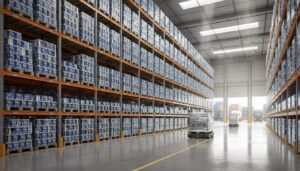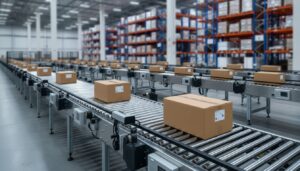
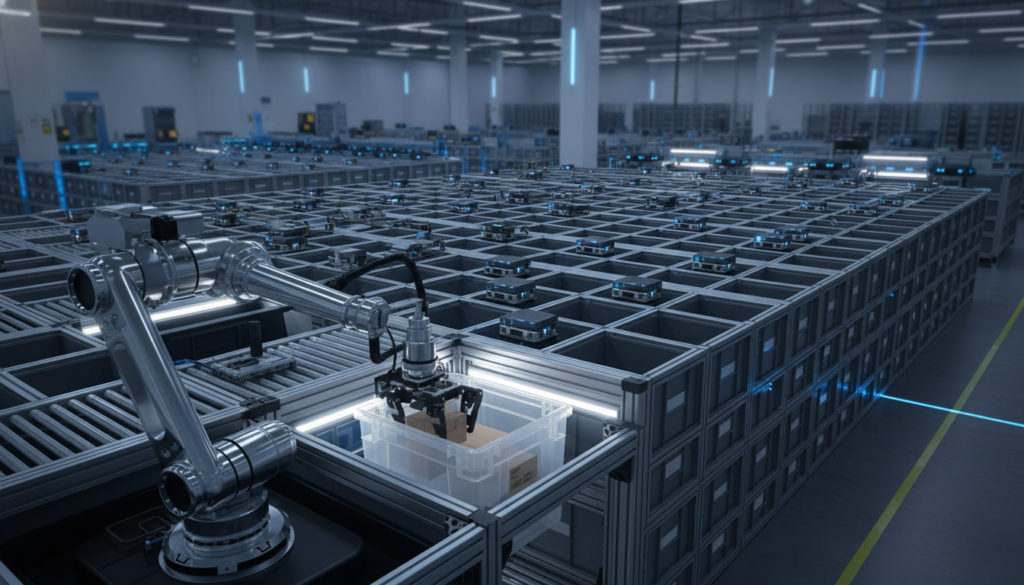
The logistics landscape is currently witnessing a tectonic shift. For the better part of a decade, the industry gold standard for efficiency was “Goods-to-Person” (GTP). Systems like AutoStore revolutionized warehouse density by bringing bins to human pickers, eliminating the miles of walking previously required in traditional shelving setups. However, as labor shortages intensify across the US, Europe, and Asia, the “Person” in “Goods-to-Person” has become the critical bottleneck.
This week, the industry’s eyes are on the Nordics. A strategic collaboration has emerged that promises to bridge the final gap in fulfillment automation: Cognibotics and Boozt team up for advanced AutoStore automation. This partnership is not merely a pilot; it represents the transition to “Goods-to-Robot” (GTR) operations, a necessary evolution for supply chain resilience in a volatile global economy.
Why It Matters: The Global Labor Crunch
To understand the magnitude of the Boozt and Cognibotics pilot, one must first look at the macroeconomic pressure cooker facing global supply chains. The era of cheap, abundant labor is effectively over in major Western markets.
The “Empty Shift” Crisis
In the United States and Northern Europe, warehouse vacancy rates for labor positions remain stubbornly high. Strategy executives are no longer just fighting for higher throughput; they are fighting to keep lines running at all.
- Europe: An aging population in Germany and the Nordics means fewer young workers are entering the manual logistics workforce.
- United States: Turnover rates in warehousing often exceed 100% annually, creating massive training costs and operational instability.
- Asia: While China has historically had labor abundance, rising wages and a demographic shift are pushing giants like JD.com and Alibaba toward “Dark Warehousing.”
The Pick-to-Pack Bottleneck
While Automated Storage and Retrieval Systems (AS/RS) like AutoStore handle the storage and retrieval efficiently, the actual picking process—taking an item from a bin and placing it into a shipping bag—has resisted automation. Why? Because human hands are miracles of dexterity. Replicating the hand-eye coordination required to pick a soft t-shirt, a rigid shoebox, or a fragile cosmetic item from a cluttered bin is an immense engineering challenge.
This is why the Boozt x Cognibotics initiative is critical. By solving the “Pick-to-Pack” friction point, they are unlocking the potential for “Elastic Capacity”—the ability to scale operations up or down instantly without the lag time of hiring and training humans.
Global Trend: The Race for “Touchless” Fulfillment
The move by Boozt is part of a broader global trend where the goal is no longer just assisting the worker but replacing the station entirely to allow workers to move to higher-value supervisory roles.
Regional Approaches to Robotics
Different regions are tackling the GTR (Goods-to-Robot) challenge with distinct philosophies and technologies.
| Region | Primary Driver | Key Technologies | Notable Players/Adopters |
|---|---|---|---|
| Europe | Space & Labor Cost | High-density AS/RS (AutoStore) + Precision Arms | Boozt, Ocado, Siemens |
| North America | Throughput & Speed | AMR-based sorting, Mobile Manipulation | Amazon (Sparrow), FedEx, Berkshire Grey |
| China | Scale & Greenfield | Fully autonomous mobile robots (AMRs), Unmanned facilities | JD.com, Geek+, Cainiao (Alibaba) |
North America: Speed and Sorting
In the US, the focus has largely been on sortation. Amazon’s “Sparrow” and “Robin” robots are designed to handle millions of packages, identifying and sorting them for final delivery. The US market favors speed and raw volume handling, often deploying robotic arms that use suction (vacuum grippers) to move items from chutes to gaylords.
China: The Greenfield Advantage
China often builds “Greenfield” sites (brand new construction), allowing for the deployment of fleets of AGVs (Automated Guided Vehicles) that carry shelves to picking stations. Because they have more space and newer infrastructure, Chinese firms like Quicktron and Geek+ have deployed thousands of robots that operate on open floors.
Europe: The Density Challenge
Europe faces a different constraint: legacy infrastructure and expensive real estate. This is why AutoStore (invented in Norway) became dominant—it maximizes storage density. The challenge for Europe has been fitting a robot arm into the existing, compact AutoStore workstations (Ports). The robot must be precise, safe to work near humans, and capable of the complex kinematics required to reach into a deep bin.
Case Study: Boozt & Cognibotics
This brings us to the specific breakthrough: Cognibotics and Boozt team up for advanced AutoStore automation. This case study serves as a blueprint for high-volume retailers operating in high-wage economies.
The Client: Boozt
Boozt is a leading Nordic technology company selling fashion, lifestyle, and beauty online. They are renowned for their operational excellence. Their fulfillment center in Ängelholm, Sweden, is the world’s largest AutoStore installation. For Boozt, efficiency isn’t a goal; it’s the core of their business model. They have long sought a way to manage the intense peaks of Black Friday and holiday shopping without the logistical nightmare of onboarding thousands of temporary staff.
The Tech: Cognibotics HKM1800
Cognibotics, a Swedish robotics leader, provided the solution: the HKM1800 robot. Unlike standard industrial arms that are heavy and dangerous, the HKM1800 utilizes a unique kinematic structure.
Key Technical Capabilities
- Direct Bin-to-Bag: The robot can reach into the AutoStore bin, identify the item, pick it, and place it directly into a shipping polybag or box.
- Juliet & Romeo Software: This is the brain behind the brawn. The software integrates seamlessly with the AutoStore grid, managing the complex motion planning required to avoid collisions and handle items gently.
- Space Efficiency: The robot is designed to fit within the existing footprint of a picking station, meaning Boozt does not need to rebuild its warehouse to accommodate the automation.
The Strategic Goal: Elastic Capacity
The primary objective of this pilot is Elasticity.
In a manual warehouse, increasing output by 50% requires increasing headcount by 50%. This is linear scaling, which is slow and expensive.
With the HKM1800 solution, increasing output is a matter of software allocation and electricity. The robots can run 24/7 without breaks, allowing Boozt to absorb order spikes instantly.
Industry Insight: “The Holy Grail for e-commerce isn’t just speed; it’s consistency. A robot doesn’t get tired at hour 10 of a Black Friday shift. The Cognibotics pilot proves that AutoStore bins—previously thought to be ‘human-only’ territory due to their depth—are now accessible to automation.”
Key Takeaways for Logistics Leaders
For C-suite executives and innovation leaders, the Boozt/Cognibotics collaboration offers four distinct strategic lessons.
1. Retrofit Capability is King
The most sustainable automation strategy is one that fits your current facility. Boozt did not rip out their massive AutoStore grid to install a new system. They found a robotic solution (Cognibotics) that overlaid onto their existing investment. Lesson: Look for “Brownfield” automation technologies that augment, rather than replace, your current CAPEX.
2. The Rise of “Motion Planning” Software
Hardware is becoming a commodity; the differentiation is in the software. Cognibotics’ success lies heavily in its “Juliet & Romeo” software suite which handles the calibration and motion control. Lesson: When vetting robotics partners, scrutinize their software stack. Can it handle variances in product shape? How fast is the “vision-to-action” loop?
3. Decoupling Revenue from Headcount
The financial model of logistics is changing. By deploying picking robots, companies can break the linear relationship between revenue growth and labor costs. This improves operating leverage. Lesson: Calculate ROI not just on labor savings, but on “Peak Capacity Assurance”—the value of never missing a shipment during high-demand periods because of labor shortages.
4. Vision Systems are Ready for Prime Time
Picking fashion items (soft, deformable objects) is notoriously difficult for robots. The success of this pilot indicates that computer vision and gripping technology have matured to a point where they can handle SKUs that are not rigid boxes. Lesson: Re-evaluate automation for categories previously deemed “un-automatable,” such as apparel and soft goods.
Future Outlook: The Autonomous Grid
The partnership between Cognibotics and Boozt signals the beginning of the Autonomous Grid.
Short-Term (1-3 Years)
We will see a proliferation of “Hybrid Stations.” Warehouses will likely maintain a mix of human stations for complex/fragile items and robotic stations for high-volume, standard items (the Pareto principle). The data from the Boozt pilot will likely lead to AutoStore certified robotic partners becoming a standard catalogue option for new installations.
Mid-Term (3-5 Years)
Collaborative Robotics (Cobots) will merge more deeply with these systems. We may see robots that can hand off items to humans for value-added services (like gift wrapping) or quality checks, creating a seamless flow between biological and mechanical labor.
Long-Term (5+ Years)
The “Dark Warehouse” for e-commerce becomes a reality. As robotic grippers mimic the human hand’s tactile sensing (haptics), the need for human intervention in the pick-pack-ship process will drop to near zero for 95% of SKUs.
Conclusion
The headline “Cognibotics and Boozt team up for advanced AutoStore automation” is more than a press release; it is a signal flare. It demonstrates that the technology to automate the most Dexterous tasks in the supply chain is no longer science fiction—it is running in Sweden today. For global logistics leaders, the question is no longer if they should adopt picking robotics, but how quickly they can integrate them to survive the labor-constrained future.