
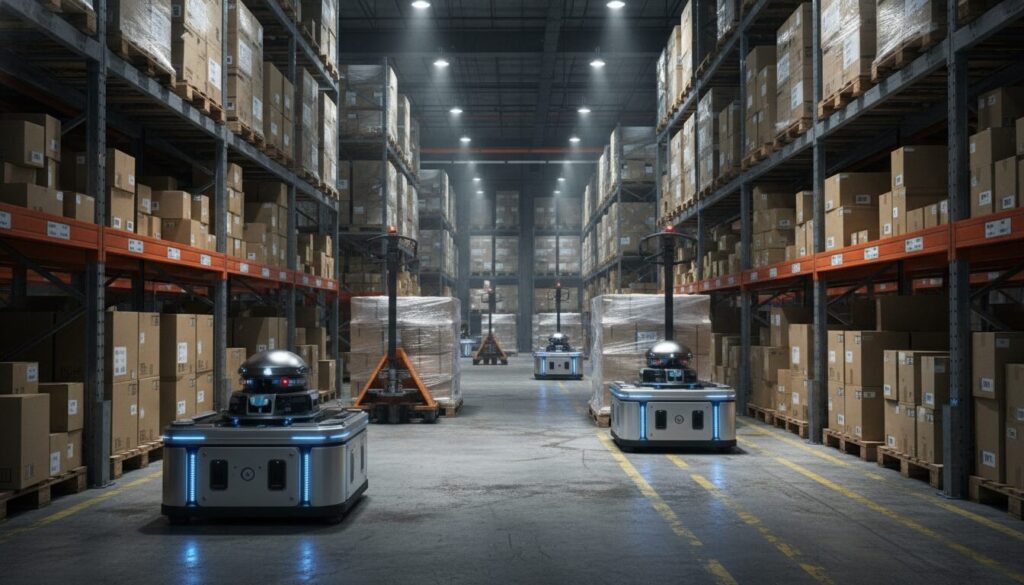
The global logistics landscape is undergoing a tectonic shift. For the last decade, the narrative of warehouse automation was dominated by “greenfield” projects—building massive, purpose-built facilities designed around robots (think Amazon’s Kiva systems or Ocado’s grids). However, the economic reality of the 2020s has shifted the focus to “brownfield” environments: existing, messy, human-centric warehouses that need automation now without halting operations to pour new concrete.
In this context, the recent announcement that Aptiv and Vecna Robotics to develop next generation autonomous mobile robots represents more than just a partnership; it signals the convergence of automotive-grade safety and industrial logistics. By merging Aptiv’s heritage in autonomous driving perception with Vecna’s prowess in AI orchestration, the industry is moving toward a future where infrastructure-light automation is the standard, not the exception.
For innovation leaders and strategy executives, this collaboration highlights a critical pivot point: the transition from “robots that work in cages” to “robots that work with people.”
Why It Matters: The End of Rigid Infrastructure
The primary bottleneck in global supply chain resilience is no longer a lack of technology; it is the rigidity of implementation. Traditional Automated Guided Vehicles (AGVs) required magnetic tape, reflectors, or dedicated “no-go” zones for humans. This required massive CapEx and effectively froze the warehouse layout in time. If the business model changed (e.g., a shift from pallet-picking to piece-picking), the infrastructure became a liability.
The Cost of Volatility
In a post-pandemic world, supply chain volatility is the norm. According to recent industry reports, over 70% of warehouses in the US and Europe are facing severe labor shortages, yet only a fraction have adopted full-scale automation due to the high barrier of entry.
The Aptiv-Vecna collaboration addresses three critical global pain points:
- Labor Augmentation, Not Replacement: In high-cost labor markets like Western Europe and North America, the goal is to handle heavy payloads (pallets) autonomously so humans can focus on complex tasks.
- Safety Standards Convergence: Bringing automotive safety standards (ISO 26262) into the warehouse (ISO 3691-4).
- Brownfield Scalability: The ability to deploy robots into an 80-year-old facility in Detroit or a cramped distribution center in Tokyo without remodeling the building.
Global Trend: The Race for “Adaptive” Automation
While the Aptiv-Vecna deal is the headline, it sits within a broader geopolitical and technological race. The approach to next-gen AMRs differs significantly across major economic zones.
United States: The Brownfield Battleground
In the US, the trend is driven by the need to retrofit aging infrastructure. Companies like GXO Logistics and DHL Supply Chain North America are aggressively trialing AMRs that can navigate “imperfect” floors. The US market favors “Infrastructure-Free” navigation because real estate costs are spiking, and moving to new facilities is expensive.
- Trend: Shift from grid-based storage (AS/RS) to flexible mobile robotics.
- Key Players: Locus Robotics, Seegrid, and now the strengthened Vecna Robotics.
Europe: Safety and Space Efficiency
Europe, particularly Germany and the UK, faces stricter safety regulations and tighter spaces. Here, the focus is on human-robot collaboration (cobots). The European market is skeptical of “black box” AI navigation; they demand certified safety data.
- Trend: High demand for VDA 5050 compliance (a standardized interface for robot communication) to allow mixed fleets from different vendors.
- Key Players: KION Group (Linde/Dematic), Jungheinrich.
China: Speed and Hardware Commoditization
China has focused on mass-producing AMRs at a lower cost, flooding the market with hardware. Companies like Geek+ and Hikrobot have dominated by volume. However, Chinese solutions often rely on QR codes pasted on floors (infrastructure-heavy). The trend is now shifting as Chinese tech giants look to AI SLAM (Simultaneous Localization and Mapping) to compete with Western tech.
- Trend: Rapid deployment speeds and aggressive pricing, slowly moving toward visual SLAM.
- Key Players: Geek+, Hai Robotics.
Comparison of Regional Approaches to Automation
| Feature | US Approach | European Approach | Chinese Approach |
|---|---|---|---|
| Primary Driver | Labor Shortage & Retrofitting | Safety Regulation & Space | Speed & Cost Scaling |
| Navigation Pref. | Lidar/Vision (Infrastructure-free) | Safety-Certified Vision | QR Code/2D Code (moving to SLAM) |
| Adoption Barrier | ROI/Payback Period | Compliance/Works Council | Hardware Durability |
| Key Innovation | Orchestration AI (Software) | Human-Machine Safety | Manufacturing Scale |
Case Study: Aptiv and Vecna Robotics
The collaboration between Aptiv and Vecna Robotics is a textbook example of Cross-Industry Innovation. It represents the transfer of Intellectual Property (IP) from the mature Autonomous Vehicle (AV) sector into the burgeoning Industrial Automation sector.
The Partners
- Aptiv (formerly Delphi Automotive): A global technology leader primarily known for automotive architecture and advanced driver-assistance systems (ADAS). They possess deep expertise in sensor fusion (combining radar, lidar, and vision).
- Vecna Robotics: A leader in high-capacity AMRs (pallet movers, tuggers). Their differentiation lies in their CaseFlow™ orchestration software and Pivotal™ command center, which manages workflow, not just robot movement.
The Solution: “Next-Gen” Architecture
The partnership aims to integrate Aptiv’s PULSE sensor suite and VxWorks (a Real-Time Operating System often used in aerospace and auto) with Vecna’s robotics platforms.
1. Perception Upgrades
Current AMRs often suffer from “phantom stops”—stopping because they mistake a piece of shrink wrap or a dust mote for an obstacle. This kills productivity. Aptiv’s automotive-grade perception software is designed to distinguish between a pedestrian, a forklift, and debris at high speeds in dynamic environments.
2. The VxWorks Advantage
By utilizing a Real-Time Operating System (RTOS) like VxWorks, the robots can process sensor data with deterministic speed. In simple terms, the reaction time of the robot becomes guaranteed, which is a requirement for high-speed interaction in mixed traffic.
3. Strategic Goal: CES 2026
The companies have targeted CES 2026 to showcase the fully integrated solution. This timeline suggests a deep R&D cycle rather than a superficial branding exercise. They are targeting the “Level 4” equivalent of warehouse autonomy—where the robot handles complex exceptions without human intervention.
Quantifiable Success Metrics (Projected)
Based on Vecna’s existing deployments and Aptiv’s hardware specs, the industry anticipates the following improvements for early adopters:
- Safety Incidents: Reduction of near-misses by 90% due to automotive-grade sensor fusion.
- Throughput: Increase in pallet movements per hour by 20-30% (due to less hesitation/stops).
- Setup Time: Reduction in mapping/deployment time by 50% (no need to install reflectors).
Key Takeaways for Logistics Leaders
For C-Suite executives in logistics and manufacturing, the headline “Aptiv and Vecna Robotics to develop next generation autonomous mobile robots” offers four distinct strategic lessons.
1. The Convergence of Auto-Tech and Logistics
The supply chain is becoming the new frontier for automotive technology. As self-driving cars face regulatory hurdles on public roads, the technology is finding an immediate, profitable home inside private warehouses. Leaders should look for vendors who are leveraging automotive-grade supply chains to lower hardware costs.
2. Infrastructure-Light is the Only Way Forward
Investments in rigid automation (bolted-down conveyors, wire-guided AGVs) are becoming riskier. The future belongs to AMRs that can be dropped into a facility over a weekend. If your automation strategy requires a 6-month shutdown to install rails, it is likely obsolete.
3. Software Orchestration beats Hardware Specs
While Aptiv provides the eyes, Vecna provides the brain. The ability of the robot to “slot in” to existing workflows (Orchestration) is more valuable than the robot’s top speed.
* Actionable Insight: When evaluating vendors, ask about their WES (Warehouse Execution System) integration capabilities, not just their battery life.
4. Safety as a Performance Enhancer
Historically, safety features slowed robots down. The Aptiv-Vecna approach flips this: better perception allows robots to move faster and closer to humans safely. High-fidelity perception removes the “hesitation” that plagues current AMRs.
Future Outlook
The collaboration between Aptiv and Vecna sets a precedent that will likely trigger a wave of M&A and partnerships between the automotive and logistics sectors.
CES 2026 and Beyond
By the time the joint solution is unveiled at CES 2026, the global AMR market will likely have segmented into “Low-End Movers” (commoditized hardware) and “High-Intelligence Orchestrators.” The Aptiv-Vecna solution positions itself firmly in the latter.
The Rise of “Perception-as-a-Service”
We may see a future where the sensors and the processing compute are decoupled from the chassis. Aptiv could potentially license its “Logistics Perception Stack” to other robot manufacturers, creating an “Intel Inside” moment for warehouse robotics.
Final Thought
The era of the “blind” robot following a magnetic strip is over. The partnership to develop next-generation autonomous mobile robots is not just about moving boxes; it is about creating a supply chain that is as sentient and responsive as the vehicles driving on our roads. For global logistics leaders, the message is clear: flexibility is the new efficiency, and superior perception is the key to unlocking it.